Showing posts with label Art. Show all posts

Wednesday, October 6, 2010

A Most Dangerous Game

Treacherous, Corrupt, Self-serving. Say what you will about Milan’s Visconti family, but they sure knew how to play cards in style.  The Visconti Tarot (also know at the Cary-Yale deck) may be one of the oldest set of playing cards in existence. The ornately painted, gold-leaf deck was created by Bonifacio Bembo between 1428-1447. We do not know who commissioned it, but its owner was most likely the third duke of Milan, Filippo Maria Visconti. Filippo was an avid card player and astrologist paying 1500 gold pieces for another set of cards containing gods, animals and birds.  

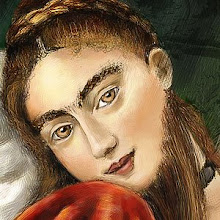
The image above depicts the Knight of Swords, but interestingly instead of the usual male figure, the cards show a demure woman wearing a balzo (her hairstyle) surrounded by some serious bling. Due to the female depiction, it is believed the deck was used by a court lady. My guess would be Maria di Savoia, second wife of Filippo Maria Visconti, but the woman in the card may be a portrayal of Filippo's previous wife - Beatrice di Tenda. 

Queen of Hope
Beatrice was the wealthy window of condottiero and defacto ruler of Milan, Facino Cane. On his deathbed, Facino encouraged Beatrice to take Filippo as her husband to secure an alliance with the Visconti family. Although she was twenty years his senior, Filippo was willing to look past such things when the misses came with a hefty dowry and an army of soldiers ready to die for her. While the people of Milan adored Beatrice, Filippo’s resentment toward her and her more popular dead husband grew daily. He increasingly ignored her and fixed his attentions on his mistress Agnes de Maino. In her solitude, Beatrice surrounded herself with men of letters including one unfortunate musician named Orombello.

You can guess what followed. Filippo accused Beatrice of having an affair with Orombello and threw them in the castle dungeon. Set to the rack, Orombello confessed, but Beatrice remained steadfast in her innocence. It hardly mattered. Both were condemned to die without a trial. Fearing the people’s outrage at what was basically a judicial murder, he ordered Beatice’s to be decapitated under cover of darkness. After a few more rounds of torture to get that confession, Beatrice di Tenda was executed at the Castle of Binasco in 1418.

The Card of Hope

What is also of note is the cards of Faith, Charity and Hope (shown above), which were not usually included in a 15th century deck. Notice that the figure of Hope is chained to an anchor while a man at her feet is bound to the same anchor. In Renaissance art, St. Peter is usually depicted at the feet of Faith, but the card of Hope may have a more literal translation.  

In 1428, Filippo married Maria di Savoia and her dad reigned as antipope Felix V.This deck of cards may have been given to Maria as a wedding gift with a potent reminder of what became of his previous wife.

Today, Beatrice’s legacy lives on in the tragic opera by Vincenzo Bellini, but could she also be portrayed in the card of Hope?

You can see more of these beautiful images at the Beinecke Rare Books & Manuscript Digital Collection.  Just search by "Visconti Tarot."

Sources and Further Reading:
The Beinecke Rare Books & Manuscript Library, Call Number ITA 109
Kaplan, Stuart & Huet, Jean, The Encyclopedia of Tarot, Volume II, US Game Systems, 1986.
Buell Hale, Sarah Josepha, Woman's record; or, Sketches of all distinguished women, from "the beginning" till A.D. 1850. Arranged in four eras. With selections from female writers of every age, Nabu Press, 2010


Tuesday, September 28, 2010

Illustration Friday: Old Fashion Medicine

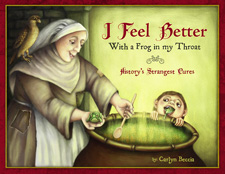
Raucous Readers will have to forgive me for the repetitive theme this month - my new book, I Feel Better with a Frog in my Throat is in stores now.  I figure that since it takes me so long to actually complete a book that you won't mind my blatant self promotion every 5 bazillian years.

This week's Illustration Friday fits perfectly with a page from I Feel Better showing one of my favorite old fashion cures for sore throats - putting a dirty sock around your neck. Why did people believe this cure worked? That's in the book.
Unfounded Medical Claims: This is not a bedtime book. Will cause rapid brain growth in your child.

I have started to get some reviews in. Here are the ones I have so far:

From Kirkus:
Disgusting and futile medical practices are always a pleasure to contemplate. Beccia, following closely in the spirit of The Raucous Royals (2008)—dry-witted artwork, conversational text, engaging historical detective work—asks readers to guess which “cures” may actually have helped a handful of ailments. Take a nasty cough, for example: Should you take a heaping helping of caterpillar fungus, frog soup or cherry bark? Common good sense will lead readers to wag their heads no when it comes to sprinkling mummy powder on a wound or drilling a hole in your head to relieve a headache, though some counterintuitive measures will come as a surprise success: spider web for an open wound, frog slime for a sore throat, moldy bread to treat a cut. The author provides intriguing background information on the cures—where they arose, why they were thought to be efficacious—and pulls more than one gem out of the nastiness, such as the property of silver to kill bacteria, giving birth to a familiar expression: “In the Middle Ages, wealthy-born babies sucked on silver spoons to protect against plague....” (note, bibliography) (Informational picture book. 6-9)


From Booklist
Author-Illustrator Beccia has gathered some of history's strangest cures for what ails you. Some of these are silly (puppy kisses), some are sticky (spider webs), some are stinky (skunk oil,) and some are sweetly sentimental (a mother's kisses) Do any of them work. You bet, and part of the fun is guessing which ones (don't you dare turn to the page where the answers are revealed). Arranged by malady (coughs, colds, fevers, etc.) each section is typically introduced by three possible cures, with wounds getting nine choices. The pages that follow reveal which cures work, why, and when and where they might have originated. Beccia's droll text is greatly enhanced by her witty single - and double-page illustrations, filled with humorous details. Boys will especially enjoy the ickier cures (anyone for urine drinking?), while teachers and librarians will welcome the careful research and the useful appended bibliography.


-Michael Cart

Monday, August 16, 2010

A sneak preview of I Feel Better with a Frog in my Throat.... and the censorship begins!

A few months ago, I got a letter from my editor telling me that a well-respected librarian refused to carry I Feel Better with a Frog in my Throat because she was afraid that children would think the people of minorities shown in the book only existed in the past.

My first reaction to this comment was the same feeling that I got when I hid Jennifer Nagel's chair on her in the first grade. I thought hiding Jennifer's chair would be funny. She was my friend and we were always playing pranks on each other. What I didn't forsee was Jennifer thinking her chair was where she left it and falling straight on her arse. I will never forget the look in Sister Agnes' eyes. I could count every line in the road map of her furrowed brow and they all pointed in one directionutter disappointment.

That was my first reaction. I had done something horrible and just like Jennifer's sore bum; there was no way to fix it.

My second reaction (about 3 seconds later) was..."What the *$#@?" I Feel Better with a Frog in my Throat is a history book. The entire book shows people of the past trying out wacky cures and finding that some of the strange ones really did work. Why would any child viewing a book about the past think that minorities only existed in the past? Aren't kids smarter than that? Maurice Sendak certainly thought so. He sums up my reaction far more eloquently:

'People look for whether a picture book has followed the "rules" about what is right and healthy for children. This comes into conflict all the time with those things that are mysterious, because no serious artist’s work is ever just a single thing. What I object to is that picture books are judged from a particular, pedantic point of view vis-à-vis their relation to children- and I insist that any work of art is much more.
 

Besides, children don't need this approach to a book. They are much more catholic in taste; they'll tolerate ambiguities, peculiarities, and things illogical; they will take them into their unconscious and deal with them as best they can.
 
Most people are out to protect children from what they think is dangerous. Genuine artists have the same concern. Their work, however, may not confirm to what the specialists think is right or wrong for children. Artists are going to put elements into their work that come from their deepest selves. They draw on a peculiar vein from their own childhoods that is always open and alive. This is their particular gift. They understand that children know a lot more than people give them credit for. Children are willing to deal with many dubious subjects that grownups think they shouldn't know about.'


It is a sad thing when this kind of censorship shapes which picture books get in front of kids because I believe it makes artists and writers afraid to give a part of their deepest selves. Yes, we should always tell the truth, but should we stuff that truth into a prescribed checklist of politically correct interpretations? Don't children deserver better than that?

Above: The most powerful cure in history - kisses


The book includes history's strangest cures from maggots, mud, and mummy powder to leeches and purging and then explains why doctors believed they worked, but the last page contains a 'cure' that every child has used throughout history - kisses.   I know it sounds corny, but I wanted to show that medicine has progressed because the power of hope pushed it forward.

This final spread is "my peculiar vein" and just so happens to be the page that this librarian most objected to. The last page is the only page in the book that illustrates a modern mother and child and that mother and child are white (gasp!) while the minorities depicted are set in the past. Her logic was that because only a white mother and child get a modern depiction that kids might think only whites are modern. Really, I might think this too if my head was trepanned with a blunt object (one of the many cures).

When I was working on this page, I pictured one image over and over again - a child holding my book in their hands with a sick parent, grandparent, sibling or pet and they can do absolutely nothing to make them feel better. Who has not wanted a little bit of hope in the face of hopelessness? Does hope need the right skin color to resonate with a child? I guess I will find out when the book is released, but I believe it does not.

Above: did caterpillar fungus cure? 

Now being a people pleaser, I thought long and hard about what I could have done differently to not get such a negative reaction. Maybe I could have shown tiny mothers and children of every nationality stuffed into the last frame of the final spread? Unfortunately, if you have ever been ill and had your child come to you with a glass of water, a warm blanket or even a kiss then you know this is a very intimate moment. A rainbow tribe singing Kumbaya would have only cheapened these very intimate emotions.
Above: the philosopher stone holds the key to never getting sick.

Don't get me wrong. This is not an attack on librarians or this particular librarian. I love librarians. They are our brave gate-keepers with the impossible job of keeping our children safe in an unsafe world. I may write children's book for children, but I want to make librarians proud. But censoring children's books on the grounds of political correctness only serves to make a Faustian bargain with young readers. They may gain knowledge, but at what price? Is it worth losing the soul of a book?

Tuesday, August 10, 2010

Illustration Friday: Caged

This poor bull in a china shop can hardly move caged inside his tight Victorian bodice.

This painting was done using a custom static bristle made in Corel Painter on top of the gessoed canvas. Patterns were modeled in Photoshop. 

Wednesday, August 4, 2010

Ripple: Saving the animals of the gulf oil spill

Illustrator Kelley Light has done an amazing thing. Instead of sitting on her butt and whining about the oil spill she has started a nonprofit called Ripple. All proceeds go toward helping clean up the mess and so far she has raised over $9000.

Here is how it works: Artists have donated their art and you can purchase prints for $10.00. Original art is $50.00. $50 is nothing to get an ORIGINAL piece of art.

I would have killed for this illustration by Dan Santat: 


Of course I had to do something melodramatic. My contribution is a painting of the Scarlet Ibis. I will let people know when it is available for purchase.
I chose the ibis because he happens to be a very important bird in the history of mankind. 

oh no, I feel some history coming... 
The ancient Egyptians worshiped the ibis because of his um....hidden talent. This industrious bird can evacuate his bowels by pushing a beak full of water right up his rectum. ouch! Well, when the ancient Egyptians saw the ibis doing his business, they immediately said - my, that looks like fun. According to Pliny (who liked to comment on such things) Egyptians learned the art of clean bowels from the majestic ibis.

Now, doesn't my little enema story make you want this postcard even more? 

Head over to ripple sketches and treat yourself to some wildlife art. 

Tuesday, July 6, 2010

Lorenzo Lotto and more winged babies up to no good

The above painting, Venus and Cupid  by Lorenzo Lotto depicts a naughty Cupid taking target practice on the nubile bride (represented by Venus) as rose petals cascade across her body. What could have been a romantic wedding night is wrecked by that darn cupid showing up. And clearly, you can see by Venus' pained expression that she would like to strangle cupid with her bridal wreath.

Supposedly, the painting is an allegorical love poem and is described by most art historians as “playful”.* Cupid aiming through the myrtle bridal wreath symbolizes the groom penetrating his new bride while his "playful" christening gives the new bride fertility. I just see it as yet another example of winged babies up to no good. 

*Next time I hear an art historian use the word "playful" to describe this painting, I would like to make them change my baby boy’s diaper in a crowded, restaurant bathroom....after a long drink. Then they wouldn't think it was so “playful.”


Image source:
The Heilbrunn Timeline of Art History

Thursday, May 20, 2010

Polydactyl Popes

Yesterday, I asked readers to guess what was suspiciously off on the Sistine Madonna for this month's giveaway. Some of you are obviously on to my tricks. "Gabal" was right. The winged babies were a clever decoy to distract you from Sixtus IV. (Shown here).  

But "Me" had the answer that I was thinking of (although I have to say Gabal that the Virgin's toe does look oddly forshortened to me too). "Me" - please email me and send me your address and I will get out your prize. (The contact link is under the scary lady to the left)

Answer: Pope Sixtus IV has an extra finger.

Art historians have long debated the meaning of the six fingers. It is doubtful that Raphael did it by accident or that Sixtus actually had six fingers. One theory is that he was making a play on the number "six" in his name and the Pope having a "sixth" sense. This painting is not the only one where that sly Raphael snuck in some extra digits.

In Raphael's Marriage of the Virgin, he gave Joseph an extra toe. Joseph is the figure on the right placing the ring on her finger and the extra toe is on the foot he is placing forward.

Raphael also gave Pope Julius II an extra finger in The Disputation on the Holy Sacrament. Detail of this painting below.


Thanks to everyone who played along. From now on you will be looking for that sixth digit in Raphael's paintings. Let me know if you know of any other incidents of art deformities. I like to use these examples in my school visits. Kids love to find hidden stuff in paintings!

I will have more giveaways next month and all newsletter subscribers are entered to win Ship of Rome by John Stack.

Sources and Further Reading:
Heindel, Max. The Rosicrucian Cosmo-Conception Mystic Christianity, Book Jungle, 2006

Thursday, April 29, 2010

Royals in Miniature

These sculptures by G. S. Stuart have so much character. He seems to capture a touch of wry humor behind each royal. Here are some of my favorite ones:

Anne Boleyn
Just wait until I get my hands on that Jane Seymour


Catherine de Medici
Those kids of mine are exhausting.


Duchess of Kendal
Has someone seen my breakfast?


Caroline of Brunswick
This dress will surely raise my husband's blood pressure

Nell Gwynne
"Pray, good people, be civil — I am the Protestant whore."

Yes, I am sure they don't need my captions, but I couldn't resist. There are plenty more over at this minisite dedicated to George Stuart and you can learn more about the Historical Figures Foundation here.

Let me know which ones are your favorite.

Wednesday, March 10, 2010

Who is the Old Duchesse?

People have often wondered who is portrayed in Leonardo's sketch, The Old Duchesse  (shown below). Some art historians believe the woman might have suffered from Paget's disease. Others believe that the drawing is meant to satirize a woman beyond the prime of her youth. Another theory is that she is a real person - a portrait of the Duchess Margarete of Tyrol-Görz, who was known as Maultasch, ("bag mouth"), which means "whore" or "ugly woman". (because of her marital scandals).

The Beauty in Ugly
Leonardo's drawing has been a big inspiration for me to paint the ugly as beautiful. Although this woman is certainly not The Pretty One there is still something undeniably beautiful about her. I love the way she is all gussied up with her breasts corseted and her hair in the horned hairstyle that had become so popular at the time. This woman may look ugly to us but she certainly doesn't feel ugly. It's a subject that I am exploring in my next book. More on that later...
Quentin Matsys painted The Grotesque Woman based on Leonardo's sketch.

And that served as a basis for John Tenniel's depiction of the Duchesse in Alice's Adventures in Wonderland.


I found this great post on the origins of some of the other characters in Alice in Wonderland from Jennifer over at Rambling, Rants and Other Random Nonsence

Sources and Further Reading:
Eco, Umberto On ugliness. New York, NY : Rizzoli, 2007

Sunday, February 28, 2010

The Old Mistress

Most people would never go near a city during a plague outbreak, but on July 12th, 1624, the great portrait painter, Anthony van Dyck feared nothing in his quest to reach Palermo, Italy. The 25 year-old virtuoso had a very important meeting with a prominent noble woman and was determined to paint her portrait. (The portrait he completed from this meeting is below.)

During the visit, van Dyck listened reverently as the old woman spoke of her bygone days as a lady-in-waiting in Philip II’s Spanish court. She squinted up at the young painter, trying to focus her half-blind eyes on his form, and advised him not “to get too close, too high or too low” because it would bring out the shadows in her wrinkles. (1) Van Dyck, grateful for her tutelage, recorded it diligently in his sketchbook—the only page to contain words.

Did this 96-year old bitty really have the right to give painting tips to one of the most talented portrait painters of the 17th century?

She most certainly did. For Van Dyck’s subject was not some crotchety, geriatric patron recording her portrait for posterity. She was Sofonisba Anguissola, one of the greatest portrait painters of the Renaissance.

Sofonisba was born in Cremona, Italy around 1532, in an age when most women were tied to a spinning wheel instead of a canvas. Believed to posses "a male soul that had been born in one of female sex," female artists were the bearded ladies of their day. (2) Yet, from a young age Sofonisba showed a spirit for painting that transcended what her contemporary John Knox identified as women's "weak, frail, impatient, feeble, and foolish" nature. 

We can thank Sofonisba's father for his daughter's artistic education. Amilcare Anguissola was not your typical Renaissance dad. He encouraged all six of his daughters to develop their artistic, musical and language talents. Educating daughters was not unheard of in the 16th century, but it was certainly not common. Moreover, painting was not considered a profession for nobility because painters were still viewed as craftsman. (Michelangelo's father railed at him for becoming a painter.) Highborn ladies simply did not paint. Needlework was fine. Music part of a lady's polish. But mixing paint was for paupers.

Yet despite this social bias, Sofonisba's art education flourished in Bernardino Campi's studio when she was just fourteen years old. Typically, a painter would be apprenticed to a master for about five to seven years. During that time, the painter would learn how to mix pigments, prepare the canvas or panel, basic drawing skills and do many, many nude male studies. Similar to today's art foundation, learning how to the paint the nude body was de rigueur for any developing artist. As a woman, Sofonisba would never be given this foundation, but would instead have to rely upon what she knew of her own anatomy. I have often wondered if Sofonisba and her sisters would have dared to paint each other nude in private the way Michelangelo and Leonardo secretly painted cadavers?

One of Sofonisba's first assignments under Campi was to copy his Pieta. (shown here). Even at a young age Sofonisba was developing her own style. There is some of Leonardo's smoky background, and Campi's strong chiaroscuro, but Sofonisba's interpretation of this popular subject seems more doleful or delicate and her dark background forces the viewer to focus on the emotion in the painting.

In 1549, Campi moved to Milan and Sofonisba then studied under Bernardino Gatti for about three years. She then left for Rome where she met the rock star of Renaissance painting - the aging Michelangelo Buonarroti.


Michelangelo's Art Challenge
Many of the great masters like Michelangelo would circulate their sketches to be copied by other artists and admired by patrons. According to a letter from Michelangelo's friend, Tommaso Cavalieri, Michelangelo, had seen a drawing done by Sofonisba of a smiling girl, and "said that he would have liked to see a weeping boy, as a subject more difficult to draw." (3) Sofonisba took up Michelangelo's challenge and sketched the picture above of her little brother, - Asdrubale being bitten by a crab. This sketch was greatly admired and became part of Vasari's collection of drawings, Libro dei disegni and would later inspire Caravaggio's Boy Being Bitten by a Lizard. Sofonisba's completed painting is below.

After her stay in Rome, Sofonisba left for Milan and continued getting commissions for portraits as her reputation grew. One of these commissions was to paint the Duke of Alba (this paintng is lost). Alba was so impressed with Sofonisba's work that he commissioned three more portraits and recommended her to Philip II of Spain.

Then Tudor history changed the course of Sofonisba's life when Philp II's wife, Mary Tudor died. Philip's second marriage was arranged with Elizabeth of Valois, (later to be called Isabel) the daughter of the French king Henri II and queen Catherine de Medici. To celebrate their wedding, a tournament was arranged with several festivities to follow. But during the joust, Henri suffered a wound to the eye and died. Suddenly, Elizabeth was journeying to a new country while grieving her father. The Duke of Alba recommended Sofonisba as a lady-in-waiting to Elizabeth, probably knowing the new queen would be lonely in the somber Spanish court. Elizabeth was also learning how to paint and Alba knew that Sofonisba's instruction would be a comfort to her.

At 27, Sofonisba was a veritable spinster when she became a lady-in-waiting to the new queen of Spain.  It was odd that her father had not arranged a marriage for her by this time. Perhaps Amilcare could not afford a dowry. Or perhaps Sofonisba shared the same beliefs toward marriage as her teacher, Michelangelo who said of his art, "I have only too much of a wife in my art...and she has given me enough trouble." (4) In an age when many women died in childbirth, a spinster's life may have seemed like a more glorified path for someone of such immense talent.

Unfortunately, little is known about Sofonisba's time in the Spanish court because so many of her paintings have been destroyed in fires or have been attributed to other painters over the years. Sofonisba gave the young queen painting lessons, played the clavichord with her and was responsible for ordering fabrics. During this friendship, Sofonisba painted Elizabeth of Valois (shown here). Many of Sofonisba's painting (including this one) have been attributed to Philip's court painter, Alonso Sanchez Coella and several portraits are still in debate.

During the Renaissance, it was customary for a portrait to be made by one artist and then copied by subsequent artists. To add to the confusion, paintings could often be a collaborative effort where one painter would paint the head while another would paint the clothing and perhaps another background. (I wish I had such an assistant...I hate painting backgrounds.) Unfortunately, we have no record of Sofonisba having an assistant, but Philip did hire Coella to copy several of Sofonisba's works. This painting may have been a copy of a lost original.
Elizabeth gave birth to two children and the first, the Infanta Isabella Clara was to become a lifelong friend to Sofonisba and Philip's favorite daughter. (shown here. She is the one of the left) Sadly, Elizabeth's third pregnancy became her undoing. In 1568, she died during a miscarriage after suffering from several weeks of nephritis (possibly a kidney infection caused by her pregnancy?). Sofonisba must have been heartbroken over the death of her confidant and queen, as was Philip. The workaholic king was said to have loved Elizabeth the most out of any of his wives and he went into a deep mourning after her death.

Philip's third wife was Anne of Austria, (shown left) the daughter of Maximilian II, described as, "a plain girl with a good complexion, gentle, kind, dull, and as devout as Philip himself".(5) Around 1570, shortly before Philip's marriage, he arranged a marriage for Sofonisba to a noble Sicilian named Don Fabrizio de Moncada. Sofonisba may have painted the below marriage portrait of her and Don Fabrizio, but the portrait is currently attributed to an unknown artist. The women in the portrait is the correct age and she does have the exact same dimpled chin and ears as Sofonisba's earlier self-portraits.

Sofonisba and her husband stayed in the Spanish court for about 18 years until around 1578 when they traveled back to Palermo. The following year, Don Fabrisio died from a "violent disease," possibly another plague traveling through Italy. Sofonisba was then recalled to Spain, but she had other ideas. She decided she was going home to Cremona. The rest of Sofonisba's life could read like a Harlequin Romance except many of the details of her life are lost. What we do know is that on her journey home, she fell in love with a much younger ship's captain named Orazio Lomellino. Around 1580, they were married and moved to Genoa. The marriage had to be a happy one because it lasted 40 years.

In Sofonisba's later years, she painted several religious painting including Saint Francis, Lot with his Daughters, and Saint John the Baptist in the Desert. Unfortunately, these paintings are lost. The painting shown here, Madonna Nursing Her Child was once attributed to Luca Cambiaso until it was cleaned in 1967 and a faint signature emerged - "Sofonisba Lomellina Anguissola Pinxit, 1588". Art historians have described this painting as "Mary looks down lovingly at her son". (6) It could be that it has lost some details in the restoration process, but I just don't see that. To me, Sofonisba's Madonna looks like she is wistfully day dreaming and not really paying attention to the baby at her breast. As any nursing mother knows, if you are not totally focused on a baby when nursing....they can sense it. If you look closer, that baby is just about to do that thing babies do to get their mom's attention. ouch!

A painting that I think better shows Sofonisba's attention to human emotion is Holy Family with Saints Anne and John. (shown below)
I love the way the older woman is looking at the child. She seems to be reflecting on her youth. Notice the man in the background. Could he be a reminder of time passing? And look at the adorable little dog curled up in the corner. Sleeping dogs typically are incorporated into Renaissance paintings to honor the deceased. Perhaps this painting was an ode to one of her younger sisters or maybe the children she never had. (7)

Sofonisba later retired to Palermo when her failing eye sight prevented her from painting. During her retirement, van Dyck painted his famous portrait of her that would later be copied by several artists. Annibale Caro said that, "there is nothing I desire more than an image of the artist herself, so that in a single work I can exhibit two marvels, one the work, the other the artist." (8) He was never to get his wish. The following year, Sofonisba died in 1625.

Sofonisba sketches continued to circulate throughout Europe and would  inspire many other female artists including Lavina Fontana, Narbara Longhi, and Fede Galizia. Vasari said of Sofonisba that she, "has worked with deeper study and greater grace than any woman of our times at problems of design, for not only has she learned to draw, paint, and copy from nature, and reproduce most skillfully works by other artists, but she has on her own painted some most rare and beautiful paintings.”(9)

Sofonisba was one the first painters to break her subjects out of the stately and cold portrayals of court paintings. One of her most famous paintings, Lucia, Minerva and Europa Anguissola Playing Chess is a ground breaking work of art because portraits typically did not portray real people interacting in a family setting. We take for granted today the spontaneous family snap shots that capture smiling faces and playful interactions. Renaissance people had nothing similar.

Currently, Wikipedia states “van Dyck and his exact contemporary Velázquez were the first painters of pre-eminent talent to work mainly as Court portraitists.” If you could step back in time and ask van Dyck if this statement was true, I think he would have a more humble answer. He could have told you about Sofonisba Anguissola, a protrait painter he met in his youth, who inspired him and countless other artists to bring grace and sensitivity to Renaissance portrait painting.

Notes:
(1) Perlingieri. p. 204
(2) Perlingieri. p. 77
(3) Perlingieri. p. 72
(4) Vasari. p. 202
(5) Perlingieri. p. 143
(6) Perlingieri. p. 178
(7) Sofonisba's sister, Lucia Anguissola was also a talented painter, but many of her works are lost. 
(8) Jacobs. p. 1-2
(9) Vasari p. 343


Sources and Futher Reading:
Vasari, Giorgio. Lives of the most eminent painters, Volume 2, New York: NY, Simon & Schuster, 1946.
Perlingieri, Ilya Sandrea. Sofonisba Anguissola, The First Great Woman Artist of the Renaissance, New York: NY, Rizzoli, 1992.
Charles de Tolnay. "Sofonisba Anguissola and Her Relations with Michelangelo" The Journal of the Walters Art Gallery, Vol. 4 (1941), pp. 114-119.

Frederika H. Jacobs. "Woman's Capacity to Create: The Unusual Case of Sofonisba Anguissola", Renaissance Quarterly, Vol. 47, No. 1 (Spring, 1994), pp. 74-101.
A nice collection of Sofonisba works can be seen  here and also at the Artchive

Monday, February 22, 2010

Africans in Medieval and Renaissance Art

Teachers this month are probably scrambling to come up with interesting curriculum to celebrate Black History Month. I am guessing that “Africans in Medieval and Renaissance Art” is probably not going to be a hot topic (especially in the US). But there is a story there and it is one that can be told through some beautiful images. By 1505, there were as many as 140,000-170,000 Africans in Europe. Many of these people were brought to Italy from the Ottoman Empire and as this section from the Victoria Albert museum points outs, not all Africans were depicted as slaves. Below is the Adoration of the Magi.
One of my favorite Raucous Royals – Duke Alessandro de’Medici was rumored to be of Moorish descent. Nicknamed, “il Moro” (the Moor), he was the son of Guilio de Medici and a Moorish slave.*  His daughter, the beautiful Giuila de Medici is believed to be depicted below as a child with her Grandmother, Maria Salviati.
Throughout the 15th and 17th centuries, African children were frequently portrayed in portraiture as no more than exotic pets and status symbols to the elite. Believe it or not, they were often shown next to an aristocratic lady to make the female sitter’s skin appear whiter. (shown below is Louise de Keroualle and her Page)

And here is Titian's portrait of Laura dei Dianti and her Page:

It may sound crazy to use a dark skinned child to make yourself look whiter, but have you ever noticed that today’s pop divas always have more voluptuous back up singers and dancers behind them?

Future exhibit on Africans in Renaissance Art
One of the most frustrating aspects of this topic is that the identity of many of these people is lost to history. I am really excited for an upcoming exhibition in Baltimore – Face to Face: The African Presence in Renaissance Europe. In October, the Walker museum will attempt to reconstruct some of these lost faces.

*He was really recognized as Lorenzo II de Medici’s son, but I am not buying it.

Sunday, January 31, 2010

Answer #12: Raucous Royal of the Month- Guidobaldo II della Rovere

OMD....is that a codpiece?You might think a swirly shaped codpieces is just another example of Over-indulgent Masculine Drivel in the Renaissance art scene.(what I refer to as OMD) But the backward curved shape was actually a protective talisman to ward off syphilis and prevent copulation. Guidobaldo's showy codpiece might be another example of fidelity. But faithful to whom? Yes, there is another love story here....

Guidobaldo was an Italian Condottieri who became Duke of Urbino after his father, Francesco Maria's assasination in 1538 (shown right). At the time of his portrait, he had fallen in love with Clarice Orsini, the daughter of Gian Giordano Orsini and famed Renaissance beauty, Felice della Rovere. Unfortunately, the Orsini were mortal enemies of Guidobaldo's father, Francesco Maria and no priest or poison was ever going to allow these two crazy, Romeo and Juliet lovebirds to marry. Instead, Francesco Maria betrothed his son to the wealthy heiress, Giulia da Varano. A series of cantankerous letters between father and son ensued where Guidobaldo was told that he would obey or forfeit his inheritance.

What would our red clad Lothario choose? Unfortunately, Guidobaldo had more to fear than just destitution. Francesco Maria was not a man you disobeyed unless you wanted to swim in the Tiber. He had killed a cardinal with his bare hands and worked hard to garner a reputation of utter ruthlessness.


Clarice's mother, Felice della Rovere put the brakes on the two lovers by whisking her daughter off to marry Don Luigi Carafa. Heartbroken, Guidobaldo acquiesced and married Giulia. To celebrate their wedding, he gave Giuila the portrait known today as Venus of Urbino by Titian. (He called it la donna nuda.) You might be thinking - ahhhh isn't that sweet. Hold that thought. The portrait was meant as an instructive model for Giulia on how to act like the correct Renaissance model/fertility goddess...but no pressure. Renaissance nudes were sometimes placed in the private chambers of nobles as ummm....inspiration. It was believed that looking at beautiful women would incite the couple's fertility.

We don't know the identity of this ideal Renaissance beauty. Possible suspects are one of Guidobaldo's mistresses (there were A LOT), Titian's mistress or even Guidobaldo's mother, Eleonora Gonzaga. Yes, that makes the gift even more creepy, but there is a startling resemblance.

Back to Guidobaldo's portrait....It was commissioned in 1532 by Angelo Bronzino to commemorate his eighteenth birthday. He places one hand on his helmet and the other on his dog possibly to indicate a successful future career as a soldier. The inscription on the helmet reads, "I will surely be true to the goal that I sang of." What exactly Guidobaldo was humming is left for the viewer to decide, but we can guess that it was not a love ballad to his family. The inscription is also in spitting distance to his swirly codpiece and some historians have theorized that its close proximity is symbolic of Guidobaldo sticking it to his dad.(1) Really? I don't know? If Guidobaldo really wanted to send a hostile message to his father, he could have written it on his codpiece. Then, there would be no confusion.*

But clearly, the ornery pooch represents serious daddy issues. That dog is definitely about to rip off your arm.

There is plenty more scandal around the della Rovere family and if you are interested in a really good read then I highly recommend The Pope's Daughter: The Extraordinary Life of Felice della Rovere by one of my favorite authors, Caroline Murphy (author of The Murder of a Medici Princess.

Notes:
*Yes, that was a joke.
(1) Brock p. 49

Sources and Further Reading:
Brock, Maurice. Bronzino, New York, NY: Flammarion, 2002.
Murphy, Caroline. The Pope's Daughter: The Extraordinary Life of Felice della Rovere, Oxford University Press, USA, 2005.

Thursday, January 28, 2010

Answers # 9, 10, 11

Answer #9: Eric of Sweden


Answer #10 Robert Dudley


Answer #11 Edward VI


I am not going to write much about answers 9, 10, 11 because I already covered them in my book and this old circus pony doesn't have any tricks left.

But #12 is one of my favorite paintings....more on that one later.