Showing posts with label Elizabeth I. Show all posts

Monday, November 1, 2010

Six steps to exorcising Halloween Demons (Elizabethan Style)


Was your child levitating from her bed last night? Was your spouse muttering gibberish and bent over in a sugar-induced stupor? Did your coworkers stagger in today looking disheveled with that telltale frothing at the mouth?  You can blame it on eating too much candy corn, but there may be a far more nefarious spirit at work.

Your loved one may be possessed by Halloween demons! 

Don’t despair. Simply take a page from the Elizabethan guide to exorcisms and choose any of the following demon expunging tactics.  

1. Give Birth
If you were a nubile woman in Elizabethan times, the only way to get rid of some demons was to just give birth. Oddly, the Elizabethans often confused pregnancy with demon possession. Blame the uncertainty on conceptions beliefs.  Doctors at the time believed conception could only take place if the woman had an orgasm. This belief led many sexually ungratified women to assume that their swelling belly was the result of demon possession and not a growing baby. One Elizabethan woman, after becoming pregnant from her affair with a local priest, insisted that her lover exorcize the demon growing in her belly. By all accounts, the priest was more up to this task because she soon gave birth to, 'a little female spirit.' (aka a bouncing baby girl).1

2. The Herbal Method
In Elizabethan times, you would also find the same herbs used to expel a fetus were also used during your typical Elizabethan exorcist. One of the most popular abortificants, rue, was believed to be an anathema to both babies and demons.  Other herbs like garlic were always removed from a woman giving birth and a women being exorcised because they were believed to bind a demon to the room.  At least this one sounds like it was on the right track. No one needs to smell garlic when they are going through labor.

3. Vinegar
When preacher John Lane was called to the house of Anne Mylner to exorcise a particularly ferocious demon, the first thing he did was pour vinegar into his mouth and then spit it into her nostrils. (I can’t imagine what vinegar up your nose feels like, but I guessing it would be far worse than say salt water up your nose.)Vinegar not only protected townspeople from the plague, but also exorcised demons. For centuries, it was believed to cleanse the body in the same way that we would try a detox diet today.

4. Farting
Demons were believed to enter the body through different orifices, with the mouth, nose and ear being preferred. A demon could hide in anything as innocent as a radish and then bam….once you ate the demon laden radish, you were possessed. If mouths, noses and ears were the point of entry, it made perfect sense that the point of exit must be the anus. This thinking led most people to believe that farting would naturally expel demons. Martin Luther was particularly fond of farting to cleanse the body and was never short on fart jokes for his dinner companions. 

5. Fasting
In 1574, John Parkhurst, bishop of Norwich, ordered the whole town to fast to expel the demons in the son of an alderman.  In Elizabethan times, it was believed food generated more blood and since demons fed on blood, fasting was the best method to starve them. This one actually might work if your fasting eliminated all chocolate consumption. 

6. Praying
You would think the old standby of praying to a particular saints would be the first line of defense against demons, but evoking any saint was a dangerous practice in Elizabethan England.  Viewed mostly as popish, Elizabeth I had forbade prophesying and exorcising demons. Any priest that practiced exorcists could be arrested and tried for witchcraft. (This law was especially ironic considering the pope accused Elizabeth’s chief alchemist, John Dee, of necromancy.) When John Darrell dared to use prayer and fasting to exorcise the demons from an apprenticed musician named William Somers, his efforts got him imprisoned awaiting trial. Luckily, local, leading clerical figures campaigned for his release.

Personally, if you have a young one jumping off the walls this morning, I would just pray, pray, pray. Those sugar demons can only survive so long. 


Notes:
(1)Sand. p. 19
Sources and Further Reading:
R. Sands, Kathleen. Demon possession in Elizabethan England, Westport (Conn.) : Praeger, 2004.
Lake, Peter and Questeir, Michael. Conformity and orthodoxy in the English Church, c. 1560-1660, Woodbridge : Boydell Press, 2000

Wednesday, October 20, 2010

Elizabeth I's Magical Unicorn

In the 16th century, Elizabeth I’s seamen were like little boys running in a vast field, trying to find the prettiest wild flowers to run back and give to their queen mum. Francis Drake, John Hawkins, Humphrey Gilbert, they were all in the race of their lives to find the best trade routes and the richest treasures to bring home to the woman who held the keys to Gloriana. But on July 22, 1577, English privateer, Martin Frobisher found the holy grail of treasures when he landed in Northern Canada while looking for the Northwest Passage through the Arctic Ocean. There, washed up on the icy shores, a long, spiral horn thrust through the earth and caught the sun’s rays like spun glass. This strange, white object was the remains of one of the most beautiful mythological creatures in Christendom and so rare that it could only be captured by a virgin.
Frobisher had not found just common beach debris. He had found the horn of a unicorn. To Read more, visit On the Tudor Trail>>

Tuesday, October 19, 2010

Packing up my bags...

and on the Tudor Trail today. Catch me at my new favorite blog revealing what Elizabeth I's pearls are really made of, my favorite wife of Henry VIII and why Tudor history is so darn addictive. Stay tuned later this week for a guest post on Elizabeth I's unicorn.

Wednesday, February 17, 2010

Quiz time: Can you guess the most deadly invader in London’s history?

The proud city of London has been brought to its knees by many invaders, but one particular assailant packed the Muhammed Ali of punches to local residents. This mystery invader could rip flesh from bones with its bare teeth at a force of 7000 pounds per square inch. They could scale the tallest fortification and fall fifty feet without any harm. They felt no remorse invading the homes of helpless women and children and they laughed in the face of danger (1) This invader may sound fictitious, but it was very real. And much like Muhammed Ali’s famous "rope-a-dope" strategy, just when Londoners thought they had it beaten…. it came back year after year and multiplied in strength and numbers.

What was this insidious raider upon the peaceful streets of London?

Scroll down for answer?


Keep scrolling


Work it


Work it


You just burned 3.5 calories,


Ok I made that up but the rest is 100% factual.


Answer: RATS. Or more precisely, Rattus rattus otherwise known as the black rat.

In the 14th century, rats were as ubiquitous as Central Park pigeons. You could hardly turn a street corner without a rat’s beady eyes staring you down. London had become such a cesspool of rodents that an English-French Dictionary warned travelers that they would enjoy their stay in London as long as they didn’t mind the “great pack of rats and mice.”

Most people would blame London's rat problem on the streets being so dirty, but rats are actually pretty clean rodents. They are very similar to cats and will incessantly lick their fur. In fact, rats clean themselves far more than the average 14th century person ever did. (if you consider rat spittle clean.)

The true problem was food, not filth. London's sanitation methods gave the rat had an all-night buffet of every food choice imaginable. Slaughter houses killed animals on the streets and left their decaying bodies to rot amongst the stench. Barber surgeons bled their patients and then dumped the blood into the narrow street. Wild pigs and dogs roamed freely and fell dead in ditches. “Rakers”, the trash collectors of their day, were employed to cart the rubbish away, but they tended to fall into the drunk and lazy category and often simply deposited waste in neighboring wards or hoped the rain would wash it into the Thames (rats btw, are excellent swimmers and have even been known to survive the good old toilet flush). Fines were instituted and often ignored. London’s population had become so large that it was simply too difficult to keep the rat's food supply down.

These were good times to be a rat.

Londoners vs. the Rats
Londoners fought back with futile measures using poisons such as hellebore root. Unfortunately, rats are extremely smart creatures and will actually learn over time what is poisonous and then warn their rat buddies not to eat the poison by urinating on it. (rats don't eat feces or urine...even they have standards.) Other rat removal methods only aggravated the problem, such as a popular 17th century remedy that advised housewives to, "Fry a sponge in butter and hang it by a string, and the rats will forsake the room."(2) I don't know about you, but I have never seen a rat forsake butter.

When poisons and butter didn’t work, Londoners employed “rat catchers” (shown above right) to round up rats Holocaust style. But rats are also amazing breeders. Left to their own vices, two black rats breeding for three years can produce 329 million offspring. That’s a lot of baby rats biting the toes of London’s children. But sadly, the rat’s true handmaiden of death was not in its bite, but on its back.

A bad day for ratsWhat could possibly be worse than a fat, healthy rat crossing your path in 14th century London? A sick plague infested rat crossing your path in 14th century London. For hidden in its fur, Mr. Rat carried one of the deadliest forms of germ warfare known to man—Bubonic Plague. The Victorians christened it “The Black Death” and for good reason. This disease was truly dark. It killed four out of five people it infected and usually in less than four days. Symptoms began with fever, chills and headaches. That was the fun part. On the last days of the disease, puss filled sores called buboes erupted like walnut sized zits. In the 14th century, the plague annihilated at least 1/3 of London’s population (about 200 people per day) and some historians estimate closer to 1/2 of the population in other areas. The death toll became so great that church bells stopped ringing to honor the dead. Husbands abandoned wives. Wives abandoned husbands. Children were orphaned over night. And then there was the little problem with how to bury so many corpses. Grave diggers got lazy and stacked bodies on top of each other in shallow graves only for the dogs to dig up the corpses the next day. Imagine seeing grandma's body dragged through the silent streets by a hungry dog. And do you think the rats cared? Well, plague was not any picnic for them either.

Some rat sympathy
In the 19th century, Robert Koch described plague as, “a disease of rats in which men participate”. (3) Koch was correct. Plague killed rats too, but there was more to the story. Plague’s true villain was a deadly bacterium inside the rat's bloodstream called Y. Pestis who chose rats as its primary disease vector. It was a smart decision, not only because rats were so abundant, but because the rat had a lethal conspirator—X. cheopis (rat fleas).(4)

The dangers of flea vomit
Here is how plague worked: the rat fleas fed on the rat’s blood and became infected with Y. Pestis. This infection resulted in a blockage of undigested blood in the flea’s foregut causing the flea to vomit the plague bacilli into its victim with each bite. As a bonus side effect, nutrients were prevented from ever reaching the flea and without any nutrients…14th century Londoners had some very hungry rat fleas on their hands. Have you have ever met a hungry rat flea? Let’s hope you never do. When starving, they are not particularly picky eaters. After their rat host dies, cats, dogs, bunnies, and cute little medieval boys and girls taste just as yummy.


The Raucous Royals against the Rats
People throughout the 14th -19th century were unaware of Y. Pestis, but they did understand the connection between debris, disease and rats. Several royals fought back against rat invaders. Edward III issued edicts demanding that Londoners clean up their act. (The king was later to lose his favorite daughter, Princess Joan to the Black Death.) Henry VIII fought back with vinegar, demanding that the palace walls be scrubbed daily to remove bugs and vermin. Queen Christina of Sweden took a more direct approach and fired four-inch canons equipped with tiny iron balls at rats. Elizabeth I employed her dog rat catchers to remove these pests and Queen Victoria hired not only dogs, but some of the most famous rat catchers in London’s history. Most kings and queens avoided rats by continually moving from palace to palace. If plague broke out, then they simply followed the advice of 14th century plague doctor Guy de Chaulliac of 'go quickly, go far, and return slowly.'(5)

Sure….Blame it on the cows instead
Debate still continues on the true cause of the Black Death, but it is still generally believed that infected rat fleas jumped from rats to humans and then….BAM you were trapped in a Grien painting. (ouch....my hair!) However, several questions have caused debate about the rat's role in the 14th century plague.

First, there were no reports of medieval rats dieing. Rat fleas typically bite humans when the rat population is decreased so dead rats piling up was a clear sign that rat fleas would be looking for their next meal. Some have speculated that the death of rats went unnoticed because dead rats were such a frequent occurrence in London.

Second, the Black Death never subsided in winter months when rat fleas obviously would not be as active. In fact, some of the highest death rates were in December and January.

Third, the disease spread so quickly and rats are not exactly the adventurous type. As long as they have food, they tend to stay in the same 100 feet radius their whole lives (approximately nine months). Some scientists have speculated that the human flea would have done a far better job spreading plague than the rat flea because humans traveled greater distances and would have had more opportunity to spread plague from person to person. Others claim that the human flea contains too few bacilli to spread the disease efficiently.

These questions have led to some rat defending conspiracy theorists. The rat defenders have speculated that the plague was really a deadly form of cattle Anthrax or the Ebola virus. To complicate matters further, plague could be transmitted person to person through the air, called pneumonic plague and this more virulent form of the plague did not require any rats. So once the plague got going, the rats were not entirely to blame.

All ends well for plague infested London
Some historians like to put a positive spin on catastrophes. I am not one of those people, but everyone wants a happy ending, so here goes:

There was a benefit that the black rat left in its wake. Plague deaths caused Europe to have a labor shortage and the surviving peasants could now demand higher wages for menial labor. This eventually led to the collapse of serfdom and freed up capital. In other words, with everyone dead and buried, the people left standing got a pay raise. Some even argue that the Renaissance wouldn't have happened without all this fire and brimstone urging progress and democracy forward. From a biological standpoint, those who survived may have also developed immunity to the plague and this immunity is identical to HIV immunity. So if you have an ancestor that survived the plague, you could be immune to HIV. Now, go thank a rat.

In his recent book, Ian Mortimer reminds us that if you had an ancestor that didn't survive the plague than you might not appreciate someone talking about the benefits of their death. I liken it to a historian 100 years from now writing that 9/11 was a good thing because the rubble got recycled into more efficient buildings. Further putting the Black Death into perspective Mortimer writes:

"The deaths in 1348-49 are so numerous that the statistics are much easier to talk about than the individual tragedies...If anything, it proves the value of virtual history—of understanding historical events as lived experiences, as opposed to impersonal facts." (6)

Rats Today: Just as lovable
Today the black rat is far less common than its much larger cousin, the brown rat. (The brown rat is the city rat you see today scampering around the corner after you have just finished a big, expensive dinner in a fancy restaurant.) Rats still cause all sorts of raucous, mostly from their gluttonous diets. They eat crops destroying valuable grain. They eat through clothing. They have killed off over 19 species of birds in their quests for eggs. (Rats really like eggs.) Heck, they will even eat right through a lead pipe. But probably the most annoying thing they eat is history. Most of British History's most important documents are illegible because they are half-eaten by rats.

Some think rats are sort of cute and keep them as pets. Today we have "fancy" rats and whole organizations dedicated to loving rats. Rat pet owners say their rats are very similar to dogs - easily trained, curious, lovable and extremely sociable. (If you get a pet rat than you have to get him a girlfriend/boyfriend. Rats hate to be alone.) Rats are sort of cute...from a very safe distance.

Plague Today: Just as lethal
The plague continued to wreak havoc throughout the 14th century and made a spectacular appearance in the The Great Plague of 1665 and again in 1890, but none of these plagues matched the destruction of the Black Death. Y. Pestis is still a very real problem today. About 3000 cases of Bubonic Plague are reported worldwide. In America, the disease can be spread by rats, skunks, prairie dogs, squirrels, chipmunks and even cats. Fortunately, the plague can now be cured by antibiotics, if it is caught it time. Currently, there is no vaccine for the plague.

Stay tuned for a future post on the wackiest plague cures in history to coincide with the release of my next book: I Feel Better with a Frog in my Throat, History's Strangest Cures (October 2010).

Notes:(1) Yes, rats really do laugh. If you tickle their tummy they will make a sort of chirping sound. If you don’t believe me then this scientist who studies rat laughter will.
(2)
From Hannah Woolley, A supplement to the queen-like closet. London, 1674.(3)Kelly. P 42
(4) Besides X. cheopis, Y. Pestis can be transmitted by over 31 different flea species, possibly including P. irritans (the human flea).
(5) Mortimer. p 203

(6) Mortimer. p 203
Sources and Further Reading:Black rat image from the Wellcome Library
Bubonic Plague
Marrin, Albert. Oh Rats! The story of rats and people, New York: NY, Dutton, 2006.
Kelly, John. The Great Mortality. An Intimate History of the Black Death, The Most Devastating Plague of all time. New York: NY, Harper Perennial, 2005.
Mortimer, Ian. The Time Traveler's Guide to Medieval England. A Handbook for Visitors to the Fourteenth Century, New York: NY, Touchstone Books, 2008.

Wednesday, November 25, 2009

Wear a wig? I would rather keep my head

Congratulations to Kary...Winner of the Royal Affairs wigged out giveaway. Only two people got the question right. So here was my very scientific process for choosing a winner - I asked my husband to pick a number between 1 and 2. He picked 2. voila. my winner. The winner just needs to email me your mailing address - info@CarlynBeccia.com

Answer: All wore wigs...except George Washington

1. Marguerite de Valois was born with the Medici dark hair in an era when women went to great lengths to dye their hair blond. Marguerite’s blond wig became so vital to her beauty regime that she only employed blond page boys. The boys would grow their hair long and then cut their hair to be donated to the queen’s coiffure.

2. Towards the end of her reign, Elizabeth I wore wigs to disguise her thinning hair. She owned more than 80 wigs including some blond wigs.

3. Mary Queen of Scots wore an auburn wig. If you got this one wrong, don’t feel bad. Most people living in the 16th century did not know she wore a wig until her executioner was left holding on to her wig instead of her head.

4. Louis XIII wore wigs, called perruques, in his early twenties to cover up his prematurely thinning hair. Out of respect, his courtiers followed suit and the age of wig wearing aristocrats became the norm.

5. In Louis XIV’s early reign he was very proud of his thick, dark mane. Unfortunately, he began to lose his hair later in his reign. He employed 40 wig makers at the court of Versailles during the golden age of wig wearing.

6. Charles II was blessed with great rocker hair and proudly displayed his long, dark locks in the big headed styles of the time. But later when his hair began to thin, he also succumbed to the wig wearing cognoscenti. Charles was even rumored to have had a wig made from the pubic hair of his mistresses.

7. Marie Antoinette preferred her towering hair dos to be created with her own hair. Unfortunately, she began to lose her hair after child birth and was forced to substitute false hair.

8. George III started his reign au natural with his own hair pulled back in a queue (Shown above. Tied back in a pony tail with a ribbon). The wig makers feared that the king’s choice to wear his own locks would put them out of business if others were to copy the king’s example. In response to this fear, they petitioned the king to insist all gentlemen be properly wigged. The petition was viewed as so ludicrous that the guild of wooden leg makers petitioned the king to insist everyone wear a wooden leg.

Later in life, George sported a brown wig that became known as the ‘brown George.’


9. It was probably unfair of me to include George Washington. First, no one's hair should do that naturally (although he did powder it). Second, he certainly was not royalty....which is why he would have never worn a wig. He vociferously supported the ideals of the French Revolution, and preferring to keep his head, was very careful not to copy the styles of headless kings and queens in an age when Americans wanted nothing to do with a monarchy. So like George III, he also wore his own hair in a queue. Poor George probably had enough problems trying to keep his fake teeth in his mouth without the hassles of wearing a wig.

Wigs/false hair are definitely back in vogue today. I am pretty certain that half of Hollywood is wearing fake hair and its only a matter of time before we see kids asking for hair extensions for Christmas. (Don't I sound like one of those crotchety, old bitties that doesn't understand fashion trends? Don't answer that.)

Everyone have a Happy Thanksgiving and wear those hair pieces with pride!

Sources and Further Reading:
Images from the
Lewis Walpole Library
Sherrow, Victoria. The Encyclopedia of Hair: A Cultural History,Westport, Conn. : Greenwood Press, 2006.
Bryer, Robin. The history of hair : fashion and fantasy down the ages, London : Philip Wilson ; Wappinger Falls, N.Y. : Distributed in the USA and Canada by Antique Collectors' Club, 2000.
Corson, Richard. Fashions in Hair, London : P. Owen, 1980.

Tuesday, October 6, 2009

Winner of The Raucous Royals giveaway

Congratulations to Kimberly of Kimberly Eve Musings of a Writer. Her article on Anne Boleyn was chosen as the winner of The Raucous Royals favorite royal contest hosted by Everything Tudor. You can read her article here:

http://kimberlyeve.blogspot.com/2009/10/writing-competitions.html

And here is another article on my favorite royal Elizabeth I
http://kimberlyeve.blogspot.com/2009/09/many-faces-of-elizabeth-i.html

Thursday, June 18, 2009

The Royal Talisman

We might laugh today at some of the amulets and talisman that protected royalty, but they were cherished and extremely costly objects hundreds of years ago. Here are a few of the lucky charms used by some of my favorite royals.

The love talisman
Catherine de Medici was one of the most superstitious queens of her day and even showed a natural talent for alchemy and astrology. Catherine's most famous talisman was her love talisman made from metals melted during favorable astrological signs and then mixed with human and goat blood. Catherine’s love talisman was destroyed when she died, but a copy can be found at the Bibliotheque nationale de France. The above is a copy which can be purchased at Esoteric Jewels. Unfortunately, Catherine’s love talisman failed her miserably. Throughout her marriage, she was trapped in a painful love triangle between herself, her husband, Henri II and his famed mistress, Diane de Poitiers.

Anne of Cleves wore a crown of rosemary on her wedding day because it was believed to be a love charm. Judging by the speed at which Henry VIII divorced her, expectant brides might want to forgo this tradition.

The friendship talisman
You wouldn’t think the hard-nosed, pragmatic queen Bess would dabble in superstitions, but Elizabeth I had her share of protective amulets. She possessed an agate amulet which promised that she would always have at least one faithful friend. This amulet obviously worked because Elizabeth had a knack for surrounding herself with loyal advisors and spymasters throughout her life.

The religious talisman
A commonly worn religious talisman was that of the Agnus Dei portraying a flag and Jesus as the sacrificial lamb. The Agnus Dei was often made from the wax of a Paschal candle and was blessed by the Pope. It was carried to protect against flood, thunderstorms, windstorms and sudden death. Mary Queen of Scots possessed two talisman stamped with the Agnus Dei and even took one to her execution. If you count a swinging ax as a sudden death, then this one didn’t work so well for Mary.

The great poet, cardinal Pietro Bembo gave the Duchess Lucrezia an Agnus Dei as a token of his secret love for her. In one of the many steamy letters to the Duchess, he wrote:

'The encolsed Agnus Dei, which I wore a time on my heart, you will deign to wear at night sometimes for love of me - if you are not able to wear it in the day - so that sweet dwelling placeof your precious heart, to be able to kiss which one single time for a long hour I would bargain my life, may be at least touched by that circle which a long time touched the dwelling place of mine. Be well.' (1)

The health talisman
One of the most common talisman was a unicorn horn to protect against disease and poisoning. Unicorn horns were so expensive that some even cost the price of a small estate. Henry VII, Elizabeth I, Francis I, and Mary Queen of Scots possessed unicorn horns to ward off illness. (They were really overpriced narwhal tusks)

Henry VII also possessed a serpent’s tongue on a chain to protect him from sudden poisoning and illnesses. In ancient Malta, located off the coast of Italy, serpent’s tongue were believed to be the tongue of snakes that had been turned to stone. (They were really fossilized shark’s teeth.) In the fifteenth and sixteenth century, serpent’s tongues were suspended from coral trees, called languiers, and placed at the dinner table. Guests would grab a tongue and dip it into their wine to protect them from poisoning. Try this amulet only if you are dining with some suspicious house guests.

The talisman for commoners
If you couldn’t afford a unicorn horn, then you would have to settle for carrying a mole's foot in your pocket. (just slightly nastier than a rabbit's foot.) This superstition was recommended by Pliny the Elder in the first century C.E. and continued to be a common practice in England up until the 20th century.

To cure toothache, people often carried a tooth-shaped stone or animal tooth. These amulets cured tooth ache by transferring the disease from your tooth onto the stone. If you squeezed it pretty hard, maybe you would forget about the stabbing pain in your jaw.

Another common amulet was an alchemy coin called a ‘thaler’ which when carried would protect against disease and illness. The word ‘thaler’ became the basis for the word dollar which today ironically transfers nasty germs instead of protecting against illness.

Stay tuned for a future post on the talisman used in divination. Shown here is the purple crystal used to cure illness and predict the future. It was used by Elizabeth I's conjurer, John Dee who claimed he could see ghosts in it.

What is your favorite lucky charm? Fess up….are you superstitious? Do you consult the magic eight ball before making any important decisions? Do you have a florescent pink rabbit’s foot hanging from your dashboard or a lucky rock in your pocket?

Image Credits:
Mole's foot, Thalers, John Dee's crystal:
Science Museum, London
Catherine de Medici's love talisman: Esoteric Jewels

Notes:
Kidwell, p. 94

Sources and Further Reading:
Kidwell, Carol. Pietro Bembo: Lover, Linguist, Cardinal. Montreal, Quebec: McGill-Queen's University Press, 2004.
Woolley, Benjamin. The Queen's Conjurer: The Science and Magic of Dr. John Dee, Adviser to Queen Elizabeth I. New York:NY, Holt Paperbacks, 2001
The Execution of Mary Queen of Scots.
Starkey, David. The Six Wives of Henry VIII. New York, NY: Harper Perennial, 2004.
Frieda, Leonie. Catherine de Medici, Renaissance Queen of France, New York, NY:Harper Perennial, 2003.
\

Tuesday, March 17, 2009

Grace O’ Malley: Queen Elizabeth’s favorite Irish Pirate Queen

Few pirate tales are more legendary than the meeting at Greenwich Palace between Irish she captain Grace O’ Malley and Queen Elizabeth I. Fictional books, ballads, and art have certainly sentimentalized the meeting between the ‘wild Irish rose’ and ‘Gloriana’. But what is the real story behind this unlikely friendship?

The Irish Queen
Grace O’ Malley (Grainne Mahal) was certainly not your typical swash buckling pirate. She was born in Ireland around 1530 to the O’Maille clan. From a young age, Grace was not the kind of woman to sit back and throw dinner parties at the castle. One story claims that when Grace’s father told her she could not accompany him on an expedition to Spain due to her long hair that she quickly solved the problem by chopping off her locks. (According to legend, this is how she earned the name Grainne Mahal because Maol means “bald” in Irish.) Another story claims that when her father’s ship was fleeing from the Algerian corsairs that Grace gave a final salute by pulling down her trousers and mooning her enemies. Another story claims that when the English seized the family galley, Grace jumped onto the back of an armed English sailor in an effort to save her father’s life. Tales like these tend to earn a gal respect amongst marauding pirates. So it isn’t hard to imagine that Grace gained quite a following by the time she reached adulthood.

Grace’s method of operation was similar to any pirate of the Renaissance. She would first lie in wait off the coast for slower merchant ships to cross her path. Then, she would seize the ships and negotiate a fee with the captain to continue on unharmed. If the captain of the captured ship refused, the plunder would follow. What made her legendary is that she was able to continue this dangerous lifestyle while avoiding being captured. Yet, it was all fun and games until Grace’s son, Tibbot, was captured in 1593 and her property was seized. Thus, Grace sailed to England to petition Elizabeth I for his release and the return of her property.

The English Queen
Queen Elizabeth had a somewhat hypocritical attitude toward her local pirates. Basically, any pirate that raided English ships was a treasonous rake. But any pirate that raided Spanish or French ships immediately became a friend and employee to England. (Bonus points were given if you brought her back some of that yummy tobacco from America that she so liked to smoke.) Grace had the potential to fall into the latter category of friendly pirate and it is for this reason that Elizabeth most likely granted Grace’s request for a meeting.

The Meeting
First hand accounts of the apocryphal meeting do not survive, but legend tells us that she appeared before the stiff-laced, bejeweled Elizabeth barefoot and in rags. They supposedly chatted in Latin, but what was said has been lost to history. What we do know is that Elizabeth agreed to all of Grace’s demands. Her son and property were to be restored and Grace was to continue her life of, “maintenance by sea and land.” This “maintenance” included the right to fight the Spanish and French on behalf of the English. (in other words, piracy).


As with many things concerning Elizabeth, we are left to guess as to why she granted Grace’s requests. It’s very tempting to imagine that Elizabeth as a powerful woman caught in a patriarchal society might have seen a bit of herself in this pirate queen. But I tend to think of Elizabeth as a pragmatist first and a feminist second. Firstly, Grace as friend over foe could only serve Elizabeth’s goals of filling the English coffers with stolen booty. And like Elizabeth, the 60-year old Grace was in the twilight of her years, and was therefore simply not much of a threat to English sovereignty. In a letter to Lord Bingham, Elizabeth reveals some of her attitude toward Grace when she wrote, “have pity for the poor aged woman.” (1) Perhaps Elizabeth painted Grace as a weak and feeble female because she knew it was the quickest way to divert attention? We will never know, but it’s hard not to romanticize these two aging warrior queens united together in one common goal: self-preservation.

If you are in the mood for a little Irish music this St. Patty’s day then I recommend listening to "Oró Sé do Bheatha 'Bhaile" which tells the tale of Grace O’ Malley. Happy St. Patty's day!

Notes:
(1) Sjoholm. P. 34
Sources and Further Reading:Sjoholm, Barbara. The Pirate Queen: In Search of Grace O’Malley and Other Legendary Women of the Sea, California: Seal Press, 2004.
Chambers, Anne. Ireland's Pirate Queen: The True Story of Grace O'malley, 1530-1603, New York: MJF, 2003.

Thursday, December 18, 2008

Royal Signatures: What Handwriting reveals about Tudor Kings and Queens

Henry VIIII recently found a fascinating post over at one of my favorite blogs, My Napoleon Obsession written by artist and history lover Carmi Cimicata. (I too have a bit of a school girl crush on Nappy.) The post shows several examples of Napoleon’s signature and how it changed over time.

Graphologists (the people who study handwriting) will tell you that everyone’s signature changes over time. Your signature even changes from signing one document to immediately signing another. In fact, one of the first signs that graphologists look for in analyzing counterfeit signatures is if the signatures are too identical. Perfection is usually a dead give away that the signature is a forgery.

Now, for those of you who might be screaming POPPYCOCK at this very moment (a word that everyone should use at least once a day), I would point out that handwriting analysis is still used in crime investigations and in my corporate days I even had to undergo a handwriting analysis for a job I was applying too. (I didn’t get the job and have crossed my t’s low ever since). I studied graphology for years before I figured out that it is ten times harder than it looks. I say this with the disclaimer that the following is my novice attempt to analyze some of the signatures of famous Tudors.

First off, graphologists never use a signature alone to analyze someone. Usually, several writing samples have to be considered to get a good impression of overall characteristics. Signatures tend to be more practiced so they reveal clues about the public persona while the handwriting reflects more of the private persona.

Also keep in mind that we don’t have the luxury to see how Tudor signatures changed over time because often their signatures were created as seals to be placed on official documents and reused over and over again. In Henry VIII's case, a dry stamp was used to put his signature on royal documents when he got too lazy to lift his chubby hand. This dry stamp left an imprint which could then be inked in by members of the Privy Chamber. To avoid forgeries, only 3 people were allowed to use the stamp at a time. For this reason, I have not used examples of Henry's signature after 1545.

Ok let’s start with my favorite larger-than-life monarch….

Henry VIIIHenry VIII
You will notice that Henry’s signature is thick in some places and thin in others. Now you might say that this is caused by his choice of writing utensil, but that actually is not so. It’s the passion of the writer that truly determines the thick and thinness of the line. And even the choice of pen can indicate personal desires. The varying thick and thinness of his writing suggesting a varying degree of pressure. Whenever writing varies in pressure, it suggests a more volatile nature. You can see this varying pressure also in the love letter to Anne Boleyn shown below.

A person with varying pressure alternates his need for risk-taking and security. Henry obviously had a very mercurial personality. He would risk everything for the love/lust he felt for his second wife Anne Boleyn, but he then craved the security and domestic calm of Jane Seymour in his third choice of wife. We can see this is very different from the steady pressure that Anne Boleyn applied in her signature. (shown below)

Henry VIIIAnother clue that points to Henry’s erratic nature is the varying slants of his handwriting. Even in the love letter to Anne Boleyn we can see the loops on his “d” slant backward yet the other letters slant dramatically forward. People with varying slants are often lively, crave variety (ahh..hmm wives) and have many interests.

Henry VIIIYou will also notice a varying baseline in Henry’s love letter to Anne (right). People who write with a varying baseline are the “jack of all trades” type. They take on many challenges and can get burnt out easily. These are not planners, but instead will wait to see what tomorrow brings.

Henry’s signature is also the best example of an illegible signature (by Tudor standards). In fact, all of the other examples here are pretty neat compared to Henry’s signature. A person with an illegible signature keeps his public persona very separate from his private persona. These people are often an enigma and even close friends rarely know them well. (You can now forgive your doctor for his messy signature)


Anne Boleyn
One of the first things that distinguishes Anne’s signature is her heavy pressure. This is a full bodied signature full of passion and sensuality. People who write with a heavy pressure are also forceful, dynamic and possess a tremendous determination. No one could argue that Anne was not determined in her quest for the King. Anne Boleyn

You will also notice that Anne chose to punctuate her name with “the queen” instead of abbreviating it with the good old Rex symbol. Many people today choose to abbreviate their names using initials for their first name. People who choose to write out every part of their name seek the limelight. These people are always willing to accept a new challenge. Obviously, Anne didn’t shy away from the limelight or the challenge to hold on to the King.

Anne BoleynAnother distinguishing characteristic of Anne’s writing is the height of her letters and the way they thrust into the upper zone seen in both her signature and her letters (left). In handwriting analysis, the upper zone represents the intellect. The middle zone represents social interaction or emotional intelligence. The bottom zone is literally are more base cravings…aka sex drive. Anne’s upper zone is very dominant suggesting an extremely clever personality, but her loops and letters are closed at the top which indicates a certain narrow-minded thinking. With these type of people, it is their way or the highway.

You will also notice that Anne’s writing in her letter takes up little space in the lower zone contrasted to Henry’s writing and certainly his signature which dips dips....dips into the lower zone. People with strong lower zones not only have strong sex drives, but also have a strong drive to accomplish all their goals…whatever the means. These people are often restless and are stimulated by variety. (I know again with the variety…ok the man liked variety. You get it)


Elizabeth IUnderscoring is another common mark in signatures. Underscoring is a sign of independent thinking. Underscores are a way of adding extra strength to the signature and also symbolize a need for recognition. Notice Anne's strong underscore in her name. Obviously, Anne needed the people to recognize her as queen. The same device can be seen in her daughter, Elizabeth’s signature (left). But you will notice that Anne’s underline moves forward in one direction while Elizabeth’s goes back and forth with loopy garlands. A back and forth underscore is a sign of indecision in the need for independence. We can see this in Elizabeth’s constant battle on whether or not to marry. Could she relinquish control to a king or must the power be all hers? Elizabeth put the offer of marriage on the table several times and then snatched it away the next.


Elizabeth I
One of the first striking things about Elizabeth’s signature is that it is honking HUGE compared to the rest of her writing. Whenever a signature is large in comparison to the rest of the writing it indicates the person has a lot more invested in the image that he/she projects to the rest of the world. I have already written about how Elizabeth created the Cult of Gloriana by being very careful about the image that she projected.

When Elizabeth was taken to the Tower and imprisoned on orders of her half-sister Mary Tudor we see a very different signature (below). Notice how small her signature is in comparison to her signature when she became queen (right).

Mary Queen of ScotsLet’s compare Elizabeth’s letter to that of her cousin, Mary Queen of Scots (below). We can see that Mary’s signature is much smaller in relation to her writing. A smaller signature represents modesty and if it is really tiny it can represent underestimating abilities. Mary certainly chose consistently to take a back seat to the men in her life. A choice she would later regret when her brother and husband #2 and #3 showed disloyalty.

Elizabeth’s signature also has several garlands on both the top and the bottom. Garlands are a sign of affability, but if the writing has too many then it represents the person trying too hard to be accepted. This is the “calculated” friendliness and a person who plasters a smile on their face to appeal to both friend and foe.

You will also notice that Elizabeth’s handwriting has very little slant. This is called an “A-slant” and it reflects a person who has an amazing control over their emotions. This is a person who makes decisions based on reason and is not swayed by emotional outbursts. An A-slant person can often seem cold and heartless when they are actually simply well-guarded individuals.

Let’s contrast this with Mary Queen of Scots writing and signature which shows the classic “C-slant”. A C-slant person is swayed by emotions and can often make impulsive decisions.

Mary Queen of Scots


Mary Queen of Scots
Mary's signature and her writing are also very dominant in the middle zone. People who are dominant in the middle-zone can only think of terms in the hear and now. They may have grandiose plans, but they have little success putting them into action. If you believe Mary was involved in all the plots and intrigues against Elizabeth then this fits perfectly with her inability to predict the significance of her actions.

So there you have it. Royal Signatures analyzed by your novice graphologist. Yes, I will admit that many of these signatures and writing samples are hard to analyze in modern context because people wrote differently, but I do think it is interesting to compare them.

Did I at least make you self-conscience about your own signature?


Monday, November 17, 2008

A Marvelous Day for Elizabeth I

Happy Birthday to my most Raucous Royal, my daughter- Charlotte Elizabeth! 450 years ago today, Charlotte's namesake ascended the throne of England.

On November 17th, 1558, Elizabeth’s half-sister, Mary I died early in the morning. The 25-year old princess Elizabeth was eagerly awaiting news of Mary’s condition at Hatfield House in Hertfordshire. As a sign that Elizabeth had been declared queen, her servant was to bring her the ring that Mary’s husband, King Philip II of Spain, had once given the now very dead queen.

According to legend, a horseman galloped up with the coveted ring and gave it to Elizabeth. The new queen then fell to her knees in prayer and recited the biblical verse, “A DOMINO FACTUM EST ISTUD ET EST MIRABILE IN OCULIS NOSTRIS”(This is the Lord’s doing and it is marvelous in our eyes.)

From the moment the ring was placed on Elizabeth’s finger, the Virgin Queen became wedded to her country.1 Now, Elizabeth could stop pretending that she was listening to the Catholic mass and go about stuffing her face with comfit cakes and marchpane.2 No, not exactly. Elizabeth had her work cut out for her. She inherited a country on the verge of bankruptcy, stricken with plague and pestilence and its people polarized by religious unrest. Things were messy. On top of these challenges, imagine stepping into a new job where all your employees are loyal to the previous boss. Her employees (called her Privy Council) wanted to carry on with business as usual – you know….taxes, poverty, beheadings, burning, hangings, quartering and bear-baiting. Elizabeth promptly fired all but ten. She appointed as her Secretary of State, William Cecil, a dour, little man who loved to wear black and never forgave a wrong.3

Elizabeth's new Privy Council may have ensured a smoother transition, but they certainly were not about to change their views on a ruler of the “weaker sex”. When a messenger mistakenly took a letter directly to Elizabeth, Cecil chided him by saying, “a matter of such weight….too much for a woman’s knowledge.”4

So how did a mere woman take a war-ridden, bankrupt, second-rate country into an age of literacy, art and prosperity? That’s a long tale. Check out the book section to read more about Elizabeth.

Notes:
(1) Philip was none too happy about the change of power, nor did he get his ring back.
(2)Elizabeth really liked sweets.
(3)Cecil had recorded in his journal every Protestant that Mary had killed for heresy. You could say he had a bit of a bone to pick with the Catholics.
(4) Thomas, p. 85

Sources and Futher Reading:
Jenkins, Elizabeth. Elizabeth the Great. New York, NY: Coward-McCann, 1958.
Thomas, Resh Jane, Behind the Mask, The Life of Queen Elizabeth I, New York: NY, Clarion Books, 1998.
Jones, Norman. "Advice to Elizabeth." History Today, November 2008, pp. 14-20.

Sunday, November 2, 2008

How Royals Squashed a Rumor

A few weeks ago, I read an interesting article about the Science of Rumors concluding that the worst way to fight a rumor is to ignore it. It is an interesting study because it leads me to my next question: How much of a past ruler's image is affected by their ability to squash rumors?

Obviously the biggest invention to change how rumors were spread was the invention of the printing press around 1440. You may guess that religious material would be the hottest reads to roll off the presses, but that was not the case. Pamphlets and libels ridiculing the elite were the first best sellers. Instead of disseminating rumors through word of mouth, a deluge of printed material could now reach the masses. As a result, Kings and Queens were forced to make a painful decision….do they ignore the printed slander or punish the authors?

Queen of France, Catherine de Medici, best remembered for being responsible for the The St. Bartholomew's Day massacre, chose to ignore polemic pamphlets. Around 1575, after the death of her son Charles IX, an especially misogynistic pamphlet was printed entitled Discours Merveilleux de la vie, actions et deportements de Catherine de Medicis Royne. In it, Catherine was blamed for the St. Bart ‘s ruckus and ordering the murders that sparked the violence. (The basic gist of it was that she was the female devil incarnate sent to seduce the people of France.) This pamphlet was more than just tabloid trash. It was distributed widely and translated into German, English and Latin. It became so popular that it was even used to later discredit future female rulers, Marie de Medici and Marie Antoinette.


What did Catherine do when she read it? She laughed herself silly. She even had the audacity to further quip that the author left so much out and remarked that if he had gone to her directly… then she could have given him much more juicy tidbits. Yet, Catherine is not remembered for her sense of humor. Her name has unjustly become synonymous with bloodshed.

During the same time period, Elizabeth I of England would not tolerate any slanderous pamphlets attacking the crown. The zealous puritan, John Stubbs wrote a book entitled, The Discoverie of a Gaping Gulf whereinto England is like to be Swallowed by another French Marriage. You can pretty much figure out from the title how Stubb’s felt about Elizabeth’s possible marriage to Catherine de Medici’s son, The Duke of Anjou. The queen was not enlightened by Stubb's work and she promptly ordered the public removal of his right hand.1 Ouch! Today, this may seem like a draconian punishment for a little free speech, but Elizabeth (and certainly her advisers) understood the importance of royal image making. A weak monarch was a matter of appearances.

What do you think about the power of rumors? With the election just days away, how much of our voting decision is based on rumors?

(1) Elizabeth may have not found the book amusing, but Stubbs kept his sense of humor to the end. Before his hand was chopped off, he delivered one last bad pun and said, “Pray for me now my calamity is at hand.” Then after they chopped off his hand, he managed to retain his composure enough to get out a “God save the queen” before fainting.

Sources and Further Reading:
Pamphlet from
The Gordon Collection.
Strage, Mark. Women of Power: The Life and Times of Catherine de Medici. New York, NY: Harcourt Brace Jovanowich, 1976.
Lancelott, Francis. The Queens of England and Their Time, D. Appleton and Co., 1858.

Sunday, September 28, 2008

Royal Vapors and Foul Rumors

This week’s post is about a dangerous and deadly substance feared and avoided by many royals throughout the 16th – 18th century.

In 1568, Ambroise Pare, the royal surgeon who lived to see the reigns of Henry II, Francis II, Charles IX and Henry III, warned that when this diabolical substance came near an unsuspecting victim, “the flesh and the whole disposition of the body are softened and the pores open, and as a result, pestiferous vapour can rapidly enter the body and cause SUDDEN DEATH, as has frequently been observed.”1 (Emphasis added for my own dramatic effect.)

In 1655, French doctor Theophraste Renaudot expounded upon Pare’s beliefs when he said that this deadly matter “fills the head with vapors. It is the enemy of the nerves and ligaments, which it loosens limbs…2”

What sort of bizarre substance could loosen limbs, soften pores and even cause death? Here are the choices:

A. Plague air
B. Sunlight
C. Eating Vegetables
D.Water


Scroll down for answer….


Keep scrolling you fool


You know you have nothing better to do


Almost there…


Correct Answer: D
Water was the deadly substance in question. Many doctors of the 16th and 17th century would not have advised bathing on a regular basis. In Louis XIV's court, pregnant women were told NEVER to bathe because it was believed to relax the womb. With all this dirt building up, did royals really stink to high heaven? We have a rough idea of what royalty looked like, but what did they smell like?

Kings and queens certainly didn’t bathe every day, but they also didn’t walk around with grime stuck in their fingernails either. In fact, some royals got downright creative when it came to what they put in their bathwater. Here is what some famous people may have smelt like...

Bubbles, Candles and a little Asses Milk
Louis XIV liked a little lavender in his bath. (more on him later)

Henry VIII bathed at Hampton Court with actual heated water pumped in from a stove in the adjoining room. To ease the pain in his sore leg, he soaked in a mixture of herbs, musk and civet . A civet is a small carnivorous cat that supposedly gives off a very distinctive musk. I am not exactly sure what cat musk smells like, but I am not imagining it to be pleasing.

Like many people of his day, Henry also went to bed with a piece of fur so that fleas and lice would jump on it and not on his royal skin. This begs the question....wouldn't the fleas be confused if you smelled like a dead cat?

Mary Queen of Scots bathed in wine. If I ever win the Newbery, Caldecott or get that call from Oprah, I am going to try this one.

While other courtiers were slathering on heavy, white, lead makeup, the mistress of Henri II, Diane de Poiteirs took the au natural approach and bathed in rain-water. All these nature baths must have worked for despite the fact that she was 19 years older than the king, she held him enthralled until his death.

Cleopatra famously bathed in Asses milk to keep her skin youthful and fresh. Ironically, this one may have really worked. Donkey’s milk contains oligosaccharides which increase the number of good bacteria and have anti-aging properties.

While suffering from a "distressing malady" Countess Platen Hanover bathed in milk and then generously donated the diseased milk to the poor. Charity sometimes began in the tub.

Clad in her flannel nightgown, Marie Antoinette bathed in a sweet concoction of pine nuts, blanched sweet almonds, marsh mallow root, Lilly bulbs and a candy paste made from roots and syrup called enula-campana. So Marie Antoinette probably smelled like fresh baked cookies with some floral undertones. Yummy.

PepysMirror Mirror on the Wall....Who is the Dirtiest of them ALL?
Which royals hardly ever bathed? Here’s a whiff into some royal tubs.

Anne of Cleves
The Germans had long shocked the rest of Europe by not washing their hands before eating and bathing infrequently. Henry VIII’s forth wife, Anne of Cleves was no different. Before she was presented to Henry, her advisors worked hard to get the stinky German Princess to take a bath.

Elizabeth I

Rumors abound that Elizabeth professed that she bathed once a month, “whether she needed it or not.” 3 But given Elizabeth's keen sense of smell and her access to the sunken bath that her father built, I suspect she bathed far more often.

Peter the Great
Peter traveled the world learning new customs, but no amount of enlightenment could get the czar practicing good hygiene. He found nothing wrong with relieving the call of nature on the glittering palace walls. These were good times to be a germ. Peter did swear by the curative properties of an occasional natural mineral spring bath, but didn't make a habit out of bathing regularly.

Ferdinand and Isabella
Ferdinand and Isabella didn’t help in the quest toward cleanliness. In Spain, the early Christian doctrines taught that bathing was a corrupt practice that could only lead to…nakedness. Cleanliness was next to Ungodliness. After the conquest of Granada, the Moors not only had to give up their religion to survive the Inquisition, they also had to give up bathing. Isabella and Ferdinand ordered the Moorish baths to be destroyed and bathing was strictly forbidden. When Columbus reported back on the daily bathing habits of the Taino people, Isabella was horrified and commanded her new subjects to stop this blasphemous bathing practice at once.

Isabella boasted that she herself had only bathed twice in her life and I am going to take her word for it.

Phillip II and his Daughter Isabella
Continuing along with the Spanish love of dirt, Phillip II banned the remaining bath houses in 1576. His daughter Isabella because a national martyr to germs when she vowed in 1601 that she would not change her shift until the siege of Ostend ended. Unfortunately, the siege lasted over three years! Eeeeeuw…. that’s an awfully long time to be wearing the same underwear. After three years, her white shift had turned a lovely shade of brown.

Henry IV
Henry’s first wife, Marguerite de Valois complained bitterly about Henry’s lack of bathing worsened by his proclivity to eat large amounts of garlic.

Rub a Dub Dub- My Favorite King and his Tub
One king that always gets accused of being dirty (in more ways then one) is Louis XIV. I have read several trivia type books containing the rumor that Louis XIV bathed “only three or two times in his life”. Search on the internet and you will find this rumor everywhere. But is it really true?

The ruling theory of the time was that simply changing your linen would soak up sweat and dirt. The rich wore tightly woven fabrics like linen and taffeta because it was believed to keep the crawlies and unseen plague away from skin. Loosely woven fabrics like wool were believed to be far less effective in staying clean.

The king’s morning ritual consisted of his hands and face being wiped down with spirits and then his sweat-drenched linen was changed (Louis reportedly sweat a lot). His courtiers then sent him on his way to go to mass, his council meeting, hunt, chase the ladies and work up some more sweat. His linen was then changed a couple of more times throughout the course of the day. In all fairness to this daily routine, most courtiers did not change their linen more than once a day so Louis is already looking pretty clean in comparison.

But if linen didn’t succeed in keeping the king clean, he could always retire to his Appartement des Bains located on the ground floor at Versailles. The Appartment des Bains was a private space created for “informal” meetings and washing. They contained a suite of rooms for disrobing and included an enormous bed situated before a large mirror. (Louis had a bit of a thing for mirrors) Louis would bathe in his long, grey smock of course linen and used a soap made from olive oil. The “cabinet des bains” contained his octagonal bath inset in the marble floor about 10 feet wide and 3 feet deep. It was decorated with Azurian gold, themes of Juno and flanked by marble columns. Pillows adorned the bottom of the bath and a wood burning stove provided heat to the perfumed water that filled it. Sounds like a good time to me.

But now before your minds get all dirty….The Apartement des Bains was more than just Louis’s playboy suite with built in Jacuzzi. It was also his inner sanctuary. As a boy, he spent many lazy hours relaxing with his mother Anne of Austria. According to Anne’s valet, La Porte, Louis would literally jump for joy whenever he joined his mother in her bath. Bathing and cleanliness was an ideal that Anne further instilled in the young boy by always insisting that his hands and fingernails were washed regularly.

Louis was also an avid swimmer and enjoyed bathing in the Seine. In the summer months, Henriette Anne (married to Louis’s brother) and her ladies covered themselves in long shifts and went for a little dunk in the river. You can bet Louis didn't pass up the opportunity to splish splash with the ladies clad in only their shifts. Now, you might argue that swimming doesn’t count as bathing, but in 17th century France, swimming was done to clean the body. Many superstitious Europeans believed that swimming in the open air on the feast of St. John the Baptist would even protect them from sickness. Remnants of this belief still exist today. People might look at you strange if you called your bathing suit a “swimming suit.”

Tracing this Dirty Rumor
Bathing was obviously not a regular occurrence, but Louis washed far more than 2 or 3 times in his entire life. So where did this rumor come from? We will never know for certain how it got started, but I suspect that somewhere along the line Louis’ “medicinal” bath got confused with the frolicking he did in his private quarters. Louis' medicinal bath was given by his personal doctor, Guy-Crescent Fagon, and consisted of bleeding, purging, freezing cold water and the always popular enema. Excuse the bad pun, but simply put…. the sun didn’t shine where they cleaned the sun king. Louis doctors believed it was far more important to clean the inside of the body than the outside. This bath was not the playful splashing of lavender scented water that Louis enjoyed with his mistresses. Louis reportedly felt awful afterwards and allowed this Nurse Ratchet bath to be given to him only twice in his life then promptly swore he would never allow it again. Fagon reported, “The king was never pleased to become accustomed to bathing in his chamber.”4 The key words here are “his chamber.” What happened on the bottom floor of Versailles was an entirely different story.

Another source of this rumor may have been Louis mistress, Madame de Montespan’s, defensive practices against offensive smells. She doused herself in clouds of perfume to mask Louis’s odor. Montespan was not trying to necessarily cover up Louis animal musk, but instead his horrendously bad breath. Brushing teeth WAS a serious problem and best saved for another post….

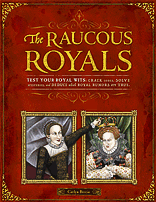
Read more about Louis and his bathing habits in the illustrated picture book The Raucous Royals.

Who is your favorite dirty royal? What do you think they smelled like?

If you would like to learn more about the history of bathing then I highly recommend Katherine Ashenburg's The Dirt on Clean: An Unsanitized History. Although Ashenburg does argue that Louis was amongst the unwashed, I will concede that she is right if you judge him in the context of modern day cleanliness. Overall, her detailed research is undeniably thorough and there are much more intriguing tidbits of bathing history that I did not mention in this post.

Sources & Notes:
(1) Ashenburg, p.94

(2) ibid, p. 100
(3) ibid, p. 99
(4) ibid, p.116

Feydeau, Elisabeth de & Lizop, Jane. A Scented Palace: The Secret History of Marie Antoinette's Perfumer, I. London: I.B. Tauris, 2006.
Albuquerque de , Martim & White, William. Notes & Queries: 2nd S. No. 45 Oct. 25. '56. Oxford University Press, 1856 .
Ashenburg, Katherine. The Dirt on Clean: An Unsanitized History. New York, NY: North Point Press, 2008.
Frieda, Leonie. Catherine de Medici. London: Phoenix, 2005.
Erickson, Carolly. Great Harry. New York, NY: St. Martin's Griffin, 1997
Folkestone Williams, Robert. Memoirs of Sophia Dorothea, Consort of George I. Published by H. Colburn, 1846. Digitized book available.


Louis XIV and Bathing
Louis XIV and Bathing: Hilton, Lisa. Athenais: The Life of Louis XIV's Mistress, the Real Queen of France. New York, NY: Back Bay Books, 2004.

Lewis, W.H. The Splendid Century: Life in the France of Louis XIV, Long Grove, IL: Waveland Press, 1997 .
Pictures of Appartement des bains and recreated rooms accessed online
Ashley, P. Marice. Louis XIV And The Greatness Of France, New York, NY: Free Press, 1965
Levi, Anthony. Louis XIV. New York, NY: Carroll & Graf Publishers, 2004.
Fraser, Antonia. Loves and Lives of Louis XIV. New York, NY: Anchor, 2007.
Mitford, Nancy. The Sun King: Louis XIV at Versailles, New York, NY: Penguin, 1995