






 We might laugh today at some of the amulets and talisman that protected royalty, but they were cherished and extremely costly objects hundreds of years ago. Here are a few of the lucky charms used by some of my favorite royals.
 The love talisman
Catherine de Medici was one of the most superstitious queens of her day and even showed a natural talent for alchemy and astrology. Catherine's most famous talisman was her love talisman made from metals melted during favorable astrological signs and then mixed with human and goat blood. Catherine’s love talisman was destroyed when she died, but a copy can be found at the Bibliotheque nationale de France. The above is a copy which can be purchased at Esoteric Jewels. Unfortunately, Catherine’s love talisman failed her miserably. Throughout her marriage, she was trapped in a painful love triangle between herself, her husband, Henri II and his famed mistress, Diane de Poitiers.
 Anne of Cleves wore a crown of rosemary on her wedding day because it was believed to be a love charm. Judging by the speed at which Henry VIII divorced her, expectant brides might want to forgo this tradition.
 The friendship talisman
You wouldn’t think the hard-nosed, pragmatic queen Bess would dabble in superstitions, but Elizabeth I had her share of protective amulets. She possessed an agate amulet which promised that she would always have at least one faithful friend. This amulet obviously worked because Elizabeth had a knack for surrounding herself with loyal advisors and spymasters throughout her life.
 The religious talisman
A commonly worn religious talisman was that of the Agnus Dei portraying a flag and Jesus as the sacrificial lamb. The Agnus Dei was often made from the wax of a Paschal candle and was blessed by the Pope. It was carried to protect against flood, thunderstorms, windstorms and sudden death. Mary Queen of Scots possessed two talisman stamped with the Agnus Dei and even took one to her execution. If you count a swinging ax as a sudden death, then this one didn’t work so well for Mary.
 The great poet, cardinal Pietro Bembo gave the Duchess Lucrezia an Agnus Dei as a token of his secret love for her. In one of the many steamy letters to the Duchess, he wrote:
'The encolsed Agnus Dei, which I wore a time on my heart, you will deign to wear at night sometimes for love of me - if you are not able to wear it in the day - so that sweet dwelling placeof your precious heart, to be able to kiss which one single time for a long hour I would bargain my life, may be at least touched by that circle which a long time touched the dwelling place of mine. Be well.' (1)
 The health talisman
One of the most common talisman was a unicorn horn to protect against disease and poisoning. Unicorn horns were so expensive that some even cost the price of a small estate. Henry VII, Elizabeth I, Francis I, and Mary Queen of Scots possessed unicorn horns to ward off illness. (They were really overpriced narwhal tusks)
 Henry VII also possessed a serpent’s tongue on a chain to protect him from sudden poisoning and illnesses. In ancient Malta, located off the coast of Italy, serpent’s tongue were believed to be the tongue of snakes that had been turned to stone. (They were really fossilized shark’s teeth.) In the fifteenth and sixteenth century, serpent’s tongues were suspended from coral trees, called languiers, and placed at the dinner table. Guests would grab a tongue and dip it into their wine to protect them from poisoning. Try this amulet only if you are dining with some suspicious house guests.
 The talisman for commoners
If you couldn’t afford a unicorn horn, then you would have to settle for carrying a mole's foot in your pocket. (just slightly nastier than a rabbit's foot.) This superstition was recommended by Pliny the Elder in the first century C.E. and continued to be a common practice in England up until the 20th century.
To cure toothache, people often carried a tooth-shaped stone or animal tooth. These amulets cured tooth ache by transferring the disease from your tooth onto the stone. If you squeezed it pretty hard, maybe you would forget about the stabbing pain in your jaw.
 Another common amulet was an alchemy coin called a ‘thaler’ which when carried would protect against disease and illness. The word ‘thaler’ became the basis for the word dollar which today ironically transfers nasty germs instead of protecting against illness.
  Stay tuned for a future post on the talisman used in divination. Shown here is the purple crystal used to cure illness and predict the future. It was used by Elizabeth I's conjurer, John Dee who claimed he could see ghosts in it.
 What is your favorite lucky charm? Fess up….are you superstitious? Do you consult the magic eight ball before making any important decisions? Do you have a florescent pink rabbit’s foot hanging from your dashboard or a lucky rock in your pocket?
Image Credits:
Mole's foot, Thalers, John Dee's crystal: Science Museum, London
Image Credits:
Mole's foot, Thalers, John Dee's crystal: Science Museum, London
Languiers: Natural History Museum
Catherine de Medici's love talisman: Esoteric Jewels
Notes:
Kidwell, p. 94
Sources and Further Reading:
Kidwell, Carol. Pietro Bembo: Lover, Linguist, Cardinal. Montreal, Quebec: McGill-Queen's University Press, 2004.
Woolley, Benjamin. The Queen's Conjurer: The Science and Magic of Dr. John Dee, Adviser to Queen Elizabeth I. New York:NY, Holt Paperbacks, 2001
The Execution of Mary Queen of Scots.
Starkey, David. The Six Wives of Henry VIII. New York, NY: Harper Perennial, 2004.
Frieda, Leonie. Catherine de Medici, Renaissance Queen of France, New York, NY:Harper Perennial, 2003. \
Starkey, David. The Six Wives of Henry VIII. New York, NY: Harper Perennial, 2004.
Frieda, Leonie. Catherine de Medici, Renaissance Queen of France, New York, NY:Harper Perennial, 2003. \


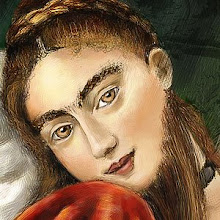
 Sometimes little embellishments like paint, eyelashes and hair were added to create a more idealistic representation as can be seen in Mary Queen of Scots’ death mask shown here.*


