







Showing posts with label Diane de Poitiers. Show all posts

Tuesday, March 23, 2010

Louise Labe: Love and History is a Battlefield

In 1548, Henri II and his newly raised mistress Diane de Poitiers, the Duchesse of Valentinois, were making their official entrance into Lyons. (His wife, Catherine de Medici was to arrive the next day after Diane.) The people of Lyons pulled out all the stops to honor Diane plastering the city with references to the Goddess Diana and her black and white colors. A tourney followed with ladies tokens wrapped around lances, trumpets blazing and the chivalric ideals that had not yet faded into story books.

Enter one lithe knight waving a banner with the motto Belle a Soi (Beautiful to Oneself) who had had a particular good day breaking lances and beating the competition for Diane de Poitiers’ attention. (No one really cared about impressing the queen.) Diane and Henri then requested an interview with this valorous knight, but when the knight lifted his visor, a gasp admited from the crowd....out tumbled the golden hair of Louise Labe.

Louise Labe was a multi-talented heroine, horsewoman, archer, dancer, singer, musician and even martial artist. Oh and she could also belt out Petrarchan verse with the steamy rocker poise of Pat Benatar in an 80s MTV video. Daughter and wife of a ropemaker, this lion-hearted poet raised herself out of an illiterate background and shattered the patriarchal mold with her distinct battle cry for women to, “raise their minds slightly, above their falstaffs and bobbins”. (1)

In love, Louise let out a more fervent battle cry writing lyrical sonnets in Italian and French. One of my favorites:

Sonnet IV - When Love Arrives

When Love arrives, I hide myself away,
Though filled by burning torments of desire,
That scorch and sear and scar my breast with fire,
And flames devour my heart both night and day.

O how I feel the harsh travails of Love!
The wounds and devastating dreams of death
Descend on me whenever I draw breath,
And so I sigh although I make no move.

The more Love comes, the more I am besieged.
I gather up my forces, yet I fear
The crack in my defenses may be fatal.

O archer Love, who scorns both gods and mortals,
You draw your bow and aim your shafts for all,
Then stab our hearts despite our fortress walls.

Louise was born between 1515 and 1524 at Parcieu en Dombes near Lyon, a haven for writers and humanist thinkers. Around 1543, Louise married a doting sugar daddy who afforded her a life of luxury and the freedom to follow her artistic pursuits. In Lyons, she opened up an intellectual salon to which suitors flocked to hear her coo, “As long as I can pluck the lute, I try. To sing about your charms in my refrain. As long as I can think, my fevered brain. Is burning with an ardent zeal. I cry. In 1555, her heady Oeuvres were printed by the renowned Lyonnais printer Jean de Tournes and became a best seller.

Louise died after 1566, probably due to plague. After her death, detractors couldn’t wrap their jaundiced minds around a woman publishing such passionate poetry. In 1584, John Calvin denounced Louise as a courtesan and whore and she became known as "la Belle Cordière" (the beautiful ropemakers wife). In 2006, professor and author Mireille Huchon argued that Louise Labe’s poetry was really written by the men who frequented her intellectual circle - Maurice Scève, Olivier de Magny, Claude de Taillemont, Jacques Peletier du Mans, Guillaume des Autels, and others, and by the publisher Jean de Tournes.

I confess that I have not read Huchon’s book (because it is in French and my French ends with ordering my Café au Lait) but her poems seem far too consistent to be written by a group of ghost writers and forgive me for being so naïve… but they just don’t sound like the work of a man. Plus, Jean de Tournes published other works by female writers including Marguerite de Navarre's Marguerites de la Marguerite des Princesses (1547) and far more caustic feminist tracks like Franqois Habert's Nouvelle Iuno, Nouvelle Pallas, and Nouvelle Venus (1545, 1547).

Debate still continues on Louise Labe's life as a poet, but she won't be the first Renaissance lady reduced to sex pot over intellectual siren. Perhaps Louise knew better than anyone when she wrote, "I see my fate, and it’s a bitter pill."

Notes:
(1) p.411 Rigolot.

Sources and Further Reading
Louise Labé and the "Climat Lyonnois", François Rigolot, The French Review, Vol. 71, No. 3 (Feb., 1998), pp. 405-413, American Association of Teachers of French.
M. Wilson, Katharina. Women writers of the Renaissance and Reformation, Athens, Ga.: University of Georgia Press, 1987.
Louise Labe's poetry

Thursday, April 2, 2009

Renaissance Beauty Secrets

In one of Shakespeare’s most famous plays, Hamlet scolds Ophelia, ‘God hath given you one face, and you make yourselves another.' Shakespeare was making a reference to Ophelia’s cunning use of cosmetics and he was not alone in his objections. Especially in England, cosmetics were generally mistrusted as sorcery designed to trick helpless men. In essence, Renaissance women faced the same challenges that we do today - they had to look like their beauty was effortless. Unfortunately, to achieve effortless beauty, women had to absorb more toxic ingredients than the average lab rat.

In last week’s post, readers were invited to take the “Are you a Renaissance Beauty” quiz. For all of you that might have been less than happy with your score (including me), here is your chance to redeem yourself. The following 500-year old beauty secrets should have the poets and artists singing your praise.

Disclaimer: The Raucous Royals takes no responsibility for any injury that might result from using these techniques.

Alabaster Skin: Steal the Look (the Renaissance Way)
In medieval times, women bleached their skin using lead pasta, but by the Renaissance, women had got white skin down to an evil science. To look like you haven’t seen the sun in 20 years, first apply raw eggs to your face as a primer. Next, mix together lead and vinegar to make ceruse. Apply it liberally to face and neck.

For a truly corpse-like face, take blue paint and apply thin veins to forehead and breasts. Finish it off with another coating of egg whites and voila…you have been turned to marble.

Tip: For an even fairer look, you could also try the old Renaissance beauty trick of applying leeches to your ears. The leeches would drain the blood from your head giving you that I am about to swoon look.

Warning: Over time, this beauty concoction would cause holes in your face. If patches of your skin start to fall off then immediately apply more lead makeup. If you prefer your skin to not look like Swiss cheese covered in frosting, you may want to try the 17th century beauty trick of applying patches of fabric to the holes on your face. Cut them into stars, moons and circles. Be creative. This is your melting skin.

Plucked: Steal the Look (The Renaissance Way)
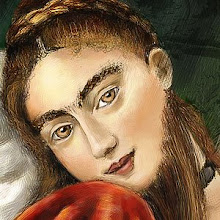
You have probably already noticed something peculiar about Mona Lisa’s mischievous eyes…she is missing her brows. Most women in the Renaissance were pluck-happy with the tweezers. They not only plucked their brows, but also their hairline to give the impression of a wide forehead. Ouch!

White Teeth: Steal the Look (the Renaissance Way)
There were many recipes to whiten teeth in the Renaissance. One recipe advised mixing pumice stone, brick and coal and then rubbing vigorously across the teeth. Crushed bone worked in a pinch too.

We think of Nostradamus as the great profit who predicted the end of the world, but he also wrote a book on beauty secrets. His formula for whitening teeth and freshening breath was the following:

Take three drams each of crystal, flint, white marble, glass and calcined rock salt, two drams each of cuttlefish bone and calcined sea-snail shells, half a dram each of fragmented pearls, two drams of bright riverbed stones (which form little white pebbles), one scruple of amber and twenty-two grains of musk, and grind them down thoroughly on a painter's marble slab. Rub the teeth with [the resultant powder] frequently and gently rub with a little rose honey any places where the gums have receded.In a few days you will see the flesh grow back, and the teeth clearly get whiter.

Warning: If you use these concoctions repeatedly, the enamel will eventually wear off your teeth. No worries. If you live in England during the reign of Elizabeth I then you could follow the latest fashion rage and paint your teeth black. It might not seem appealing at first, but it shows that you (like the queen) can afford the sweets that cause tooth decay.

Beautiful Hair: Steal the Look (the Renaissance Way)
When it comes to Renaissance beauty, blonds couldn't have been having much fun. To get those golden locks apply a mixture of saffron, lemon juice and rhubarb. Next, sit the sun for the WHOLE afternoon wearing a hat with the crown removed called a Solana. (Shown here).

If you had black hair and wanted to get rid of those pesky grays then you could try some of the recipes listed in Isabella Cortese's 1584 best-seller, Secrets. The following recipe must have not only altered your hair, but a few strands of DNA:

Take four or five spoons of quicklime in powder, two pennyworth of lead oxide with gold and two with silver, and put everything in a mortar and grind it with ordinary water; set it to boil as long you would cook a pennyworth of cabbage; remove it from the fire and let it cool until tepid. And then wash your hair with it. After an hour, wash your hair with clean, warm water and no soap, and then wash yourself with ordinary cleaning agent and soap your hair as usual; and do this every week.

Royal Beauty Secrets
Lastly, if the above concoctions don’t have you feeling 10 years younger, then you can steal these beauty elixirs from some famous royals:

  • Catherine de Medici used pigeon dung on her face to get that dewy, young complexion.
  • Mary Queen of Scots bathed in wine to keep herself looking young and fresh.
  • Diane de Poitiers’ fountain of youth was to drink gold. Yummy.

Enjoy!

Monday, December 8, 2008

Diane de Poitiers – Harlot of Heroine?

I have to take a tiny break from Catherine de Medici this week. I am still researching the enigmatic mistress of Henri II, Diane de Poitiers and she is proving to be an uncooperative subject. The problem lies in the fact that I am finding a mass of contradictions from various sources. This leads to an obviously sticky problem – who’s version of history do we believe? Protestants hated Diane. Catholics loved her. Both had a hard time keeping their religious prejudices out of the equation.

What is certain is that there will be tons of rumors to debunk. Stay tuned…

Monday, December 1, 2008

Catherine de Medici - Part III: When in Rome…Don’t Drink the Water

In last week’s post, Catherine de Medici was making a fresh start in the French court. Unfortunately, her happiness would be short lived. On September 25, 1534, her cousin and biggest supporter, Pope Clement VII wrecked everything by dropping dead. The official report was that he died of a “gastric disease,” but rumors quickly spread that he was poisoned. Foul play was certainly probable considering that many Popes before Clement had succumbed to an unenviable death.1 Poisoning became so common that a popular saying of the time was, “He who drinks of the water in the Vatican will die soon." Assassinations were secretly carried out by the “Council of Ten” or “Terrible Ten,” a covert and highly autonomous Venetian police force that answered to no one.

Still, we can only speculate on what caused Clement’s death. Wikipedia reports that Clement died after accidentally eating death cap mushrooms. This is highly unlikely given the fact that the extremely potent death cap mushrooms, (even in small amounts) kill within a matter of days. Clement’s illness lasted over 5 months. More likely, his wine was flavored with a little “eternity powder,” a lethal mixture of henbane, water hemlock or mandragora. Eternity powder was usually administered in small doses over several months resulting in a slow death that looked like…gastric problems.

Catherine de Medici: Stark Naked and Alone
If Catherine shed any tears for her uncle, then she would have had few people to grieve with her. Florence mourned Clement's death by raiding and vandalizing his tomb. People did have reason to be angry. Clement had left behind a legacy of higher taxes and inflated grain prices. Most damaging for Catherine, he also left behind her unpaid dowry. Francis was now stuck with an unpopular, Italian daughter-in-law without a cent to her name, prompting him to make the remark, “the girl has come to me stark naked.”3 Three years after the marriage, Catherine was also failing at her sole purpose as wife to Henri II – she had yet to become pregnant. It was roughly during this time that Henri began his affair with the infamous Diane de Poitiers (shown here) more on her later...

A Damsel in Distress
So let’s recap. Catherine is stuck in France with no money, no blue blood, and no little Henri’s running around. Her husband has taken a mistress and her uncle has died. (But she does have great shoes.) How could Francis secure the Valois line if Catherine did not become pregnant? The logical solution would be for him to replace his daughter-in-law with a more fertile and politically advantageous bride. The Guise brothers began campaigning for Louise of Guise as the replacement wife. Years earlier in England, Henry VIII had kicked Queen Catherine of Aragon to the curb and swapped her for Anne Boleyn. What was to stop Francis from doing the same to Catherine?

Catherine knew her situation was doomed so she went to Francis begging him to at least let her serve the new queen as a lady-in-waiting. Luckily, Francis was a big softy for a damsel in distress. He said, “It is God’s will that you should be my daughter and the wife of the Dauphin. So be it.”4

Amen. So Catherine stayed put and set herself the task of becoming pregnant.


A Bitter Pill to Swallow
First, Catherine applied poultices of ground up stag antler and cow dung…a guaranteed remedy for infertility. When that didn’t work, she tried drinking large quantities of mule’s urine. (belch) Catherine even drilled holes in her chamber’s floor so that she could spy on her husband and his enigmatic mistress, Diane de Poitiers. Unfortunately, the peep show taught Catherine little in regards to fertility and much more than she needed to know about her husband’s passion for his mistress. After ten years of trying everything imaginable…time was running out.

The Fertility Doctors comes a Knockin’
Finally, the 16th century version of a fertility doctor, named Doctor Fernel was brought in and he diagnosed a slight irregularity in the couple’s reproductive organs. He prescribed a cure to which Henri and Catherine followed. I wish I could tell you more about this cure, but history doesn’t know what voodoo magic he used. All we know is that it worked fabulously. After 10 years of cow dung and sex education, Catherine gave birth to Francis II on January 19, 1544. Over the following years, she would give birth to 9 more children. Not too shabby for a mere "merchant's daughter."

Peace at last...Hardly
Although Catherine secured the succession, peace was still out of her reach. A royal cat fight was brewing between the two leading mistresses of the French court – Diane de Poitiers (mistress of the heir to the throne, Henri II) and the Duchess D’Etampes (mistress of King Francis I). Who will be the last strumpet standing??? I wouldn't put my gold coins on the aging king's mistress. All it takes is one kick of the bucket...and M. D'Etampes is out on her arse. Stay tuned for next post to see who comes out on top.

A full list of sources will be given at the end of Catherine de Medici's story

Notes:

(1) Pope Alexander VI was poisoned in 1503 after drinking poisoned wine which had been intended for the Cardinal de Corneto. The Venetian ambassador reported that it was the"the ugliest, most monstrous and horrible dead body that was ever seen, without any form or likeness of humanity” - de Rossa, p.151.
(2) The inscription on Clement's tomb read, 'To Clement the Seventh, Pontifex Maximus, whose invincible valour was only exceeded by his clemency.' The vandals changed the inscription to read, 'To Inclement, Pontifex Minimus whose conquered valour was only exceeded by his avarice.'
(3) p. 48. Frieda
(4) p. 58. Frieda