
If you google “Marie de' Medici” or search for images of her on
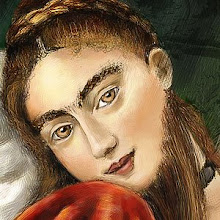
Wikepedia you will find this painting depicting a doe-eyed, young girl with reddish brown hair, sumptuously dressed in priceless jewels befitting a queen. This painting does depict a member of Medici royalty, but I highly doubt it is Marie. The alluring beauty portrayed in this painting most likely belongs to the forgotten Eleonora di Toledo de Medici, called “Leonora” and sometimes "Dianora."
Much has been written about Leonora’s aunt,
Eleonora di Toledo, Duchess of Florence and Siena and her uncle
Cosimo Medici, the powerful grand duke of Tuscany. If you have ever visited the Uffizi gallery then you have experienced the tremendous scale of Cosimo’s legacy. Yet, Leonora’s legacy and the obvious foul play surrounding her death have been all but forgotten to history.
Leonora was the only daughter of Don Garzia di Toledo and Vittoria d’Ascanio Colonna. She was born in the glittering Florentine court in 1553 and was left in the care of her aunt Eleonora and uncle Cosimo while her father completed his tour of duty as a naval commander-in-chief for Spain. As a child, the princess Leonora’s beauty and charm were celebrated throughout Florence. One writer said she had eyes, ‘like two stars in her head.’ She was certainly a shining star to Cosimo for he grew so fond of Leonora that he became reluctant to see his pretty niece married off far away from Florence.

Cosimo’s solution was to betroth Leonora to his son,
Don Pietro (shown here in his youth) so that he could keep an eye on those two crazy kids. Leonora was given a generous dowry which included forty-thousand ducats of gold (around 18 million in today’s currency) and Cosimo added to that a few Medici villas and lands across Tuscany. You would think that spending your honeymoon in your private Italian villa rolling in the ducats would make for a good marriage, but such was not the case. Pietro was a violent, simple-minded, little viper who liked to empty the Medici coffers on gifts for his mistresses. He avoided Leonora to the point that the marriage was not consummated until a few years after the wedding.

Abandoned and unloved, Leonora grew increasingly gloomy. To console herself, she spent her days with her vivacious cousin, Isabella de Medici. (shown here bearing a striking resemblance to Leonora) Isabella was beautiful, cultured, educated and best of all, threw fabulous parties at her private Florentine residences of Palazzo Medici and Villa Baroncelli. Isabella had an atypical level of autonomy for a Medici princess while under her father, Cosimo’s protection. Her husband, Paolo was indebted to Cosimo to keep the ducats flowing so Isabella was allowed to stay in Florence while Paolo worked in Rome.

And while the cat was away spending Isabella’s dowry, the mice princesses did play. Isabella’s parties promised the finest food, music, theater, poetry and art. Most interestingly, were the naughty, late night party games like “the school master” where one guest would role-play the school master and instruct (wink wink) the other guests. Another party favorite was the “game of the devil’s music” where guests would reenact animal sounds. If there is one thing that can cheer a girl up it’s howling like a wolf.

It isn’t hard to guess what happened next. Leonora began an affair with a dashing, young poet named Bernardino Antinori while Isabella snuck around with her handsome cohort, Trolio Bandito (shown here greeting Catherine de Medici) And while the princesses had their fun, the clock ticked away on the protection Cosimo afforded them. Time ran out when Cosimo died in 1574 leaving his son
Francesco to rule as Grand Duke of Tuscany.
In 1576, the foolishly, hot-headed Bernardino was imprisoned in Bargello for brawling (allegedly fighting with another courtier for Leonora’s affections). He was imprudent enough to write Leonora love letters and these letters were discovered hiding in Leonora’s footstool. Bernardino was arrested and imprisoned in Elba’s prison. He was strangled a month later.
The scandal reflected poorly on Francesco because it looked like he had little control over the Medici women running amok under his nose. And if there is one thing you can’t have in a ruling Italian family…it’s to look like you are losing control. In
God Father like style, Pietro got the ok to take care of his wayward wife. Leonora was staying at the Medici villa at Cafaggiolo in July of 1576 when her husband strangled her with a dog-leash. She fought hard and allegedly bit Pietro's hand during the struggle. Leonora was just 23 years old.
Her young son, Cosimino suspiciously died of dysentery a few weeks later. We can only speculate if his death was due to natural causes, but Pietro may have suspected that Cosimino was not his son.
Francesco reported that Leonora had died of a “really terrible accident”, but no one was buying it. In typical Machiavellian spin control, Francesco had to come clean with the court of Spain and Phillip II (Leonora’s father Don Garzia was pissed). Francesco wrote to Phillip admitting to the honor killing:
Although in the letter I had told you of Donna Eleonora’s accident, I have nevertheless to say to His Catholic Majesty that Lord Pietro our brother had taken her life himself because of the treason she had committed through behavior unbecoming to a lady1..
Isabella suffered the same fate a few weeks later. While on a hunting trip in Cerreto Guidi, she was murdered by her husband, Paolo.
 Murder of a Medici Princess
If you enjoy a true murder and mischief tale, then I highly recommend
Murder of a Medici Princess by Caroline P. Murphy. Murphy’s amazingly detailed research focuses on Isabella de Medici, Cosimo’s beloved daughter. Murphy deftly unravels the power and corruption that destroyed Isabella along with her unfortunate cousin. The book contains historical treasures such as letters Isabella wrote and first hand accounts of her murder. I especially enjoyed how Murphy deciphers the hidden meanings and often thinly veiled sarcasm in Isabella’s letters that show how the spirited Princess attempted to appease her distant husband. It’s these nuances that I would have missed if I read the letters on my own.
Murphy doesn’t sugar coat Isabella’s story either. The
Murder of a Medici Princess is by far a darker tale then your typical royal biography, but it does promise a fascinating, albeit disturbing look into how the Medici women were forced to navigate through Florence’s political machinations and corruption.
Back to the Painting…

I am not sure how Francesco’s daughter, Marie de' Medici, became labeled as the sitter in Alessandro Allori’s painting. Allori did paint Marie de Medici as a young girl with the intentions of using the portrait in betrothal agreements and also painted her wedding at Cana. But an earlier miniature identified as Leonora clearly resembles the mislabeled painting in both dress and likeness. Leonora wears a peacock blue gown mimicking her aunt Eleonora’s Spanish colors. The dress and jewels are practically identical. (shown above)

Another painting clearly marked as Leonora (notice the left hand corner) also shares the same dress patterns and likeness. It's very possible that a painting of Marie would share the same Florentine lily motifs and coat of arms, but it's the similarities in the collar and facial features that convince me that this painting is really Leonora. I have already talked about
what Marie de Medici really looked like as a young girl in previous posts, but if you have more information or a different opinion about the painting then please feel free to share.
The Medicis: Family of Mischief
In 16th century literature in media, The Medicis’ scandals seem to fall in the shadow of the Tudors’ many romps and beheadings. Maybe they just had better PR because as far as dysfunctional families go, the Medicis don’t disappoint. They are chock full of pampered princesses, ruthless thugs, smarmy popes, adultery, incest and corrupt rulers clawing their way to power. There’s a little bit for everyone.
In a few weeks, I will be traveling across to France to feature Leonora and Isabella’s cousin – the famed poisoner and supposed instigator of the St. Bartholomew Massacre, Queen Catherine de’ Medici.
Sources:
Langdon, Gabrielle. Medici Women: Portraits of Power, Love and Betrayal in the Court of Duke Cosimo I, Toronto, ON: University of Toronto Press, 2007.
Murphy, P. Carolone, Murder of a Medici Princess, New York, NY: Oxford University Press: 2008.
Notes:
(1) Langdon. p. 179







 A few weeks ago, I read an interesting article about the Science of Rumors concluding that the worst way to fight a rumor is to ignore it. It is an interesting study because it leads me to my next question: How much of a past ruler's image is affected by their ability to squash rumors?
 Queen of France, Catherine de Medici, best remembered for being responsible for the The St. Bartholomew's Day massacre, chose to ignore polemic pamphlets. Around 1575, after the death of her son Charles IX, an especially misogynistic pamphlet was printed entitled Discours Merveilleux de la vie, actions et deportements de Catherine de Medicis Royne. In it, Catherine was blamed for the St. Bart ‘s ruckus and ordering the murders that sparked the violence. (The basic gist of it was that she was the female devil incarnate sent to seduce the people of France.) This pamphlet was more than just tabloid trash. It was distributed widely and translated into German, English and Latin. It became so popular that it was even used to later discredit future female rulers, Marie de Medici and Marie Antoinette.
 During the same time period, Elizabeth I of England would not tolerate any slanderous pamphlets attacking the crown. The zealous puritan, John Stubbs wrote a book entitled, The Discoverie of a Gaping Gulf whereinto England is like to be Swallowed by another French Marriage. You can pretty much figure out from the title how Stubb’s felt about Elizabeth’s possible marriage to Catherine de Medici’s son, The Duke of Anjou. The queen was not enlightened by Stubb's work and she promptly ordered the public removal of his right hand.1 Ouch! Today, this may seem like a draconian punishment for a little free speech, but Elizabeth (and certainly her advisers) understood the importance of royal image making. A weak monarch was a matter of appearances.


