









 This week’s post is about a dangerous and deadly substance feared and avoided by many royals throughout the 16th – 18th century.
In 1568, Ambroise Pare, the royal surgeon who lived to see the reigns of Henry II, Francis II, Charles IX and Henry III, warned that when this diabolical substance came near an unsuspecting victim, “the flesh and the whole disposition of the body are softened and the pores open, and as a result, pestiferous vapour can rapidly enter the body and cause SUDDEN DEATH, as has frequently been observed.”1 (Emphasis added for my own dramatic effect.)
In 1655, French doctor Theophraste Renaudot expounded upon Pare’s beliefs when he said that this deadly matter “fills the head with vapors. It is the enemy of the nerves and ligaments, which it loosens limbs…2”
 What sort of bizarre substance could loosen limbs, soften pores and even cause death? Here are the choices:
A. Plague air
B. Sunlight
C. Eating Vegetables
D.Water
Scroll down for answer….
Keep scrolling you fool
You know you have nothing better to do
Almost there…
Correct Answer: D
Water was the deadly substance in question. Many doctors of the 16th and 17th century would not have advised bathing on a regular basis. In Louis XIV's court, pregnant women were told NEVER to bathe because it was believed to relax the womb. With all this dirt building up, did royals really stink to high heaven? We have a rough idea of what royalty looked like, but what did they smell like?
Kings and queens certainly didn’t bathe every day, but they also didn’t walk around with grime stuck in their fingernails either. In fact, some royals got downright creative when it came to what they put in their bathwater. Here is what some famous people may have smelt like...
Bubbles, Candles and a little Asses Milk
 Louis XIV liked a little lavender in his bath. (more on him later)
Henry VIII bathed at Hampton Court with actual heated water pumped in from a stove in the adjoining room. To ease the pain in his sore leg, he soaked in a mixture of herbs, musk and civet . A civet is a small carnivorous cat that supposedly gives off a very distinctive musk. I am not exactly sure what cat musk smells like, but I am not imagining it to be pleasing.
Like many people of his day, Henry also went to bed with a piece of fur so that fleas and lice would jump on it and not on his royal skin. This begs the question....wouldn't the fleas be confused if you smelled like a dead cat?
Mary Queen of Scots bathed in wine. If I ever win the Newbery, Caldecott or get that call from Oprah, I am going to try this one.
 While other courtiers were slathering on heavy, white, lead makeup, the mistress of Henri II, Diane de Poiteirs took the au natural approach and bathed in rain-water. All these nature baths must have worked for despite the fact that she was 19 years older than the king, she held him enthralled until his death.
Cleopatra famously bathed in Asses milk to keep her skin youthful and fresh. Ironically, this one may have really worked. Donkey’s milk contains oligosaccharides which increase the number of good bacteria and have anti-aging properties.
While suffering from a "distressing malady" Countess Platen Hanover bathed in milk and then generously donated the diseased milk to the poor. Charity sometimes began in the tub.
Clad in her flannel nightgown, Marie Antoinette bathed in a sweet concoction of pine nuts, blanched sweet almonds, marsh mallow root, Lilly bulbs and a candy paste made from roots and syrup called enula-campana. So Marie Antoinette probably smelled like fresh baked cookies with some floral undertones. Yummy.
 Mirror Mirror on the Wall....Who is the Dirtiest of them ALL?
Which royals hardly ever bathed? Here’s a whiff into some royal tubs.
Anne of Cleves
The Germans had long shocked the rest of Europe by not washing their hands before eating and bathing infrequently. Henry VIII’s forth wife, Anne of Cleves was no different. Before she was presented to Henry, her advisors worked hard to get the stinky German Princess to take a bath.
Elizabeth I
Rumors abound that Elizabeth professed that she bathed once a month, “whether she needed it or not.” 3 But given Elizabeth's keen sense of smell and her access to the sunken bath that her father built, I suspect she bathed far more often.
Peter the Great
Peter traveled the world learning new customs, but no amount of enlightenment could get the czar practicing good hygiene. He found nothing wrong with relieving the call of nature on the glittering palace walls. These were good times to be a germ. Peter did swear by the curative properties of an occasional natural mineral spring bath, but didn't make a habit out of bathing regularly.
Ferdinand and Isabella
Ferdinand and Isabella didn’t help in the quest toward cleanliness. In Spain, the early Christian doctrines taught that bathing was a corrupt practice that could only lead to…nakedness. Cleanliness was next to Ungodliness. After the conquest of Granada, the Moors not only had to give up their religion to survive the Inquisition, they also had to give up bathing. Isabella and Ferdinand ordered the Moorish baths to be destroyed and bathing was strictly forbidden. When Columbus reported back on the daily bathing habits of the Taino people, Isabella was horrified and commanded her new subjects to stop this blasphemous bathing practice at once.
Isabella boasted that she herself had only bathed twice in her life and I am going to take her word for it.
Phillip II and his Daughter Isabella
Continuing along with the Spanish love of dirt, Phillip II banned the remaining bath houses in 1576. His daughter Isabella because a national martyr to germs when she vowed in 1601 that she would not change her shift until the siege of Ostend ended. Unfortunately, the siege lasted over three years! Eeeeeuw…. that’s an awfully long time to be wearing the same underwear. After three years, her white shift had turned a lovely shade of brown.
Henry IV
Henry’s first wife, Marguerite de Valois complained bitterly about Henry’s lack of bathing worsened by his proclivity to eat large amounts of garlic.
 Rub a Dub Dub- My Favorite King and his Tub
One king that always gets accused of being dirty (in more ways then one) is Louis XIV. I have read several trivia type books containing the rumor that Louis XIV bathed “only three or two times in his life”. Search on the internet and you will find this rumor everywhere. But is it really true?
The ruling theory of the time was that simply changing your linen would soak up sweat and dirt. The rich wore tightly woven fabrics like linen and taffeta because it was believed to keep the crawlies and unseen plague away from skin. Loosely woven fabrics like wool were believed to be far less effective in staying clean.
The king’s morning ritual consisted of his hands and face being wiped down with spirits and then his sweat-drenched linen was changed (Louis reportedly sweat a lot). His courtiers then sent him on his way to go to mass, his council meeting, hunt, chase the ladies and work up some more sweat. His linen was then changed a couple of more times throughout the course of the day. In all fairness to this daily routine, most courtiers did not change their linen more than once a day so Louis is already looking pretty clean in comparison.
But if linen didn’t succeed in keeping the king clean, he could always retire to his Appartement des Bains located on the ground floor at Versailles. The Appartment des Bains was a private space created for “informal” meetings and washing. They contained a suite of rooms for disrobing and included an enormous bed situated before a large mirror. (Louis had a bit of a thing for mirrors) Louis would bathe in his long, grey smock of course linen and used a soap made from olive oil. The “cabinet des bains” contained his octagonal bath inset in the marble floor about 10 feet wide and 3 feet deep. It was decorated with Azurian gold, themes of Juno and flanked by marble columns. Pillows adorned the bottom of the bath and a wood burning stove provided heat to the perfumed water that filled it. Sounds like a good time to me.
But now before your minds get all dirty….The Apartement des Bains was more than just Louis’s playboy suite with built in Jacuzzi. It was also his inner sanctuary. As a boy, he spent many lazy hours relaxing with his mother Anne of Austria. According to Anne’s valet, La Porte, Louis would literally jump for joy whenever he joined his mother in her bath. Bathing and cleanliness was an ideal that Anne further instilled in the young boy by always insisting that his hands and fingernails were washed regularly.
Louis was also an avid swimmer and enjoyed bathing in the Seine. In the summer months, Henriette Anne (married to Louis’s brother) and her ladies covered themselves in long shifts and went for a little dunk in the river. You can bet Louis didn't pass up the opportunity to splish splash with the ladies clad in only their shifts. Now, you might argue that swimming doesn’t count as bathing, but in 17th century France, swimming was done to clean the body. Many superstitious Europeans believed that swimming in the open air on the feast of St. John the Baptist would even protect them from sickness. Remnants of this belief still exist today. People might look at you strange if you called your bathing suit a “swimming suit.”
Tracing this Dirty Rumor
Bathing was obviously not a regular occurrence, but Louis washed far more than 2 or 3 times in his entire life. So where did this rumor come from? We will never know for certain how it got started, but I suspect that somewhere along the line Louis’ “medicinal” bath got confused with the frolicking he did in his private quarters. Louis' medicinal bath was given by his personal doctor, Guy-Crescent Fagon, and consisted of bleeding, purging, freezing cold water and the always popular enema. Excuse the bad pun, but simply put…. the sun didn’t shine where they cleaned the sun king. Louis doctors believed it was far more important to clean the inside of the body than the outside. This bath was not the playful splashing of lavender scented water that Louis enjoyed with his mistresses. Louis reportedly felt awful afterwards and allowed this Nurse Ratchet bath to be given to him only twice in his life then promptly swore he would never allow it again. Fagon reported, “The king was never pleased to become accustomed to bathing in his chamber.”4 The key words here are “his chamber.” What happened on the bottom floor of Versailles was an entirely different story.
 Another source of this rumor may have been Louis mistress, Madame de Montespan’s, defensive practices against offensive smells. She doused herself in clouds of perfume to mask Louis’s odor. Montespan was not trying to necessarily cover up Louis animal musk, but instead his horrendously bad breath. Brushing teeth WAS a serious problem and best saved for another post….
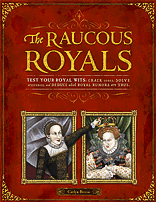
Read more about Louis and his bathing habits in the illustrated picture book The Raucous Royals.
Who is your favorite dirty royal? What do you think they smelled like?
 If you would like to learn more about the history of bathing then I highly recommend Katherine Ashenburg's The Dirt on Clean: An Unsanitized History. Although Ashenburg does argue that Louis was amongst the unwashed, I will concede that she is right if you judge him in the context of modern day cleanliness. Overall, her detailed research is undeniably thorough and there are much more intriguing tidbits of bathing history that I did not mention in this post.
Sources & Notes:
(1) Ashenburg, p.94
(2) ibid, p. 100
(3) ibid, p. 99
(4) ibid, p.116
Feydeau, Elisabeth de & Lizop, Jane. A Scented Palace: The Secret History of Marie Antoinette's Perfumer, I. London: I.B. Tauris, 2006.
Albuquerque de , Martim & White, William. Notes & Queries: 2nd S. No. 45 Oct. 25. '56. Oxford University Press, 1856 .
Ashenburg, Katherine. The Dirt on Clean: An Unsanitized History. New York, NY: North Point Press, 2008.
Frieda, Leonie. Catherine de Medici. London: Phoenix, 2005.
Erickson, Carolly. Great Harry. New York, NY: St. Martin's Griffin, 1997
Folkestone Williams, Robert. Memoirs of Sophia Dorothea, Consort of George I. Published by H. Colburn, 1846. Digitized book available.
Louis XIV and Bathing
Louis XIV and Bathing: Hilton, Lisa. Athenais: The Life of Louis XIV's Mistress, the Real Queen of France. New York, NY: Back Bay Books, 2004.
Lewis, W.H. The Splendid Century: Life in the France of Louis XIV, Long Grove, IL: Waveland Press, 1997 .
Pictures of Appartement des bains and recreated rooms accessed online
Ashley, P. Marice. Louis XIV And The Greatness Of France, New York, NY: Free Press, 1965
Levi, Anthony. Louis XIV. New York, NY: Carroll & Graf Publishers, 2004.
Fraser, Antonia. Loves and Lives of Louis XIV. New York, NY: Anchor, 2007.
Mitford, Nancy. The Sun King: Louis XIV at Versailles, New York, NY: Penguin, 1995


