







Showing posts with label Catherine of Aragon. Show all posts

Wednesday, April 7, 2010

Secret Fertility Potions of the Royals

The sun is out. Birds are chirping. Lawn mowers are cutting grass. My window is open and it finally feels like spring. We tend to think of spring as the time babies are born, but that is actually only true for sparrows. For humans, more babies are born in August than any other month presumably making the cold weather more conducive for conception.  No worries. The Raucous Royals is here to offer the following fertility secrets passed down by the royals.

The ancients just didn’t seem to get the whole concept of menopause. Such was the case of Byzantine Empress Zoe in the 11th century who at the age of fifty was forced to tie pebbles to her body, hang fertility amulets around her, and wear chains. By fifty, women have enough problems with things hanging without adding rocks to their body. Poor Zoe. She never did get that baby, but on the positive side, her body was compared to a "well baked chicken" with "every part of her was firm and in good condition." I kind of wish someone would say by giggly post-partum bits look like firm poultry.

Throughout medieval and Renaissance times, when a queen was anointed with the consecrated oil, it was believed this oil guaranteed fertility. Some batches must have gone bad because greasing up didn’t always get the job done. When the first wife of Henry VIII, Catherine of Aragon could not conceive she made a pilgrimage to the shrine of Our Lady Walsingham and donned a hair shirt. She went through all that itchiness and she was still just left with one daughter, the future queen of England Mary Tudor.

Catherine de Medici wins hands down for enduring the most uncomfortable fertility rituals. She applied a poultice of ground antlers and cow dung prescribed by her alchemists. When that didn’t work, she swallowed elixirs of mare’s milk, rabbit’s blood, and sheep’s urine. (gulp). And of course, she ceased all riding of mules because it was well-known that the animal caused sterility. I would be pissed if someone took away my mule!

But don't think the women were having all the fun wallowing in cow dung. Men too had some freakishly weird fertility potions. Ferdinand of Aragon ate bull’s balls to increase his virility. Judging by the amount of mistresses he had, I hardly think he needed it.

Other queens swore by “taking the waters”. Such was the case with Anne of Austria who realized her advancing age and infrequent visits from her husband, Louis XIII, were making her chances of conceiving slim to none.  Miraculously, she conceived Louis XIV after taking the waters in Auvergne and he was born in 1638. Nicole Kidman reportedly swears by these same fertility waters.

Wife of Charles II, Catherine of Braganza was another fan of fertility dips and spent her summers in the fecund waters of Tunbridge Wells and Bath. Unfortunately, she was not as successful giving birth to a healthy baby. I guess the Bath waters did not have the same magic.

During Louis XIV's reign, it’s no wonder how anyone ever got pregnant because women could not have sex one hundred days of the year during Catholic observance days. Soon fertility went hand in hand with some of the wackiest superstitions in history. For example, to get a son, women were instructed to conceive during the waxing moon and to constrict the man’s left testicle. (girls came from the left testicle, boys came from the right). Men were also instructed to work a bit harder because it was believed that a woman’s orgasm increased fertility. (Yey! This one is actually true.) The church advised women to pray to St. Leonard, a hermit who founded a monastery and was the patron saint of prisoners. (Ironic, considering pregnancy often feels like an imprisonment). I do believe in the power of prayer and praying to any saint seems like a far better option then waiting for a waxing moon. I would just pick another saint. Those handcuffs he is holding are kind of scary.

When royals failed to conceive, they also could rely on the old Renaissance card trick - the phantom baby. When Henry VIII’s sister, Mary married the ailing, decrepit King of France, Louis XII, there was little hope for an heir. But without a heir, Mary also had little chance of staying in France and the clock was ticking with her gouty husband. No problem for this Tudor vixen. After Louis’ death, Mary simply wrapped her thin waste in towels and staged an occasional fainting spell. Unfortunately, no one bought the ruse especially the mother of Francis I, Louise of Savoy, who knew her son had a pretty good chance of becoming the next king if there were no visits from Mr. Stork. Louise ordered a full medical examination that turned up with Mary looking much thinner minus her pseudo baby bump. Shortly after her husband’s death, Mary was sent packing.

The beautiful Bianca Capello took the pregnancy ruse one step further. Around 1564, Bianca caught the eye of the son of the Grand Duke of Florence, Francesco de Medici. Unfortunately, Bianca was already married to a young clerk named Pietro Bonaventuri and Francesco was married to Johanna of Austria. In the Medici household, pesky husbands had a habit of turning up dead and wives were practically invisible. Such was the fate of Pietro when he was found murdered in the streets of Florence after a “scuffle”.

Bianca and Francesco carried on until 1574 when Francesco became Grand Duke of Tuscany. Throughout Francesco’s marriage, Johanna had only born him six measly daughters (a son died in youth). Now all Bianca needed to get the misses out of the way was a bouncing baby Medici. She took to wearing layered clothing and told Francesco the happy news. After a secluded "birth", she swiped a baby from a working class mother and passed it off as Francesco's new heir to the Medici fortune. The baby was named Antonio, Johanna died a few years later, and Bianca had her fairy tale ending.

Not exactly. Even though Bianca had conveniently disposed of her accomplices, Francesco found out. No worries still. Illegitimate sons could become heirs in Florence….if they could survive the machinations of the family members they were replacing. Antonio did survive. Mom and Pops were not so lucky. Bianca and Francesco mysteriously turned up dead after vacationing in their villa. Their symptoms coincide with arsenic poisoning probably ordered by Francesco’s brother Ferdinando...but that is a post for another day.

Friday, March 6, 2009

The Raucous Rumor of the Month: The sassy Christina of Milan snubs Henry VIII

Good stories are often repeated. I am obviously very fond of this truism because it is the basis of my latest book. And as far as rumors go…. this one is just too tantalizing not to repeat.

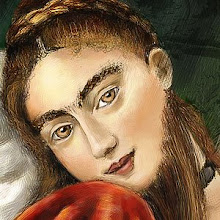
This rumor surrounds the enigmatic Christina of Milan and her public rebuff of Henry VIII when he was seeking her hand in marriage. Christina is shown here demurely averting our gaze in a panting completed by Holbein in 1538. The painting was reportedly an accurate portrayal of her famed beauty despite first-hand accounts of a browner complexion.

At first glance, it’s hard to believe that the sweet, dimple-faced, 16 year old in the painting would dare to snidely insult the King of England. Yet, her slightly upturned smile seems to reveal a sardonic wit beneath the surface of her dutiful morning attire. This dry wit is most appropriately illustrated in Christina’s rumored response to becoming Henry’s wife that if she had two heads, “one should be at the King of England's disposal.” SLAM! Oh no she didn’t.

No, really… she did not.

The true story behind Christina and Henry’s proposed marriage doesn’t quite read like a Jennifer Aniston tabloid diss on Angelina Jolie. In fact, Christina of Milan may have been quite enamored with the idea of being the next Tudor rose. For one, queen of England was a big step up from a Duchess.

The only contemporary accounts of Christina's attitude toward Henry point to a sort of bemused curiosity and a submissive acceptance of her fate. When her attendant, Gran Battista Ferrari returned from his visit to England, Christina questioned him about Henry VIII. Their conversation was interrupted by a summons to supper, but she continued to question Ferrari afterwards. For someone supposedly repelled by the thought of marrying Henry, she was definitely curious. Later, Wriothesley asked Christina what she thought of Henry and she responded that she believed him to be a “noble prince” and that she would comply with the wishes of her uncle, Emperor, Charles V.

Some historians have argued that the length of time that Christina sat for Holbein (only three hours) is proof of her disinterest, but Holbein never took more than three to four hours to complete his sketches and then finished his paintings from these sketches. Such was also the case with the infamous portrait of Anne of Cleves later to become Henry’s 4th wife.

The real impediment to the marriage was not Christina’s lack of attraction to Henry, but the fact that Henry was attempting to dip his big, fat toe into his ex wife’s family gene pool. Christina of Milan just happened to be the great-niece of Catherine of Aragon thereby putting her in the forbidden degrees of affinity. The only way to marry Christina would have been for Henry to get a papal dispensation from Pope Paul III. Unfortunately, Paul was not about to give Henry any more free passes to marry. In fact, he actually went out his way to block the marriage by reissuing his trusty papal bull excommunicating Henry. And since Charles V had grown pretty chummy with the Pope he was not about to let his niece marry someone the Pope had publicly denied important sacraments…like the sacrament of marriage.

Henry was left with no other choice, but to marry someone outside of his family. Thus, he was stuck with Anne of Cleves – a story for another day.

Rumors that Christina was blatantly opposed to the marriage were floating around in the 16th century, but the two-headed comment was not recorded until the 17th century. Although Christina never had the gumption to make the famed remark, we can always find truth in every fiction. The rumor is an accurate reflection of the 16th century world attitude toward Henry seeking a 4th wife. Most people thought he did need a wife with two heads.

Warnicke, Retha M. The Marrying of Anne of Cleves: Royal Protocol in Early Modern England, Cambridge University Press, 2000
Fraser, Antoinia. The Six wives of Henry VIII, New York, NY: Vintage, 1993.

Monday, February 16, 2009

Passionate Love Monkeys

Throughout the 16th and 17th century, it was believed that women had less control of their sexuality than men. This lack of control made women weaker than their male counterparts. It was only through the quiet domesticity of marriage that lust could be tamed. Ironically, gender stereotypes are reversed today.

As discussed in a previous post, monkeys in Renaissance art often symbolized frivolity and gave a lighthearted feel to a painting. But monkeys also represented beastly desires. How does a queen control these desires? She must chain the monkey.


In the painting by Sir Anthony van Dyck, Henrietta Marie's monkey is safely chained to her dwarf, Sir Jeffrey Hudson. In this painting above of Catherine of Aragon, the queen is also not taking any chances with an unleashed monkey*. A chained monkey represented the subject’s absolute control over base desires. Clearly, neither queen is giving into that crazy monkey love.

* Actually it is a marmoset to those who know their monkeys
Sources: Edited by: Fudge, Erica, Renaissance Beasts, University of Illinois Press, 2004.

Wednesday, February 4, 2009

Unrequited Love – Henry VIII and Catherine of Aragon

Catherine of Aragon Whenever I think of unrequited love, I think of the intractable Catherine of Aragon who refused to be pushed aside for Henry VIII's mistress, Anne Boleyn. Catherine even went to her deathbed with only forgiveness in her heart for the king who had caused her so much pain. Her death fits into the Raucous Rumor of the month...

Rumor: Anne and Henry wore yellow to mourn the death of Catherine of Aragon because it was the color of mourning in Spain. Some accounts report both Anne and Henry wearing yellow to show their respect. Some accounts report just one wearing yellow.

Possible Source: This rumor has been floating around the internet for some time. Its origins are not completely unfounded. Edward Hall, the chronicler, reported that Anne wore yellow for mourning.

The Truth:
After Catherine's death, the Spanish Ambassador, Chapuys, wrote a letter to Emperor Charles V stating:

“On the following day, Sunday, the King was clad all over in yellow, from top to toe, except the white feather he had in his bonnet, and the Little Bastard (Elizabeth) was conducted to mass with trumpets and other great triumphs. After dinner the King entered the room in which the ladies danced, and there did several things like one transported with joy.” (1) Parenthesis added by me

Chapuys was well aware that yellow was the color of jubilation. In the inventory for the Accounts of the Revels, there are numerous examples of yellow velvet and yellow satin being ordered for the ladies’ dresses to celebrate the royal festivities. Interesting, Anne was pregnant at the time of Catherine’s death and had decorated her confinement room in yellow ochre. Hall's reference to Anne wearing yellow to mourn may have been merely a sarcastic jab at Anne's lack of grief for Catherine’s death. (2)

Juana the Mad
Either way, the color of mourning in Spain was black, not yellow. When Juana the Mad’s husband died (shown above), she ordered all her ladies to wear black. When she herself died, Charles V wore black. And when Philip II died, a proclamation ordered by his son, Philip III sent the country into mourning. In Seville, so much black fabric was sold that it created a black market on black clothes. (no pun intended) In fact, when Chapuys was invited to attend Catherine’s funeral, he was offered black cloth to mourn his beloved queen, not yellow.

Sorrowful Tears or Dancing on the Grave?Anne Boleyn
We can only guess as to why Anne and Henry were callous enough to wear yellow. Henry was certainly relieved at the death of his ex-queen for it meant that he no longer had to fear any meddling from her nephew, Charles. Catherine’s death signified a brief respite from the fear of Spanish invasion. For Anne, it signified the death of her greatest rival.

There seems to be this trend lately amongst Annophiles to raise the tragic queen up to sainthood as a woman incapable of any blame. I personally don’t see any figure who usurps another women’s position as a feminist role model. Whether you choose to see the controversial Anne Boleyn as harlet or heroine, neither Henry nor Anne were feeling twangs of compassion over Catherine's death. The two lovers were as joyous as their yellow attire.

Stay tuned for next week when we snoop into the love letters of Henry VIII to Anne Boleyn....

Notes:
(1) SP January 1536, 21-25, 141. Chapuys to Charles V, 21 Jan.Vienna Archives.
(2) Warnicke, p. 188

Sources and Further Reading:
Warnicke, Retha M. The Rise and Fall of Anne Boleyn. New York, NY: Cambridge University Press; Reprint edition (July 26, 1991).
Starkey, David. The Six Wives of Henry VIII. New York, NY: Harper Perennial, 2004
State Papers Online


Thursday, November 20, 2008

Catherine de Medici: Part II - Hath No Fury than a Pope Scorned


In last week's post on Catherine de Medici, the citizens of Florence were debating what to do with the 13 year old Medici Duchess. The options were:

A. Strip her naked and exposed her on the city walls as target practice.
B. Place her in a brothel to spoil her marriage value.
C. Lock her up in a convent


Fortunately for Catherine, the citizens went with option C, but Catherine never knew if they would come storming into the convent to enact plan A or B. At one point, she even cut off all her hair and donned a nun’s habit daring the people to hurt a bride of Christ. Catherine intended to survive even if it meant a life of seclusion.

Yet, just a few months earlier the Florentine people had called her “Duchessina” (little duchess) and loved and respected her. We can imagine a 13 year old girl not fully understanding why her people had loved her one minute and then wanted her dead the next. Such a precipitous fall from grace cemented Catherine's distrusting nature. We will see this chariness color her political decisions later in life. (more on that later...)

Where was I? Ah yes, death and destruction…


Rome….A Bigger Mess

Months earlier, Catherine’s cousin Giulio de Medici, (Pope Clement VII) had some uninvited guests in the form of Spanish and German troops under Charles V. The main forces consisted of 13,000 German reiters and these brutes were not attacking Rome for religious redemption. They mostly just wanted booty. Instead of being paid, they worked out an agreement where they agreed to sack Rome if no limit was set to their pillaging. And pillage they did. They helped themselves to Rome’s goodies like hyperactive kids on a sugar high. It was said that their commander, von Frundsberg, wore around his neck a gold chain with the sole purpose of strangling the Pope. To amuse themselves further, they dressed an ass up in papal vestments and ordered a priest to feed it the consecrated Host. I don’t find it very funny, but the Germans found it hilarious. When the priest refused, they hacked him to pieces. hmmmm...still not funny.

All of these stories most likely reached Catherine.

But Frundsberg didn’t get to use his gold chain because Clement escaped disguised as a servant with a long beard and tattered hat. It wouldn’t have fooled me, but barbarians are not too smart when they are busy pilfering.

So with his papal robes dragging behind him, Clement hid out at the Castel St. Angelo while the holy city took a good beating. It was roughly during this time that English legates came to see the pope about Henry VIII’s divorce from Catherine of Aragon. They found Clement sitting on a straw pallet with his gouty leg propped up, vowing never to shave again. Clement was on hard times.

So let's recap. We have a very pissed off Pope, dressed like a pauper, sitting on a straw throne, needing a shave, his palace in Rome is in tatters, his people have been murdered and raped, and now the city where he came from was revolting and trying to drive out his Medici relatives. I am not defending the guy, but let’s just say he was probably in a bad mood. Clement felt betrayed by the Florentine revolt and intended to put it down swiftly and cruelly. Machiavelli didn’t dedicate The Prince to Clement’s brother, Lorenzo II, for nothing. Clement ‘s mission to put down the Florentine revolt reflected a Medici family mantra - “do evil if necessitated.”

In an act of marketing genius, Clement then made a secret agreement with Charles V to end the destruction in Rome in exchange for placing the crown of Charlegmagne on Charles' head (shown here on the right)1. This gave Charles serious religious prestige and cost Clement nothing. But how do you put a revolt down with no army? No worries. Clement employed the same barbarians that had sacked Rome just months earlier to put down the Florence revolt. The German historian Leopold Von Ranke, with his usual overly dramatic flair, described it best when he wrote, "With astonishment did men behold Clement launch upon his native city the very army by which the horrors of the Sack of Rome had been perpetrated before his eyes."2 (Cue the organ)

You have to be a little leery of a pope that finds employment for barbarians. Yet whether his tactics were justified, Clement was still triumphant. He then came to Florence to bring his prize back to Rome - his young cousin, Catherine de Medici.

The Pope’s Booty
Catherine was not of royal blood, but she did have a dowry big enough to tempt any prince so Clement went about looking for a suitable groom. Several suitors were proposed including:

A. The Duke of Richmond (Henry VIII’s illegitimate son)
B. King James V of Scotland
C. Prince of Orange
D. Duke of Milan


Any one might have made a fine husband, but Clement had higher aspirations for Catherine. Knowing that France could use some spare gold, Clement waved the carrot of Catherine’s dowry in front of King Francis I and Francis bit. Catherine was to be married to Francis’s second son, Henri II. Francis was not just hungry for Catherine’s dowry. She also fit into his grand scheme of taking a chunk of Italy here and there and the wily Clement VII did nothing to make Francis think border expansion was not possible.

Thus, the young Catherine de Medici traded up that donkey for a white palfrey and made her royal entrance into France wearing enough bling to blind a person.3 Cinderella stories prevail that she had a fairy god mother in the form of Leonardo da Vinci who designed the first high heel shoe for her star-studded premier. These tales certainly make for a good story if it were not for the fact that Leonardo died in 1519 and spent the last years of his life in France, not Italy. But Catherine did bring a sense of style to the court by employing the most talented Florentine seamstresses to make her dresses.

A very busy Woman
Besides high heels, Catherine made the following popular in France:

1.The first forms of ice cream - or sorbet4
2. The Fork - That one didn’t catch on until later
3. Handkerchiefs - but they were more like decorative squares and not the snot rags that we think of today
4. Dwarfs - Catherine had a thing for dwarfs
5. A train of Bears -Cause everyone needs a few Bears in your royal procession
6. Underware - the ladies of the court were going commando until Catherine came along
7. Seers and Soothsayers- Catherine was buddies with Nostradamus and the Ruggieri Brothers (more on them later...)
8. The side-saddle - Invented later in her reign to show off her legs
9. The folding fan
10. Tobacco – Made popular later in her reign. She ground it up to treat headaches, but unfortunately the rest of the court found other uses for it. (that means lung cancer for the kids at home!)

You would think a woman that shows up with fortune tellers, dwarfs and ice cream might impress a guy, but Henri seemed indifferent to his Father’s choice of bride. Perhaps he thought the “merchant’s daughter” was not high enough on the royal food chain for him. Perhaps her lack of beauty did not appeal to him. Perhaps he resented having no say in the matter. We will never know. But we do know that Henri was Francis’s least favorite son and relations between the two were never the stuff of hallmark commercials. Henri most likely blamed his Father for selling him short in the marriage market and probably saw his marriage alliance as proof of his Father’s lack of affection for him.5

Catherine already had a rough start.

King Francis I – Mentor or Sleazy Voyeur?
If Henri showed little affection for his new bride, at least Francis seemed happy with his choice. He liked Catherine so much that he even stayed in the newlywed’s chamber to make sure that he “saw valour in the joust.” We can only imagine how the 14-year old Catherine felt about her Father-in-law sticking around for her first moments as a newlywed. Yuck. It just might have killed the moment. Even worse, Pope Clement VII checked in on the two honeymooners the next morning to make sure that the deed was done. He left satisfied.

In truth, Francis probably would have made a better husband for Catherine than his son. They shared a love of dance, poetry, art, and beautiful people. Catherine knew how to please and Francis…liked to be pleased. Catherine quickly ingratiated herself into Francis harem, called the Petite Bande – a group of beautiful ladies that surrounded Francis everywhere he went. But Catherine was that girl who stood out amongst Francis’s bevy of dimwitted groupies. She was the girl with the “personality” who could keep up with the boys. She stayed side by side with Frances in the hunt and took her falls without a complaint. She knew all the latest dances. She knew all the hot artists (Vasari adored her)6 She made Francis laugh. Heck… she even knew how to use a fork. Catherine had that little something extra to make any man go hmmmm. It must have been refreshing for Francis to have a true Renaissance woman in his court when he had chosen so many of his companions by beauty alone. In turn, Francis became a mentor to Catherine and we can see many of her later political decisions influenced by these early years. (more on that later...)

So you can see Catherine had a chance of making a place for herself at court, winning the love of her people and being remembered by history as a true Renaissance queen. But we all know that is not how things turned out. No, her uncle, Pope Clement VII had to go and wreck everything. What did he do to wreck Catherine’s chance of happiness? Answer to come in Part III…

All sources will be listed at the end of Catherine's story.

Notes:

(1) This is a reproduction of the crown. The original crown was destroyed in 1590.

(2) Strage, p 16.


(3)Catherine wore a pair of priceless pearl earrings that she later gave to Mary Queen of Scots. These pearls ended up as part of Elizabeth I’s crown jewels after she ordered the execution of Mary Queen of Scots.

(4) The origins of the first forms of ice cream and many foods are spotty. I have included sorbet in the list because Francis fell in love with sorbet after Catherine's arrival in France. I have seen many tales circulating on the internet about Catherine introducing all sorts of recipes to France and changing how the French prepared food. Unfortunately, there isn't any proof that Catherine brought her cooks with her to France, and even if she did, it would not have changed how food was prepared. French and Italian cooking techniques were fundamentally the same. Also, In the 16th century, food was not distinguished by nationality so we would not have had "French Cuisine" or "Italian Cuisine"

(5) He almost married Mary Tudor. aka Bloody Mary - a real prize.

(6) Francis had a strong appreciation for the Renaissance Italian artists. In the art bargain of the century, Francis bought the Mona Lisa from Leonardo for 4000 gold coins.

Monday, September 22, 2008

Royal Monkey Business

Pietro Barbino I’ve been thoroughly enjoying the binge drinking monkeys over at Got Medieval, but why should the medieval revelers have all the fun? You can find plenty of monkey antics in royal courts too.

For example, take the Medici court. Despite their reputation as the omnipotent godfathers of Florence, they loved a good monkey prank just as much as the next person. Some of this monkey business can be found in the following account describing a scuffle between the Medici court’s favorite dwarf, Pietro Barbino (possibly depicted in the this statue) and a ferocious monkey:

“There was a bit of entertainment in the form of a combat between the dwarf and a really good monkey that belongs to the Provveditore.The dwarf had two injuries, one in the shoulder and the other in the arm, while the monkey was left with his legs crippled. The monkey eventually gave up and begged the dwarf for mercy. The dwarf, however, didn’t understand the monkey’s language and having seized the monkey by the legs from behind, kept beating his head on the ground. If My Lord the Duke [Cosimo I de’ Medici] hadn’t stepped in, the dwarf would have gone on to kill him. The dwarf fought naked, having nothing to protect him except a pair of undershorts that covered his private parts. Suffice it to say that the dwarf was the victor and he won ten scudi in gold, which had been secured by pledging the ring of the Bishop of Forlì [Bernardo de’ Medici].”
Archivio di Stato di Firenze, Mediceo del Principato 1171, insert 2, folio 62 (Entry 6488 in the "Documentary Sources" database.)

When was the last time you saw a naked dwarf wrestle an angry monkey? If Cosimo had not stepped in…all my scudi would have been on the naked dwarf. And what if the monkey had put up a better fight? Well then we might not ever appreciate this great piece of art immortalizing Pietro Barbino flashing his bits in the Boboli gardens. Monkeys can change the course of history.

Catherine of Aragon with her monkeyMonkey Portraits
And like the medieval monkeys (which btw would be a great name for a children’s book), royal monkeys were also portrayed in art. Pet monkeys were the hairless dogs of their day. Only the rich could afford them in their menagerie so they became regal status symbols. They also gave a lighthearted feel to a painting and could more directly symbolize controling your monkey lust. The painting to the left is of Catherine of Aragon and is believed to have been commissioned around 1530. An earlier painting depicting the same subject is dated at 1525. Around this time, Henry VIII started to monkey around (sorry...couldn't resist) with Anne Boleyn and began seeking a divorce from Catherine. This divorce would eventually lead to his break from the Catholic Church.

Notice how the monkey grabs at the cross. Could the monkey symbolize Henry? Is the artist saying, “Henry's a silly monkey to go against the Catholic religion” Or maybe the monkey symbolizes Anne Boleyn and the artist is saying, “you’re a fool to play with religion. And btw, you look like a monkey.”

Anne did hate monkeys so my guess is on the latter.

Love Me...Love my Monkey
Catherine the GreatIn Catherine the Great's court, every courtier fought for an audience with the young, foppish favorite of the queen - Plato Zubov. Zubov was an audacious 22 to Catherine's 60, but age didn't matter much to the ailing queen. Catherine trusted Zubov enough to handle the political dredgery of meeting with generals, foreigners and royal butt kissers in search of favors. Yet royal courtiers best hold on to their wigs if they sought a meeting with Catherine's studly gatekeeper. Zubov's monkey was known to amuse both himself and his master by jumping on shoulders and stealing wigs right off the heads of unsuspecting visitors. The eager courtiers were forced to endure, but everyone knows that there is nothing funny about a monkey stealing your wig.

I am sure there are plenty more monkey tales, but those are the ones that stick out in my mind.

Sources and Further Reading:
The Medici Archive Project. Referenced online at:
http://www.medici.org/news/dom/dom012002.html
MacDonogh Katherine. Reigning Cats and Dogs. New York, NY: St. Martin's Press, 1999.
Troyant, Henri. Catherine the Great. New York, NY: Penguin Group 1994