





 In last week’s post, I featured the riveting and almost unbelievable tale of Marie Tussaud and asked readers to guess if it was true. Although certainly a dramatic tale, much of what I wrote is complete rubbish. I really hope you didn't believe any of it. Let’s take a closer look at fact vs. fiction...
 Royal Connections
Not a single piece of written evidence exists to show Marie ever lived at Versailles. She wasn’t even on the royal payroll. Most likely, Marie’s claimed connection to Madame Elizabeth was not a complete lie, but a tiny fib. Madame Elizabeth was known to make wax effigies of religious characters so it is very probable that she asked Marie to stop by now and then for instruction.
Marie also speaks of the court gossip, Madame Campan (shown here) as if they were best friends. Interestingly, Madame Campan never bothers to mention Marie Tussaud in her Memoirs of Marie Antoinette. This is very curious coming from someone who recorded daily life at Versailles with such detail.
 Marie’s Death Mask
Many of the details of how Marie made her death masks may be complete fabrication. Marie relates how she was forced to take a death mask of Foulon's severed head with the angry mob standing over her. This ghoulish relic became very popular in her later exhibitions. In the memoirs of Chateaubriand, he describes how Foulon's head was pushed into his carriage and he was forced to look upon the grisly remains. His exact words were, "an eye in one head had been pushed from its socket and was dangling on the corpse's face, the pike sticking through the gaping mouth, the teeth clenched on the iron.' (1) How did Marie make a mask directly from De Launay’s face if it was so poorly mutilated? A mask taken from the scene that Chateaubriand describes would have probably looked more like a smashed grapefruit than a severed head.
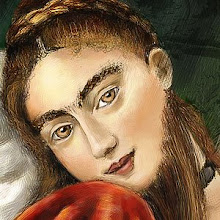
 Then there is the story of the Princesse de Lamballe’s murder (shown on the right) –a well-documented event with many first hand accounts. They also basically repeat the same grisly details – tortured and murdered, head on a pike, paraded in front of Marie Antoinette etc. etc. I have yet to find a single eye-witness that mentions Marie ever being there. Kate Bertridge poses many of these questions in her fascinating book - why did the angry mob want a wax effigy of the Princess as a memento? Why not take a lock of hair? Hmmmm suspicious.
Art Inspires Life or Life inspires Art
The ghastly realistic heads modeled from Marie Antoinette, Louis XVI, Robespierre, and Madame Lambelle can be found in Madame Tussaud’s Chamber of Horrors in London today (shown below). In Marie’s memoirs she claims that she would take her bag of sculpting tools and tip toe into Madeline Cemetery to pick through the rolling heads. During her work, members of the National Assembly stood over her as she was forced to make wax molds from the decapitated victims that she once knew personally. The image of Marie forced into her profession, a victim of the revolution herself, certainly casts her in a sympathetic light. Unfortunately, the truth may not be as tragic.

At the time, an unconfirmed rumor existed that the executioner Charles-Henri Sanson was proffering Revolutionary heads for Curtis and Marie for a fee. Supposedly, Curtis would make wax molds from the purchased heads and then return them to trunks in the Madeline cemetery. It wouldn’t be the only example of Sanson profiting from revolutionary relics. One of Sanson’s ingenious marketing ventures was to sell the fat from the guillotined corpses as a cure for rheumatic pains. After the death of King Louis XVI, he also auctioned off the dead king’s hat and had a profitable business in buttons and locks of royal hair. Selling these items were the perks of being an executioner and were well in the rights of the executioner, but the king’s body was an entirely different story.
Authorities were so careful about destroying the king’s remains that they used a double dose of quicklime to decompose it. One layer of quick lime would have really got the job done, but The National Assembly wanted to make sure that relics of the king were not made. They even ordered all of the king’s possessions from the Temple to be burned. So how did Marie creep into Madeline Cemetery to make a mold of the king’s head when authorities were taking every means possible to destroy any memory of the monarch? Was Marie really a shrewd businesswoman who profited from an illegal racket of decapitated heads? We will never know the truth, but the fact that authorities were so adamant about destroying royal remains is a curious contradiction to Marie’s version of events.(2)
 The Guillotine that killed Marie Antoinette
The guillotine located in the Chambers of Horrors today claims that it is the original knife that lopped off Marie Antoinette’s head, but these claims cannot be confirmed. The original catalog listing describes this relic as, ‘purchased by Madame Tussaud herself, together with the lunette, which held the victim’s head in position and the chopper which the executioner kept at hand for use should the guillotine knife fail. The executioner, Sanson vouched for the authenticity of these articles and gave them to his grandson.’(3)
Executions were a family business to the Sanson family and Charles-Henri Sanson passed down the trade to his son, Clement-Henri. After the revolution, it was obviously a lot harder to find work as an executioner and Clement-Henri fell into debt. He tried to remedy his solvency by opening up a bawdy Chamber of Horrors in the Sanson home. Unfortunately, the home-based chambers of horrors just didn't have the same ghoulish appeal as the real thing. For one, Sanson tried using the famous guillotine to decapitate unfortunate sheep. Most people were not amused. He then tried to sell the "national razor," but was unsuccessful finding a buyer. The guillotine and symbol of radical bloodshed soon disappeared. 4 Clement-Henri did sell the original plans used to make the guillotine to the Tussauds and from those plans a replica was made. Most likely, the original guillotine was destroyed by the Justice Ministry after the Revolutionary fires cooled. Keeping the guillotine would have been tantamount to Americans preserving slave ships. I find it hard to believe that it wouldn't have been destroyed.
 Pals with Josephine and Napoleon
Marie claims that she was in La Forte Prison at the same time as Josephine, but no record exists of Josephine being imprisoned there. (She was imprisoned in Carmes prison.) In fact, no records exists of Marie ever being imprisoned there either. Marie even goes so far as to say that her friendship with Josephine secured her an intriguing assignment making a life mask from Napoleon Bonaparte. The wax model of Napoleon became the most popular exhibit amongst the British who viewed Napoleon as more myth than man. This story seems absurd when we remember that Napoleon was a man who could never sit still. He dictated to his artists the pose, the props, even the frame of the painting. He left nothing to chance. Jacque Louis David begged him to pose for a formal sitting and Napoleon always refused. So it seems odd that he would sit for wax being poured on his face when he wouldn’t sit for a state portrait.
 Napoleon certainly had a utilitarian appreciation for wax sculpture. In 1796, he purchased models from the famous wax anatomical sculptor, Felice Fontana to be used in anatomical studies for his army surgeons. In 1806, he even set up a school in Rouen to teach artists the art of wax modeling. (4) With his usual quest for knowledge, especially knowledge that would help in his military campaign, Napoleon valued wax as a teaching medium. But as art….wax held less allure for the pragmatic emperor.
More slippery than a ball of wax.
Marie’s memoirs become problematic when these incongruities are exposed. For one, if she lied about people she knew and events…what else did she lie about? Do we throw the whole memoirs out or choose to believe some of it? I will confess that I am being hard on Marie. Her memoirs do provide a first hand account into a very dramatic period in history and we must also remember that Marie’s legacy was born out of the dime museum era in entertainment. This was an age when P.T. Barnum displayed the first “Fejee Mermaid” - captured off the coast of Fejee island and Joice Heth - a women over 160 years old. A good hoax was an art and deception was part of the entertainment. In other words, audiences knew that they were being tricked and that was half the fun. Marie indulged in the same humbug as her fellow showman while blurring the line between entertainment and history. So we must take her memoirs with the proverbial grain of salt and remember that Marie Tussaud was a showman first and a historian second.
 What do you think about Marie’s account of history? How much of it should we believe? And I will pose a deeper question for the more philosophically inclined – is the modern day Madame Tussauds a reflection of who we revere in society today? You certainly won’t find firefighters, police officers, teachers or even many examples of royalty drawing crowds to Madame Tussauds.
Notes:
(1) Bertridge. p. 113
(2) Pilbeam p. 62,
(3) Bertridge. p. 132.
(4) Pilbeam p. 109
Sources and Further Reading:
Tussaud, Marie. The Memoirs of Madame Tussaud, Saunders and Otley, 1838. Bertridge, Kate.
Marie Tussaud: A Life in Wax, New York, NY: Harper Perennial, 2007.
Pilbeam, Pamela. Madame Tussaud and the History of Waxworks, London and New York: Hambledon & London, 2003.
Madame Tussaud and Sons' Exhibition, Biographical and Descriptive Sketches of the Distinguished Characters which Compose the Unrivalled Exhibition and Historical Gallery of Madame Tussaud and Sons ... G. Cole by W.S. Johnson, 1866
Time Magazine, Heirs of the Widows, Monday October 15, 1951
Chateaubriand, FrancÌois-ReneÌ, The memoirs of Chateaubriand, New York, NY: Knopf, 1961.


 A “hands on” Worker
