.jpg) Welcome to our guest blogger, author Susan Holloway Scott. Take it away Susan....Meet the “Merrie Monarch”: King Charles IIBy Susan Holloway Scott
Welcome to our guest blogger, author Susan Holloway Scott. Take it away Susan....Meet the “Merrie Monarch”: King Charles IIBy Susan Holloway ScottTired of the Tudors? Had enough of Henry? Do I have another English king for you! Charles II (1630-1685)was a monarch so intriguing, so charming, and so historically hot that he doesn’t need Jonathan Rhys Meyers to boost his reputation.
Like all heirs to thrones, Charles II was welcomed into the world with fireworks and ringing church bells. He had an idyllic childhood, even for a royal prince: his father, Charles I, was an unusually devoted father, his mother adored him, and he’d six brothers and sisters to round out the close-knit family. There were trips to the menagerie at the Tower of London, portraits painted by Sir Anthony van Dyck, (shown below) and junkets on the Thames on the gilded royal barge.

But while Charles I was an excellent father, he was a miserable king. Hopelessly out of touch with his people, he tried to force an absolute monarchy on an unwilling Parliament. A long and bitter Civil War began in 1642, ending eventually in the trial and beheading of Charles I in 1649. In his place, a conservative army general, Oliver Cromwell, was made Lord Protector to rule with Parliament.
The nineteen-year-old Charles barely escaped to the Continent. Though nominally now Charles II, he was a king without a throne or a country, and perhaps more importantly, without any money. His mother and his younger brothers and sisters were scattered about various royal courts, poor relations that wore out their welcome. Charles himself became a wandering pauper-king in exile, his circumstances so straitened that he wore darned stockings, gave away his beloved dogs, and could only afford to dine on meat once a week.
Back in England, life under the Puritans was equally grim. In an effort to “purify” the country of its excesses, almost everything that was fun was outlawed by Parliament. Maypoles were burned, music, dancing, and theater forbidden, bright-colored clothing became illegal, and holidays scratched from the calendar. Church-going was about all that was permitted, and the Puritans made sure there wasn’t a scrap of pleasure there, either, smashing centuries-old stained-glass windows and forbidding music.
But by the time of Cromwell’s death in 1659, the English had become thoroughly weary of their Puritan Parliament. In retrospect a king didn’t seem so bad at all, and Charles was invited back. His return to the English throne gave his reign its name –– the “Restoration” –– and he was greeted with wild rejoicing and celebrations.

Riding into London on a white horse on his thirtieth birthday in 1660, Charles dazzled his people like a modern Hollywood star. He was tall (6’2”), dark, and handsome, lean and athletic and full of boundless energy. He wasn’t fair-haired-English-handsome, but favored his Italian grandmother, Marie de’Medici, with heavy-lidded, dark eyes, a sensual mouth, and long, black, curling hair. He was intelligent and well-spoken with a dry wit, and his own sufferings made him peculiarly sympathetic to his people, with a genuine kindness rare in kings. He had an appealing air of melancholy; in best RAUCOUS ROYALS tradition, the king known to posterity as the “Merrie Monarch” was in fact not very merry by nature (who can blame him?), but he surrounded himself with outrageously amusing friends that ensured his court was THE place to be.
That wasn’t all. Unlike most vengeance-crazed monarchs, Charles generously pardoned everyone except the men who’d signed his father’s death warrant, resulting in a country-wide sigh of relief. He brought back music, dancing, flirting, Christmas, and Maypoles. He reopened the theatres, and for the first time in English history, permitted actresses on the stage. He loved pretty women, fast horses, and dogs of every description. After a decade of Puritan dreariness, once again everyone began to dress to impress, and big-time partying was back in fashion. Was it any wonder that Charles was instantly, wildly popular?
And why not? While his cousin across the Channel, Louis XIV of France, kept himself aloof and distant in his grand palace at Versailles, Charles was always in the thick of things. He appreciated London all the more for having been exiled from it, and with a freedom that would horrify Secret Service agents today, he enjoyed the city like any other Londoner, and was infinitely accessible, even to his most humble people.

Every morning he rose early and walked briskly through St. James’s Park with his dogs (the King Charles spaniels so popular now are named after him) and any one who could keep pace with his long legs. He attended the theater as often as he could, cheering and jeering and buying over-priced fruit from the orange girls along with everyone else. He fed the ducks and swans in the park. He regularly swam naked in the Thames, even in the winter, and didn’t care who watched.
As one of his friends and part-time poet John Wilmot, Earl of Rochester (yes, the same Rochester played by Johnny Depp in the movie Libertine) noted with approval: “Nor are [the king’s] high desires above his strength/His scepter and his p**** are of a length.”

When London was devastated by the Great Fire in 1666, Charles didn’t simply do the 17th century version of a fly-over to survey the damage: he joined the bucket brigades, fighting the fires himself. His intellectual curiosity led him to keep a scientific “closet” in the palace for puttering about with chemicals and curiosities like two-headed snakes. An excellent horseman, he would ride in races with the professional jockeys at Newmarket, and often win from his skill and daring, not because he was the king. Afterwards he would drink with the jockeys and grooms, enjoying being a regular guy. Following a formal court reception, he’d shed the silk and ermine, change into plain clothes, and go carousing in low-rent rum shops and brothels with friends, often not coming home to the palace until nearly dawn.
Ah, the brothels. For while Charles didn’t swear, smoke, or drink or eat to excess (unlike Henry VIII, he remained flat-bellied and athletic until his death), he did have one enormous vice: he loved, loved, loved women, and women loved him. Though he often made fun of his own appearance, he was by all reports incredibly attractive to the opposite sex. From high-born ladies to lowly milkmaids, women of every rank found him pretty near irresistible. It wasn’t just that he was king, either, or a matter of royal conquest by that good-sized scepter. Charles genuinely liked women, particularly clever, amusing women who could entertain them with their wit as well as in his bed, and they clearly returned the favor many times over. Many, many, many times.


No one knows the exact number of women Charles had sex with in his lifetime. It was not uncommon for him to call upon one mistress in the afternoon, visit his queen’s bed in the evening, frolic with another mistress after that, and then wind up the night at a brothel. The man famously required almost no sleep. In addition to his wife and queen, Catherine of Braganza, (shown left) he kept three main mistresses over the course of his reign: Barbara Villiers Palmer, Duchess of Cleveland (shown right), a hot-tempered, passionate lady that he’d first met in exile; Nell Gwyn, (shown below left) a common-born actress who entertained him with her impertinent wit; and Louise de Keroualle, Duchess of Portsmouth, (shown below right) a luscious French-born virgin sent as a gift (and a spy) to Charles by his cousin Louis XIV. These were the women rewarded with titles, houses, estates, incomes, and jewels, and political power. There were far more who only received the pleasure of the royal person, and perhaps a coin or two besides.


Unlike Henry VIII, Charles never sent any of his lovers to the chopping-block. Instead he managed the rare trick of remaining friends with his mistresses even after they’d ceased their mistress-ly obligations, and all of them evidently stayed in love with him. (Both Nell Gwyn and Louise de Keroualle remained faithful to his memory, for neither took another lover after his death –– though Louise outlived him by 50 years.) Even his homely little queen loved Charles dearly despite his raging infidelities, and though he was repeatedly urged to set her aside when she proved barren (shades of Henry!) he refused to shame her with a royal divorce.
The greatest irony of Charles’s reign is that while he sired fourteen natural children (!) that he acknowledged with titles, his queen never bore him a legitimate son and heir. While most of the noble families of Britain today can count Charles as an ancestor (Diana, Princess of Wales, Camilla, Duchess of Cornwall, and Sarah, Duchess of York are only a few of his descendents) at his death in 1684, Charles’s crown passed to his incompetent brother James, and the Glorious Revolution of 1688 followed soon after.
Of course Charles wasn’t perfect. He was often at odds with his Parliaments. His relative poverty as a king led him accept secret subsidies from the French, and his attempts at wars on the Continent were costly and unproductive. His Roman Catholic leanings were worrisome for the nominal head of the Anglican Church. His constant need for activity and his wandering inattention to detail would today probably be diagnosed as some form of ADD; his contemporaries simply called him lazy. Later historians, particularly the Victorians, were so repulsed by his promiscuity that they overlook his other qualities, and wrote instead of him “lolling idle” on his throne.
But to the people he ruled, Charles was their much-loved and very human king, and at his death the country was plunged into grief-stricken despair. If there had been political approval ratings in the 17th century, Charles’s would have been off the charts. He unified a country torn by civil war, restored its economy, and placed England firmly on the world stage. What’s a mistress or two compared to that?
 Susan Holloway Scott freely admits to having spent way too much time in the company of Charles II, who appears in all four of her historical novels. Her next book, The French Mistress, features both Charles and his mistress Louise de Keroualle, and will be released in July. Susan will return next month to dish more on Charles, Louise, and the other royal mistresses – and to give away a copy of The French Mistress.
Her website: http://www.susanhollowayscott.com/







.jpg)


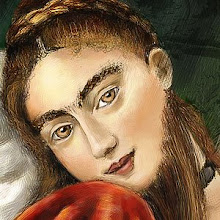
 Sometimes little embellishments like paint, eyelashes and hair were added to create a more idealistic representation as can be seen in Mary Queen of Scots’ death mask shown here.*


