Showing posts with label Leonardo da Vinci. Show all posts

Wednesday, March 10, 2010

Who is the Old Duchesse?

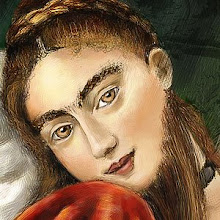
People have often wondered who is portrayed in Leonardo's sketch, The Old Duchesse  (shown below). Some art historians believe the woman might have suffered from Paget's disease. Others believe that the drawing is meant to satirize a woman beyond the prime of her youth. Another theory is that she is a real person - a portrait of the Duchess Margarete of Tyrol-Görz, who was known as Maultasch, ("bag mouth"), which means "whore" or "ugly woman". (because of her marital scandals).

The Beauty in Ugly
Leonardo's drawing has been a big inspiration for me to paint the ugly as beautiful. Although this woman is certainly not The Pretty One there is still something undeniably beautiful about her. I love the way she is all gussied up with her breasts corseted and her hair in the horned hairstyle that had become so popular at the time. This woman may look ugly to us but she certainly doesn't feel ugly. It's a subject that I am exploring in my next book. More on that later...
Quentin Matsys painted The Grotesque Woman based on Leonardo's sketch.

And that served as a basis for John Tenniel's depiction of the Duchesse in Alice's Adventures in Wonderland.


I found this great post on the origins of some of the other characters in Alice in Wonderland from Jennifer over at Rambling, Rants and Other Random Nonsence

Sources and Further Reading:
Eco, Umberto On ugliness. New York, NY : Rizzoli, 2007

Wednesday, March 3, 2010

Me Me Me. It's all about me.

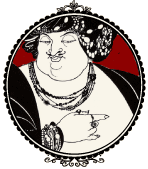
Several people have told me that the Bearded Lady, Annie Jones from my book Who put the B in the Ballyhoo? looks like me. I like those people. She is obviously quite a vixen.

Other people have said I look like my unflattering portrayal of Anne Boleyn from The Raucous Royals. I don't like those people as much.


And when my husband first saw the image of Babe Ruth, (The Fat Lady), he said that she looked just like me. I didn't speak to him for days.

But he was right. She does look like me. In fact, every face I paint looks a little like me. I paint me everywhere. Sheeeesh... I must be one of those narcissistic crazies. 

Or maybe all artists paint themselves in portraits? And I found this GREAT site (The artscholar.org)  to proove it.

Below is Titian's portrayal of Pope Paul III. They could be twins.


Did Van Eyck marry his sister? I doubt it.


And this is why art scholars who say the Mona Lisa is a self-portrait are just not getting it.

There is also a section on the site that has different portraits of Napoleon. Every artist made Napoleon look just a little like the artist. What do you think?

Sources:
Art from Who put the B in the Ballyhoo? and The Raucous Royals
Portrait comparisons from the Art Scholar

Wednesday, November 18, 2009

Raucous Rumor of the Month: Did Leonardo da Vinci die in the arms of King Francis I?


In 1818, Ingres captured the poignant moment of Leonardo’s death in the arms of his patron, Francis I. In the painting, the forlorn king cradles an aged Leonardo in an intimate lovers embrace as a distraught figure (believed to be Leonardo’s assistant Melzi) dramatically gestures toward the deathbed. The scene is so intense that critics of the time felt that Francis looked like he was suffocating Leonardo. (I think he looks more like he is about to lay a wet one on him.) It certainly is an emotionally charged scene and one that would inspire other artists such as Cesare Mussini in 1929 (shown below). But does this painting really capture Leonardo’s death or was it just another tall tale passed down through legend? Let's trace the history of this rumor...

Following the death of his patron Giuliano de’Medici, Leonardo left Italy and came to France in 1516, at the age of 64. In France, he spent his final years in the manor of Clos-Luce near Ambroise. Despite the fact that his hand had become too crippled to paint, Francis and Leonardo enjoyed a lively and respectful friendship discussing architectural projects, philosophy, engineering and art to all hours of the night. (Imagine being a fly on the wall for one of those conversations?) According to Benvenuto Cellini, Francis, “did not think that any other man had come into this world with more knowledge than Leonardo.” (1) The king so admired Leonardo’s art that he even attempted to have The Last Supper transported to France. If walls had not proved so hard to move, Milan might have lost its national treasure.

After many crippling months of sickness, Leonardo da Vinci died on On May 2nd, 1519 at Ambroise. A contemporary description of Leonardo’s death was left by Vasari in his Lives of the Most Excellent Painters, Sculptors, and Architects:

The king, who was accustomed frequently and affectionately to visit him, came immediately afterwards to his room, and he, causing himself out of reverence to be raised up, sat in his bed describing his malady and the different circumstances connected with it, lamenting besides that he had offended God and man, not having worked in art as he ought to have done. He was then seized with a violent paroxysm, the forerunner of death, when the king, rising and supporting his head to give him such assistance and do him such favour as he could, in the hope of alleviating his sufferings, the spirit of Leonardo, which was most divine, conscious that it could attain to no greater honour, breathed its last in the arms of the king. “(1)

Vasari probably heard the death bed tale from Melzi, but Melzi does not mention such a scene in any of his surviving letters. Would Vasari invent a story just to be more colorful? Perhaps. Vasari certainly did his share of gossiping, but his biographies are one of the few contemporary art history works of the Renaissance that we have today.*

The legend of Leonardo’s death continued into the reign of Louis XIV when the French Chronicler, Andre Felibien wrote:

“...the king having been to visit him during his illness, he wished to half raise himself in bed, and that, desiring to express to the king his deep feeling of the honour His Majesty did him, he failed in his speech and expired in the arms of the king. "(3)


Many historians have argued that Francis could not possibly have been at Ambroise for Leonardo’s last breath because the king had issued an Order in Council from Saint-Germaine-en-Laye one day prior. But Mrs Charles Heaton makes a valid point that this proves nothing because an Order in Council was often issued in the king’s absence and signed by the secretary of state.

Unfortunately, we will never know for certain who was present at Leonardo's death. Art critics have categorized Ingres' painting as an example of artistic hegemony meant to symbolize that the great master had come home to his true resting place – France. But even if the painting does not depict Leonardo’s death accurately, the emotions it captures on losing such a extraordinary artist and inventor are certainly genuine.

* In one on his biographies he tells an amusing tale of Giotto di Bondone who painted a fly on the surface of a portrait that looked so real that his older master, Cimabue repeatedly tried to brush it away. (this tale has now been doubted by art historians but it seems to me like the kind of hijinx that Giotto might get himself into).

Notes:
(1)Knecht, P 173
(2)Heaton, p. 192
(3)ibid

Sources and Further Reading:

Knecht, Robert J., The French Renaissance Court 1438-1589, New Haven: CT, Yale University Press, 2008.
Heaton, Charles, Leonardo da Vinci and his works: consisting of a life of Leonardo da Vinci, MacMillan and Co. 1874.
Stanley, Diane. Leonardo da Vinci, New York: NY, Harper Collins, 2000.

Thursday, July 30, 2009

Raucous Royal of the Month, Cecilia Gallerani (1473 – 1536)

When the Italian court poet Bellincioni first laid eyes on the Leonardo da Vinci’s Lady with an Ermine he declared;

“…the more living and beautiful Cecilia shall appear in the eyes of generations to come, the greater will be thy glory! For long as the world endures, all who see her face will recognize in Leonardo’s work the close union of Art and Nature.”(1)

Bellincioni’s praise stands true today, but who is the woman who went on to become Mona Lisa’s greatest rival? Although some debate continues about the sitter’s identity, most art historians have identified the woman as Cecilia Gallerani, the beloved mistress of the duke of Milan and Leonardo’s greatest patron, Ludovico Sforza(shown here). Cecilia was only a teenager when she sat for this painting, but had already secured her status as a student of classical studies, a poet, musician, singer and renowned beauty.

As the dress of the painting indicates, Cecilia Gallerani was not of nobility, but her father held several prominent positions at court. Ludovico had Cecilia installed in a suite of rooms in the Castello of Milan and court gossip indicated that he intended to make her his wife. Unfortunately, legitimizing their affair would have severed any strategic alliances for Milan and the smitten duke was not willing to let his heart rule matters of state. Instead, he married the equally alluring Beatrice d’Este, Duchess of Ferrara in January of 1491 (shown below)(2).

Ludovico most likely expected Beatrice to be another acquiescent wife and turn a blind eye to the affair, but his new wife proved far too spirited to tolerate any competition. Beatrice was so jealous of Cecilia that she even refused a magnificent gold robe from her husband because his mistress had once worn a similar robe. Debate still exists on whether Leonardo ever painting Beatrice’s portrait but we might infer that Beatrice refused such an honor because it had already been tainted by the memory of the great Maestro painting her rival.(3)

After many jealous tirades, Ludovico ended his affair with Cecilla, but continued to provide for her and their son Cesare. He arranged a prominent marriage for her with Count Lodovico Bergamini and provided a sumptuous trousseau along with a villa near Cremona. It was here that Cecilia continued to entertain some of the most learned minds until her death in 1536.

We are left with a curious letter that reveals Cecilia’s modesty in her later years. In a letter to Beatrice’s sister, Isabella d’Este, she tells Isabella that the portrait painted by Leonardo, “was painted when I was still at so young and imperfect an age. Since then I have changed, altogether, so much so that if you saw the picture and myself together, you would never dream it could be meant for me!” (4) Cecilia’s beauty may have not held the test of time, but her portrait certainly is a testament to Leonardo’s genius.

Sources:
Cartwright, Julia. Beatrice d'Este: Duchess of Milan 1475-1497, London: J.M. Dent & Sons, Ltd, 1910

Notes:
(1) Cartwright, Kindle Location: 1129-35 or p. 53
(2) It is still not know if the portrait of Beatrice d'Este is truly her.
(3)
Cartwright, p. 91
(4)Cartwright, p. 54

Thursday, July 16, 2009

James IV's Flying Alchemist

Since the first caveman flapped his wings like a bird, men have dreamt of flying. This dream has led to many fools jumping off precipitous cliffs decked in bird feathers. Everyone has probably heard the Greek myth of Daedalus and his son Icarus who lunged from their tower prison wearing feathers held together by wax and twine. All would have gone smoothly if Icarus had quit the horseplay, but when do you ever see a flying boy listen to his dad? That naughty Icarus flew too close to the sun, melted his wings and fell into the ocean. The lesson was clear: aim to high and you just might find yourself plummeting to your death. The Italian Mathematician, Giovanni Battista Danti didn’t quite learn this lesson and was convinced a few feathers and some determined flapping would make him fly like superman. Unfortunately, his attempts only landed him on the roof of Saint Mary’s Church.

Other men claimed to be more successful. In the middle ages, a monk named Elmerus was rumored to fly from the top of a tower in Spain. Supposedly, the great astronomer and mathematician, Regiomontanus invented a mechanical eagle which flew across the channel to greet Charles V. These tales seem unlikely, but there were some inventors who may have realized the dream of flight.

The Flying Chariot
In the 13th century, scientist and philosopher Roger Bacon was rumored to have designed a "flying chariot.” Bacon believed that a copper globe would rise upward if it were filled with something lighter than air. In essence, Bacon understood the mechanics of hot air balloons five centuries before his time.

The Flying Maestro
Leonardo da Vinci's treatise on the art of flight is probably the most famous example of early aviation studies. For over sixteen years, Leonardo worked under the patronage of Ludovico Sforza, the Duke of Milan. (Ironically, his official title was not the duke’s painter but “the duke inventor”).

Along with art commissions, Leonardo designed military equipment such as crossbows, catapults, lightweight bridges, cannon, armored vehicles, and poured his genius into fantastical flying machines (shown here). But Ludovico seemed unimpressed with Leonardo’s flying machines and worried more that the great Maestro would kill himself before completing the bronze equestrian monument to honor his father. We still don’t know for certain if Leonardo ever built his flying machines, but a few years later there was one man brave enough to take the plunge…

The Flying Bird Man
John Damian was a surgeon in France before moving to Scotland around 1507. He then began his career as alchemist to James IV with the promise that he would discover the philosopher stone—the elixir to life. Damian’s experiments merely required copious amounts of aqua vitae, an aqueous solution of ethanol (aka whisky). Damian failed to discover the elixir to life, but must have got plenty drunk trying…or at least drunk enough to jump off the west parapet of Stirling Castle in a hen suit.

Predictably, Damian’s tale does not end well. His makeshift hen wings carried him for about a half a mile until he descended ignominiously into a pile of dung and broke his leg. Many historians have argued that because his flight did not end with him falling to his death in the rocks 75 meters below Stirling Castle, he was technically the first man to fly….or at least the first man to hang glide in a hen suit.

Damian never attempted another flight, but he did claim that he knew the reason for his failure. He should not have used hen feathers because they were obviously attracted to dung. I find this entirely plausible considering that hens are not too bright. Unfortunately, the theory only got him laughed out of the aviation business by everyone at James’ court. Damian then spent his final years with the far more rational goal of turning base metals into gold. We can guess how that turned out.

Sources and Further Reading:
The Times: Was 16th-century Scots alchemist the first man to fly?

The Daily Mail (London, England), The Flying Scotsman First; Leap of Faith: Abbot John Damian Threw Himself from Stirling Castle Bumpy Landing The Possible Route of the Abbot's First Flight, September 6, 2008.

Macdougall, Norman. History Today, The Kingship of James IV of Scotland - 'The Glory of All Princely Governing'?, Volume: 34 Issue: 11 November 1984 Page 30-36

Wells, George. The War in the Air. BiblioLife, 2008