







Showing posts with label Alexander VI. Show all posts

Tuesday, October 12, 2010

The Fashionable Prostitute: Part 2


Rated R for Raucous Content

On the evening of October 30th 1501, Johanna Burchard made his way through Rome’s windy streets and followed the smell of roasting pig flesh and warmed chestnuts wafting out of the Vatican Palace. As Master of the Ceremonies, he was expected to attend every fete hosted by Pope Alexander VI and his son Cesare Borgia, but he had grown tired of the endless parties. Night after night, the Borgias celebrated the forthcoming marriage between the pope’s daughter, Lucrezia and her betrothed, Alfonso d’este.

As Burchard entered the dimly lit apartments, the low sounds of swishing velvet enveloped him as fifty beautiful courtesans beckoned him inside. Pearls, rubies and emeralds coiled around their necks and down their low cut gowns like overgrown vines strangling a tree. Rubbing his tired eyes, Burchard recognized the sumptuously dressed blonde, known as Fiammetta, strumming her lute above the banquet table. She was Cesare’s mistress and was rumored to be so rich that she had commissioned an entire fresco to be painted in the church of S. Agostino. Across the room a plump, golden haired beauty with reddened earlobes sang before her admiring crowd, demurely lowering her eyes to see who was watching. She was known as Imperia, the most beautiful women he had ever laid eyes on and the cherished muse of Raphael.  The rest of the women were nestled in corners flirting with Rome’s finest nobleman, only occasionally lifting their heads to let their silver bell laughter fill the room.

These women were not your typical meretrici (prostitutes), but members of a ruling class called cortigiana (courtesans) and they were not just beautiful ornaments, but educated in art, music, dance, poetry and most importantly, conversation. Yet, if we are to believe Burchard’s account, their greatest talents were in the art of making love. In the darker pages of his diary, Burchard writes:

 “After supper the lighted candelabra which had been on the table were placed on the floor, and chestnuts thrown among them which the prostitutes had to pick up as they crawled between the candles. The Pope, the Duke and Lucrezia, his sister, were present looking on. At the end they displayed prizes of silk mantles, boots, and other objects which were promised to whomsoever should have made love to these prostitutes the greatest number of times. The prizes were distributed to the winners according to the judgement of those present.”(1)

Understandably, the pope failed to make it to mass the next day.

Burchard (who was no friend of the Borgia) is the only person to relay such louche details so historians have long wondered if the famous “banquet of the chestnuts” is perhaps a little exaggerated. Still, we can imagine that your typical Borgia get-together probably did not have the pin the tail on the donkey type of party games.  We also can only guess at who attended this infamous orgy. Cesare, Lucrezia and Alexander were there, but we do not know if their famed mistresses attended. One thing is for certain. Any party thrown by the diabolical Cesare Borgia would have had the most desired women at his beck and call. 

The reign of the Borgias was the golden age for courtesans. Wealthy courtesans rode through the streets throwing gilded eggs filled with rose water or coyly sang from their windows down to their admirers below. Prostitution became so ubiquitous that Pietro Aretino’s  (best remembered for his contributions to the Book of the Prick) cantankerously observed that “Rome always has been and ever will be….the town of whores.” 

Aretino’s views may have been colored by his animosity toward the Romans after he was forced to flee Venice. Rome was certainly not the only city where prostitution was rampant.  Venice especially became celebrated for the classical beauty of their art, architecture and women. Estimates vary, but there were roughly 11,000 prostitutes servicing 300,000 inhabitants.

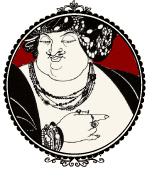
With so many prostitutes and courtesans, how could a typical traveler tell the difference between a puttana (whore) and respectable matrona (married woman)? Your lower class courtesans were usually easier to spot.  They dressed like men wearing braghesse (codpieces) and dresses cut so low that it revealed their breasts. Most fantastic of all were the shoes.  Venetian prostitutes wore shoes that would have intimidated even the most daring super models of today. Called pianelles, they were made of wood and elevated the wearer as much as a foot above the ground. You can see from the picture above that navigating a dirty street would be next to impossible without the help from a suitor or two.   

Your higher priced onesta cortegiana (honest courtesan) dressed so well that it would often be very difficult to tell them apart from the rest of patriarchal society. This was a problem not just in Venice and Rome, but throughout Italy. It was especially problematic when they attended mass. You have to remember that church was the fashion runway of the day and often the only chance most women got to show off their wares. So we can imagine that if you were a respectable noble woman and some hussy pranced by you wearing more glitter than a Christmas tree that it would start to unnerve you. Eventually, the class wars led to the upstanding socielities of Florence to put pressure on the Grand Duke to enact sumptuary laws for all courtesans. Prostitutes were not allowed to wear gold, silver, gemstones, or silk. That meant no fancy pearls. (This led to the practice of prostitutes flashing their necks to show that they were unadorned.) Florence’ prostitutes were also required to wear a yellow veil with a big, tacky yellow stripe on it known as “the whore’s mirror.”  If you wanted to find a prostitute in Florence, you just had to follow the yellow stripes like a road map.

Now dear reader, in these tough economic times, I hope you can relate to the sentiment that everyone has to make a living. Telling a courtesan that she can’t wear her pearls is kind of like telling a fire fighter he can’t use a hose.  Most courtesans simply ignored the sumptuary laws or were granted special dispensations to dress as they please. Such was the case with famed courtesan and prolific writer, Tullia d’ Aragona  who pulled a few “favors” from the Duke and was allowed to dress like a noblewoman.  As educated women and skillful conversationist, most courtesans sought to distance themselves from the common prostitutes. Lucieta Padovana was indignant regarding the sumptuary laws arguing, “non reptandose meretrice” but instead a “cortesana” (2). (Basically…I am not some common prostitute. I am a courtesan. Big difference. )

Still sumptuary laws persisted and often became difficult to keep track of. In Florence, prostitutes were required to wear gloves, wooden high heels, and a bell on her headpiece (assumingly so everyone could hear her siren jingle coming.) In Bergamo 1490, a saffron colored scarf was required. In Piedmonth, they had to decorate their headgear with horns.  In Milan, they were required to wear white in 1492, black in 1498, white again in 1541. You could see how all of this would get confusing for the common traveler. As they say, necessity is the mother of invention, or at least it was for Crispijn de Passe the elder whose best seller, the Miroir (1603) became the defacto guide for seeking out fashionable courtesans.

to be continued in Part 3 of the Fashionable prostitute…


Notes:
(1) Bradford, p. 121
(2) Rosenthal, p. 72


Sources and Further Reading:
Bradford, Sarah. Lucrezia Borgia: Life, Love and Death in Renaissance, Penguin 2005
Rosenthal, Margaret. The Honest Courtesan, University of Chicago Press, 1993
Rosenthal, Margaret F. and Jones, Ann Rosalind. The Clothing of the Renaissance World, Thames and Hudson, 2008

Sunday, May 9, 2010

Raucous Royal of the Month, Caterina Sforza: Daughter of Perdition


"...more is always said then the real truth"
- Caterina Sforza


On August 1483, the 21 year old Caterina Sforza rode up to the Castel Sant’ Angelo as shouts of “Duca! Duca!” cut through the stifling heat. Clad in a green satin dress with two yards of fabric flowing behind her, a long black cape, and a curved falchion (sword) in her clenched fist, she looked like an avenging angel sent from the underworld. The people of Rome pushed and clamored to get a glimpse of the golden-haired warrior princess who had held the city of Rome for thirteen days against her enemies’ opposition. Weeks earlier, Pope Sixtus IV had died and the Eternal City had erupted into chaos with mob riots and warring families trying to cut each others throats. Her husband, Girolamo Riaro, had met the turmoil by hightailing it out of Rome, but Caterina had bravely ordered the garrison to defend the city and galloped out on horseback in the midst of melee.

To the people of Rome, she was the vision of strength, courage and Sforza determination. She was also 7 months pregnant.


Caterina Sforza was born in 1462 as the illegitimate daughter of Galeazzo Maria Sforza and Lucrezia Landriani. She was given a humanist education along with learning hunting and the martial arts skills which would become so feared that one contemporary wrote, “when she had a weapon in her hand, she was hard and cruel.” (1) She most likely learned brutality from her father who once executed a poacher by having him swallow an entire hare including fur. With another, he had him nailed to his coffin....alive. One of his favorite past times was to visit the local convents at night and rape the nuns. Over time, Galeazzo's actions tended to garner him a few too many enemies in high places and in 1474, he was assassinated by the Visconti.

Three years later, Caterina married Girolamo Riaro, nephew (wink wink) of Pope Sixtus.* As long as Sixtus was in power, Caterina and Girolamo were treated like the Hollywood golden couple. Girolamo was elevated to the Lordship of Forli while he lived amongst the decadence of Rome. Meanwhile, Sixtus was in the process of remaking Rome as the envy of the world. Work had just begun on the Sistine Chapel (named after Sixtus) along with several other construction projects of new churches, bridges and streets. Art flourished.  The Vatican Library was founded. Rome had become the place to be.  It was also a cesspit of corruption with a few strong families tenuously holding on to power through nepotism and simony. (The term nepotism comes from the Medieval Italian word for nephew- nepote.)

Then Sixtus died in 1484. The glory days for Caterina were over. Pope Innocent VIII was elected and as a token bone for getting kicked out of Rome, he let Caterina and Girolamo keep Forli to rule. The denizen of Forli didn't exactly appreciate the gesture. After enduring months of tax increases, the opposing Orsi family threw Girolamo out a window. They then took Caterina’s six children as hostage.

Yet Caterina appeared unfazed by the hostage situation. When the Orsi threatened to hack her children to pieces if she did not surrender the strategic fortress of Rocca di Ravlaldino, Caterina simply lifted up her skirts and told her enemies to keep them because she had the “mold” to make more. This skirt lifting incidence is retold by many biographers including Machiavelli who wrote in his Discourses:

“She reproached them from the wall with the death of her husband, threatening them with every kind of revenge. And to show that she did not care about her children, she uncovered to them her gen- ital members, saying that she still had means for producing more children.” (2)

First hand accounts tend to be less colorful then Machiavelli’s version of events. According to Leone Cobelli who was actually present during the siege, Caterina, simply made “four figs” at her captives. (The four figs was a not-so-nice gesture made by placing the thumb between the index finger and middle finger while making a fist - your Renaissance equivalent of giving someone the finger.) Cobelli fails to mention Caterina lifting her skirts or telling her captives to keep her children.

Other accounts describe Caterina as claiming she was pregnant and that her unborn son would avenge her enemies. (A threat to be taken seriously in Renaissance Italy) One thing is certain. Caterina certainly didn’t fall into weeping histrionics at the sight of her children taken hostage. Was her seemingly apathetic stance a clever bluff or the actions of a heartless mother?

Whichever it was, it worked. With the help of Uncle Ludovico Sforza (il moro) she regained control of Forli and spent the next few years as regent for her young son, Ottaviano. During this time, she brushed up on her alchemy skills, wrote a book of beauty recipes and best of all, devised ways to avenge her husband’s death. She got really creative with the patriarch of the Orsi family, Andrea Orsi. She and had him dragged through the streets tied to a horse’s tail and then ordered his heart cut out and his body dismembered.

Those were fun times for Caterina. When the Borgia Pope Alexander VI took charge, everything went to hell in a handbasket. Citing Caterina's salacious conduct in taking lovers, he ordered that Forli be given to his son, Francescolotto Gibo. (This punishment seems kind of harsh when you consider that Francescolotto was no choir boy.) Then in 1498, Alexander’s son Cesare Borgia struck a deal with king Louis XII where Louis promised to drive out the ruling families of Romagna in exchange for claims to Milan and Naples.

Declaring that 'should I have to perish, I want to perish like a man,' Caterina defended Ravaldino fortress from Caesar and his thugs by using one of oldest Borgia tricks in the book...poison. (3) She sent Alexander some chatty letters that she sealed with a kiss and rubbed on some local plague victims. Unfortunately, her terrorist attack on the Pope failed when spies revealed the plot to Alexander. Cesare promptly had Caterina imprisoned where she was mostly likely raped and tortured. Caterina was release in 1501 and died 7 years later of pneumonia.

Caterina Sforza: The Artist Muse
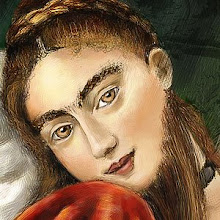
She is immortalized by countless artists including Botticelli in his The Three Graces (Caterina is believed to be the grace in the far right) and also several portrayals of the Virgin and Child. Leonardo was believed to have met her around 1500 and she may have been his model for the Mona Lisa. (There are some slight similarities seen in the paintings below, but most art scholars still credit the sitter's identity to Lisa Gherardini Giocondo. Personally, I don't see the similarities.) Caterina was also good friends with Michelangelo and she became one of the few people he trusted.


Caterina Sforza: The Mother 
Despite being called a  “Virago”, “The Tiger of Forlì” and “Daughter of Perdition” by Pope Alexander VI, Caterina sure was fertile. She had 11 children, popping them out practically every reproductive year of her life. But Caterina is not exactly your Hallmark card mother. While she undeniably had tremendous political acumen, history has also branded her as the uncaring shrew who in a moment of passion, labeled her womb as the artillery in her quest for revenge. I had wanted to include Caterina Sforza in my book The Raucous Royals, but I had to cut her when I realized there was just no way to tackle her skirt lifting rumor delicately enough for a younger audience.

Today, Caterina Sforza is reduced to a buxom action figure in the video game, Assassins Creed with a proclivity for more skirt lifting. It hardly does her any justice. At least in the game she tries to win back her children.

Happy Mother's Day to all my mom readers. And remember if your kids don't worship the ground you walk on today then take a Machiavellian stance and just threaten to whip up another batch.


Notes:
* Girolamo was most likely Sixtus's son. "Nephew" became a euphemism for son in the 15th century.  
(1) Jones,  page 181
(2) Machiavelli, Discourses 3.6, CWO: 444
(3) Fraser p. 201

Sources and Further Reading:
Jones, David E. Women warriors: a history, Potomac Books, 2002.
Fraser, Antonia. Warrior Queens, The Legends and the Lives of the Women Who Have Led Their Nations in War, Anchor, 1990.
Julia L. Hairston, Renaissance Quarterly, Vol. 53, No. 3 (Autumn, 2000), pp. 687-712. The University of Chicago Press on behalf of the Renaissance Society of America
Breisach, Ernst, Caterina Sforza: A Renaissance Virago, University of Chicago Press, 1968

Wednesday, September 30, 2009

Raucous Royal of the Month: Lucrezia Borgia and her many Loves

When you hear the name Lucrezia Borgia, many can’t help but think of the woman popularized in operas and fiction novels as the most infamous femme fatale in history. Rumors abound of the poisons, like La Cantarella, that Lucrezia was quick to dust upon her guest’s foods. In one colorful tale, Lucrezia had a poisoned ring with a hidden needle which she used to prick her enemies and secretly murder them.

Today, we know that the tales of poisoning are complete rubbish, but her family cannot be forgiven so easily. Born the bastard daughter of Pope Alexander VI (Rodrigo Borgia), Lucrezia was surrounded by intrigue and decadence during the height of the church’s corruption. The year she was born, 1480, marked the flowering of Renaissance art and literature, but also a time where it was commonplace for Popes to have concubines and poisoning one’s enemies was considered a gentleman’s way of removing political obstacles. Machiavelli wrote of Alexander VI that he, 'never did or thought of anything but deceiving people. ' Machiavelli was especially fond of Lucrezia's diabolical brother, Cesare Borgia who would later become his role model for political ambition along with the poster child for syphilis.

Even by Renaissance standards, growing up a Borgia was like living a life straight out of the Godfather. Dinner guests had a habit of winding up dead and late night antics often involved a few debauched orgies. And just like true Renaissance godfathers, they epitomized Don Vito Corlione's mantra of “keep your friends close, but your enemies closer.” At the time, Italy was broken up into a bunch of warring city states where the Pope had to form outside alliances quickly and deftly to stay in control. In the heart of these shifting alliances, Lucrezia became a valuable bargaining chip in the marital market. Unfortunately, Lucrezia’s husbands also came with expiration dates. Her family would hitch her to one man, but when the political alliance ceased to serve its purpose, they would find another match more suitable. This left Lucrezia with the helpless title of “pawn” and also made her a few enemies quick to spread rumors.

Bachelor #1
Though careful bribes, Alexander bought himself a pope’s hat in 1492 and soon began looking for a suitable match for his beloved daughter. Lucky bachelor #1 was Giovanni Sforza, a man twice Lucrezia’s age and a bit too dull to inspire much passion in his new wife. But Giovanni came with an alliance to the powerful Milanese family so Alexander threw enough ducats at him to help him forget Lucrezia's illegitimate status. A few years later, the doting father came to the conclusion that his daughter could do better and decided to divorce Lucrezia and Giovanni on the grounds that Giovanni was impotent. Although non-consummation, was commonly used to dissolve marriages, something about the title of "impotent" just rubbed Giovanni the wrong way. That’s when the mud slinging began. Right about this time, a nasty rumor began circulating that Alexander was sleeping with his daughter. No one can prove the rumor today but my guess is that being a veteran soldier, Giovanni might have been fighting his divorce with words instead of weapons.

No one could seem to come up with a solution to the mess until Giovanni’s buddy, Ludovico Sforza (il Moro) suggested that they hold a public performance where a few qualified men could judge Giovanni’s…ahh performance. We don’t know exactly what Lucrezia thought of this suggestion, but she did decide to run away to a nunnery. Eventually, Giovanni figured out that fighting the divorce was a worthless cause that would only end up with him broke or swimming with the fishes in the Tiber River. He conceded to the charge of impotence and let his next wife prove the contrary. (He went on to father a child by her).

Bachelor #2
Alexander next decided to form and alliance with Alfonso of Aragon. Although a bastard too, Alfonso came with the backing of his father, the King of Naples and the boyish good looks that made all the ladies swoon. Lucrezia did her fair share of swooning too and was soon expecting her first child with Alfonso. All would have ended happily if Alexander had not changed his mind yet again and decided that an alliance with King Louis XII of France would suit him better. He began negotiating with Louis to marry Lucrezia's brother, Cesare to a french princess—an alliance that was in direct opposition to Lucrezia’s marriage with Alfonso. At the time, Louis was attempting to gobble up Naples which made him no friend to Alfonso's Arogonese family.

In fear of his life, Alfonso headed for the hills leaving a 6 months pregnant Lucrezia behind. Lucrezia begged her father to assure Alfonso that he would not be harmed and the runaway newlywed returned to see the birth of his first son. But if Alfonso believed a promise from a Borgia, then he was a bit of a fool. One night, he was stabbed from behind on the steps of St. Peters. His half-dead body was dragged home to a distraught Lucrezia who nursed him back to health. While Alfonso was recuperating, Alexander appointed a guard to watch him, but the guard must have taken a coffee break because someone crept in and strangled Alfonso. Suspicious? Certainly. Many people assumed that Cesare ordered the killing with the blessing of Alexander. Lucrezia was so heart-broken that her father and brother had to send her away because they could not stand to hear her weeping while they were trying to whoop it up during all those lavish banquets.

Bachelor #3
Lucrezia's third marriage alliance was quite a coup considering that Alfonso d’Este, Duke of Ferrara (shown here), came with a pedigree that was well out of her league. Alfonso was the son of Ercole d’Este and had enough legitimacy to snub his blue blood nose at his new bride. At first, he was downright disgusted to marry Lucrezia and sent his spies to Rome to dig up some dirt. Unfortunately, his spies couldn't come up with much and Alfonso was forced to marry Lucrezia. Over time, Alfonso seemed to care deeply for Lucrezia despite the fact that their marriage was not exactly the paradigm of marital fidelity. He was rather fond of his prostitutes and Lucrezia had her share of dalliances while Alfonso was out cavorting with lowlifes.

Lucrezia's affairs
Lucrezia may have had an affair with the great poet Pietro Bembo (shown here). It is possible that Pietro’s love for Lucrezia was more of the chivalrous kind where he would never tarnish the object of his affection with base actions. It's also possible that he restrained himself because he didn't want to end up hanging from the rafters. Whether chivalry or true passion, their love letters would certainly make even the biggest cynic blush. Here is one of my favorites:

Bembo to Lucrezia:
The supreme cause which at the start did give
Things created their measure and their state
Willed me to love you and accept my fate
To manifest the faith whereby we live.
As virtues from that principle derive,
Ruler, moderator, sole joy innate
Whose face the fortunate may contemplate
Who seeling peace by grace abounding strive,
Yours is the radiance which makes me burn,
And growing with each act and gracious word
My joy in seeing you is never done.
Nor for my restlessness is there reward
Higher than yourself, wherefore I turn
To you, as heliotrope looks to the sun.

Lucrezia was also linked with Francesco Gonzaga (shown here), husband of one of her greatest rivals, Isabella d’Este. This affair seems more plausible given his over-sexual nature, but again cannot be proven. Francesco had a fondness for young boys, horses, and prostitutes that eventually ended with him having a bad itch in his nether regions. He broke off his affair with Lucrezia when the syphilitic pustules became a turn off.

Lucrezia Borgia: Dumb Blond or Savvy Entrepreneur?
Because her family was so notorious for debauchery and violence (I have barely touched the surface of all the scandals), much of what we know of Lucrezia is seen only through the eyes of the men that manipulated her. But was she just an abused pawn in her family’s political gain? Recent research shows that Lucrezia had many entrepreneurial talents and amassed her wealth through many careful investments in land reclamation. Using her persuasive nature, she settled border disputes and unlike other women of her day, held the titled to her investments. Sure, she spent an inordinately long time washing her hair, but she also spoke 5 languages, was trusted to handle her father affairs while he was absent, became a great patron of the arts and supported many charities.

In 1519, Lucrezia Borgia died giving birth to her eighth child. Alfonso was so grieved that he fainted at her funeral. Lucrezia and Alfonso did come to share a mutual respect and understanding, but her greatest love may have been the family she obeyed despite her own heart.

Sources and Further Reading:
Bradford, Sarah. Lucrezia Borgia - Life, Love And Death In Renaissance Italy, New York:NY, Viking 2004
Bellonci, Maria. Lucrezia Borgia, New York:NY, Phoenix 2002.
Translated by: Shankland, Hugh. The Prettiest Love Letters in the World, Boston:MA, David R. Godine, 1987.
Diane Yvonne Ghirardo, “Lucrezia Borgia as Entrepreneur.” Renaissance Quarterly 61 (2008): 53-91.