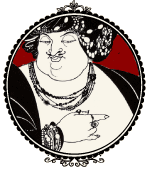









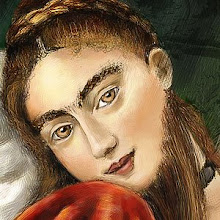


"a bewitching face, the easiest of figures; she affected the most elegant simplicity."
When raven haired Jeanne Francoise Julie Adelaide Recamier entered a room she was like a scratching post covered with catnip. Wherever she went...the claws came out. In one Paris reception, reigning society queen, Mme. Talien, threw off her shawl in a huff to show off her splendid figure and long arms. Mme. Recamier even came to the attention of Marie Antoinette who was so taken with her beauty that she compared her side by side to Madame Royale. (every teenage girl's nightmare)
By the turn of the 19th century, nothing was more coveted than an invitation to Mme. Recamier's literary salon. Known as "Juliette," fashionistas flocked to her soirees to admire her furniture and elegant dresses. Men fell at her feet to worship her "betwitching face" unadorned with face paint. Recamier soon attracted the attention of notorious rake, Lucien Bonaparte who wrote her passionate love letters exclaiming, "Oh Juliette, life without love is but a long sleep...Happy the mortal who shall become the friend of your heart!" Add to her list of admirers, Josephine Bonaparte's son, Eugene Beauharnais who took a ring from her and then begged, "be good enough, Madame, to soften the lot of him who is sincerely attached to you."
Considering the scandal that surrounded her upbringing, it is surprising that Recamier was so admired as the beacon of virtue. Rumors abounded that her husband was actually her father. Many of her recent biographers have speculated that her father married her to name her his heir and protect her fortune from the upheaval of Revolutionary Paris.


As the reigning beauty throughout Paris, she became one of the models for The Three Graces and commissioned her portrait to be painted by Jacques-Louis David. Unfortunately, when Madame Recamier saw her portrait she was not pleased and promptly fired David from the commission.
Biographers have long speculated on why David was fired. Some have said it was due to the inordinately long time he took to complete the commission. The most obvious answer is because David took some artistic liberties with how he represented her. He had done the unthinkable. He had messed with her hair. Instead of painting her legendary, dark siren locks cascading down her back, he painted a much lighter shade to contrast with his darker background and match his artistic vision of the neoclassical beauty. (The Greeks really loved their blondes). David never finished the painting, but it was still admired throughout Paris. The sofa that Madame Recamier reclines on is even called a recamier today.

It does look like the poor girl was shorn by the executioner before sitting for this painting. You have to wonder if David did this on purpose?
After firing David, Recamier hired his student Francois Gerard to paint her portrait with less artistic license.

Which painting do you like better?
I have to agree with Recamier. Gerard's painting is far more flattering to the sitter. Besides, even if you are Jacques-Louis David, you just don't mess with a woman's hair.
Sources and Further Reading:
Mme. Recamier experienced financial hardship after Napoleon's policies bankrupted her husband. She later became featured in her benefactor, Madame de Stael's novel Corinne. Sadly, Juliette went blind in her final years and died at the age of 71 of cholera.
I am really not doing Juliette justice with this cursory biography, (her life is full of raucous scandal!) but Lucy Moore covers Juliette Recamier in her fabulous book Liberty: The Lives and Times of Six Women in Revolutionary France. You can even get this one at the bargain price over at amazon. See link below.
Sources and Further Reading:
Putnam's magazine: an illustrated monthly of literature, art and life, Volume 1
Austrian, Delia. The Life of Juliette Recamier, BiblioLife, 2010
Moore, Lucy.Liberty: The Lives and Times of Six Women in Revolutionary France, Harper Perennial, 2008.