How Christopher Columbus got his own holiday might be one of the seven wonders of history. I confess that I have a bit of a bone to pick with Chris. My disenchantment goes back to my third grade history report in which I sentimentally droned on about what a fabulous guy he was, only to find out later I had been fed a pack of lies.
Smarty pantsLet’s start with the story we know and love. In 1492, Columbus sailed the ocean blue from Spain to the islands of the Caribbean while looking for a sea route to the Indies. No, he didn’t believe the earth was flat. No one thought the earth was flat. But Columbus also certainly didn’t expect to hit the Americas instead of his desired destination. Unfortunately, when anyone tried to tell him he hadn't arrived in the Indies, the naysayer ended up with their tongue cut off.
Go ahead and make meHis voyages were also not as harmonious as my history books led me to believe. After weeks of being lost at sea, his crew begged him to turn around, but Columbus refused. The desperate crew soon came to the conclusion that it would just be better for everyone if they threw Columbus overboard. But there was one problem. No one but Columbus knew the way home and their captain’s last dieing words were not going to include directions. Everyone believed that they would die. So you can imagine the rejoicing when the crew landed in the Caribbean. That’s when the fun began.
 Mine, Mine, Mine
As soon as Columbus’s crew got off the boat, they slapped down a Spanish flag claiming the unknown territory. Unfortunately, the land already belonged to some confused Native Americans of the Arawak tribe. According to Columbus’s log, the Arawaks thought Columbus’s crew were straight out of heaven accept they couldn’t quite understand why angels stunk so much and why they were wearing so much darn clothes. Then, they became even more confused when the angels turned out to be no-good thieves.
Indian GiversWe first must understand how the Arawak culture worked. The natives sort of remind me of my grandmother (god rest her soul). I would say, “nice necklace grandma” and she would immediately insist that I have it. Tell her you like her cookies and she would send you home with every last crumb. The Native Americans demonstrated the same generosity. If you complimented anything they owned, then they would immediately give it away. But there was a catch. The Indians would give things away….but then they would expect them back. To them, humans didn’t own things. Columbus saw things a bit differently. Once someone gave you something (or you stole it), it was yours to keep. He called the natives “Indian Givers”, (a phrase we still use today), and couldn't understand why they would want their gifts back.
Yuck, Cooties!And what did the natives get in return for their generosity? Columbus’s crew gave some very special gifts to them in the form of measles, tetanus, typhoid, influenza, pneumonia, dysentery, whooping cough, smallpox and pork chops. The last one was
Queen Isabella’s idea. She knew a fattened pig was the perfect food source. Unfortunately, the pigs also spread trichinosis. All those poor Native Americans knew is that one minute they were living happily smoking their peace pipe with perfectly working bowel movements and the next they had a bad case of the runs and some wild pigs running through their homes. Fair? Hardly.
oooouuuuuu shiny thingsBy now, the honeymoon was over. The Indians soon had enough and attacked Columbus’s crew killing many of them. Columbus just got more men to come over and enslaved the Indians forcing them to mine for gold. Meanwhile, the Indians just couldn’t understand why Europeans got so worked up over shinny things. It would be like a bunch of aliens landing in New York and demanding large quantities of
bobble head dolls. Sure, bobble head dolls are amusing, but they have no monetary value. To the Indians, gold was not currency, and certainly not something that they were willing to die for.
I know you are, but what am I 
Columbus seemed to take a sadistic delight in the rape, pillage and murder of innocent people. The rape and pillaging part is generally scratched out of the history books because it makes a far less picturesque tale then the tiny ships of the Nina, Pinta and Santa Maria merrily sailing across the ocean. Any Indian who didn’t give Columbus enough gold immediately had his hands cut off or was bled to death. By the time Columbus was done being a fabulously swell guy, 250,000 Indians had died. ok ok, we must remember that this was part of exploration and he did nothing more horrible than any other explorer of his time. But like my grandmother always said…. just because everyone else is doing it doesn’t mean you have to do it.
When you look at all the mayhem Columbus caused, you can’t help but wonder why school children everywhere still have to write reports on such a big jerk. But if there is one thing that the kids at home should learn from this blog it is this - the person with the most toys gets to write the history books and Columbus certainly brought back his share of new toys. His spoils included gold, slaves, chocolate, peanuts, potatoes, tobacco and possibly syphilis.**
Maybe Columbus' appeal to school kids is because he kind of acted like a spoiled brat. He didn't share. He spread countless germs. He bullied others. He is the kind of guy that we teach are children not to grow up and become. So why then do we honor him in classrooms across America?
** Some historians even argue that good old Chis spent his last days suffering from some itchiness. The other side of the debate is that Columbus did not bring back syphilis to Europe. Syphilis may have randomly mutated into a virulent pathogen at the end of the 15th century and the fact that it began to wreak havok on the population at the time of Columbus’s return home was mere coincidence.Sources and Further Reading:Hayden, Deborah. Pox: Genius, Madness, And The Mysteries Of Syphilis, New York, NY: Basic Books, 2003.
Christopher Columbus: Explorer of the New World. DVD. History Channel. 2005.
Cook, Noble David, “Sickness, Starvation, and Death in Early Hispaniola”, Journal of Interdisciplinary History, Vol. 32, No. 3 (Winter, 2002), pp. 349-386.



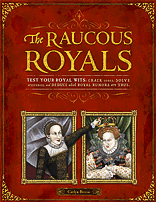



 In the raucous book of the month, Royal Affairs, Leslie Carroll takes readers on a lively tour through some of history’s busiest boudoirs. Everyone enjoys a good love story, unfortunately kings and queens could rarely choose a mate for love. Royal marriages were usually arranged to secure stronger alliances and a few heirs in the royal nursery. Rarely, did a happily-ever-after occur when the bride stepped off the boat. Carroll reminds us that it was the love affairs that happened outside of the marriage that provide a glimpse into a king or queen's true desires and reveal the kind of paramour that could command royal attention.