



Thursday, July 30, 2009

Raucous Royal of the Month, Cecilia Gallerani (1473 – 1536)

When the Italian court poet Bellincioni first laid eyes on the Leonardo da Vinci’s Lady with an Ermine he declared;

“…the more living and beautiful Cecilia shall appear in the eyes of generations to come, the greater will be thy glory! For long as the world endures, all who see her face will recognize in Leonardo’s work the close union of Art and Nature.”(1)

Bellincioni’s praise stands true today, but who is the woman who went on to become Mona Lisa’s greatest rival? Although some debate continues about the sitter’s identity, most art historians have identified the woman as Cecilia Gallerani, the beloved mistress of the duke of Milan and Leonardo’s greatest patron, Ludovico Sforza(shown here). Cecilia was only a teenager when she sat for this painting, but had already secured her status as a student of classical studies, a poet, musician, singer and renowned beauty.

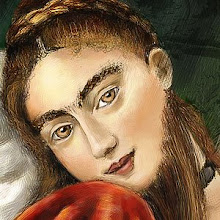
As the dress of the painting indicates, Cecilia Gallerani was not of nobility, but her father held several prominent positions at court. Ludovico had Cecilia installed in a suite of rooms in the Castello of Milan and court gossip indicated that he intended to make her his wife. Unfortunately, legitimizing their affair would have severed any strategic alliances for Milan and the smitten duke was not willing to let his heart rule matters of state. Instead, he married the equally alluring Beatrice d’Este, Duchess of Ferrara in January of 1491 (shown below)(2).

Ludovico most likely expected Beatrice to be another acquiescent wife and turn a blind eye to the affair, but his new wife proved far too spirited to tolerate any competition. Beatrice was so jealous of Cecilia that she even refused a magnificent gold robe from her husband because his mistress had once worn a similar robe. Debate still exists on whether Leonardo ever painting Beatrice’s portrait but we might infer that Beatrice refused such an honor because it had already been tainted by the memory of the great Maestro painting her rival.(3)

After many jealous tirades, Ludovico ended his affair with Cecilla, but continued to provide for her and their son Cesare. He arranged a prominent marriage for her with Count Lodovico Bergamini and provided a sumptuous trousseau along with a villa near Cremona. It was here that Cecilia continued to entertain some of the most learned minds until her death in 1536.

We are left with a curious letter that reveals Cecilia’s modesty in her later years. In a letter to Beatrice’s sister, Isabella d’Este, she tells Isabella that the portrait painted by Leonardo, “was painted when I was still at so young and imperfect an age. Since then I have changed, altogether, so much so that if you saw the picture and myself together, you would never dream it could be meant for me!” (4) Cecilia’s beauty may have not held the test of time, but her portrait certainly is a testament to Leonardo’s genius.

Sources:
Cartwright, Julia. Beatrice d'Este: Duchess of Milan 1475-1497, London: J.M. Dent & Sons, Ltd, 1910

Notes:
(1) Cartwright, Kindle Location: 1129-35 or p. 53
(2) It is still not know if the portrait of Beatrice d'Este is truly her.
(3)
Cartwright, p. 91
(4)Cartwright, p. 54

Thursday, July 23, 2009

Let Them Eat Hair Garnishes

(I am on the countdown to my next book deadline so I am recycling a old guest post this week....)

We tend to associate the potato more with Ireland and England than we do with France and that may because the humble spud had a very rocky start with French Parisians. Although already widely accepted in England, the potato did not come to France until around 1600.(1) Still, no respectable royal would dare to eat the strange, dirty, lumpy looking spud. The potato became so feared that in 1619 it was banned from Burgundy, France because it was rumored to cause leprosy. It all made perfect sense to 16th century scholars. A potato looked like leprosy so therefore it must cause leprosy.(2)


The leprosy spud finally got an image makeover in the 18th century with the help from a potato propagandist and French chemist named Antoine-Auguste Parmentier. Parmentier threw some fabulous parties and invited the French upper class to taste his potato creations. At one of these parties, Parmentier gave Louis XVI a bouquet of potato flowers. Knowing his wife's proclivity for putting vegetables in her hair, Louis thoughtfully placed one delicate, purple sprig in Marie Antoinette's pouf. Thereafter, the potato may not have become a fashion accesory, but it did become the new, hot foot delicacy among the upper class.


The potato then went on to feed the French peasants and everyone loved their queen and...lived happily ever after. Ok not exactly. Unfortunately, it took a few bread shortages, a nasty revolution, and some beheaded monarchs for the government to finally see the potato's full potential for feeding the rest of the starving country. In 1794, a year after Marie Antoinette was beheaded, the queen's beloved flowerbeds in the Tuileries were plowed over to make way for the purple blossoms that would feed a nation and become one of France's biggest exports.

Notes:
(1) Some historians have blamed the slower populations grown of France in the 18th century to their dependence of grain while other countries had the starchy potato to fall back on. In reverse to France’s grain dependency, reliance on the potato backfired in Ireland during the Great Potato Famine.
(2) This was at a time when walnuts were eaten to treat headaches because they looked like a brain and eating the brains of another animal would make you smarter.

Sources and further reading:
Langer L. William, "American Foods and Europe's Population Growth 1750-1850." Journal of Social History 8.2 (1975): 51-66.
Salaman N. Redcliffe, The History and Social Influence of the Potato, Cambridge, UK: Cambridge University Press, 1985.

Thursday, July 16, 2009

James IV's Flying Alchemist

Since the first caveman flapped his wings like a bird, men have dreamt of flying. This dream has led to many fools jumping off precipitous cliffs decked in bird feathers. Everyone has probably heard the Greek myth of Daedalus and his son Icarus who lunged from their tower prison wearing feathers held together by wax and twine. All would have gone smoothly if Icarus had quit the horseplay, but when do you ever see a flying boy listen to their dad? That naughty Icarus flew too close to the sun, melted his wings and fell into the ocean. The lesson was clear: aim to high and you just might find yourself plummeting to your death. The Italian Mathematician, Giovanni Battista Danti didn’t quite learn this lesson and was convinced a few feathers and some determined flapping would make him fly like superman. Unfortunately, his attempts only landed him on the roof of Saint Mary’s Church.

Other men claimed to be more successful. In the middle ages, a monk named Elmerus was rumored to fly from the top of a tower in Spain. Supposedly, the great astronomer and mathematician, Regiomontanus invented a mechanical eagle which flew across the channel to greet Charles V. These tales seem unlikely, but there were some inventors who may have realized the dream of flight.

The Flying Chariot
In the 13th century, scientist and philosopher Roger Bacon was rumored to have designed a "flying chariot.” Bacon believed that a copper globe would rise upward if it were filled with something lighter than air. In essence, Bacon understood the mechanics of hot air balloons five centuries before his time.

The Flying Maestro
Leonardo da Vinci's treatise on the art of flight is probably the most famous example of early aviation studies. For over sixteen years, Leonardo worked under the patronage of Ludovico Sforza, the Duke of Milan. (Ironically, his official title was not the duke’s painter but “the duke inventor”).

Along with art commissions, Leonardo designed military equipment such as crossbows, catapults, lightweight bridges, cannon, armored vehicles, and poured his genius into fantastical flying machines (shown here). But Ludovico seemed unimpressed with Leonardo’s flying machines and worried more that the great Maestro would kill himself before completing the bronze equestrian monument to honor his father. We still don’t know for certain if Leonardo ever built his flying machines, but a few years later there was one man brave enough to take the plunge…

The Flying Bird Man
John Damian was a surgeon in France before moving to Scotland around 1507. He then began his career as alchemist to James IV with the promise that he would discover the philosopher stone—the elixir to life. Damian’s experiments merely required copious amounts of aqua vitae, an aqueous solution of ethanol (aka whisky). Damian failed to discover the elixir to life, but must have got plenty drunk trying…or at least drunk enough to jump off the west parapet of Stirling Castle in a hen suit.

Predictably, Damian’s tale does not end well. His makeshift hen wings carried him for about a half a mile until he descended ignominiously into a pile of dung and broke his leg. Many historians have argued that because his flight did not end with him falling to his death in the rocks 75 meters below Stirling Castle, he was technically the first man to fly….or at least the first man to hang glide in a hen suit.

Damian never attempted another flight, but he did claim that he knew the reason for his failure. He should not have used hen feathers because they were obviously attracted to dung. I find this entirely plausible considering that hens are not too bright. Unfortunately, the theory only got him laughed out of the aviation business by everyone at James’ court. Damian then spent his final years with the far more rational goal of turning base metals into gold. We can guess how that turned out.

Sources and Further Reading:
The Times: Was 16th-century Scots alchemist the first man to fly?

The Daily Mail (London, England), The Flying Scotsman First; Leap of Faith: Abbot John Damian Threw Himself from Stirling Castle Bumpy Landing The Possible Route of the Abbot's First Flight, September 6, 2008.

Macdougall, Norman. History Today, The Kingship of James IV of Scotland - 'The Glory of All Princely Governing'?, Volume: 34 Issue: 11 November 1984 Page 30-36

Wells, George. The War in the Air. BiblioLife, 2008

Monday, July 13, 2009

Interview with Author, Susan Holloway Scott

First, could you tell readers a little about your background and how you got started writing historical fiction?

I graduated from Brown University with a degree in art history. At Brown I learned the magic of working with primary sources, of being able to reach back through centuries of opinions to squirrel out the truth about the past. I loved art history and still do, but didn’t want to make a career of it, and so I went into public relations (which was excellent training for writing fiction.)

I wrote my first book in a sleep-deprived frenzy while on maternity leave with my daughter. Miraculously, the book sold, and I wrote historical romances under the name Miranda Jarrett, setting books everywhere from colonial America to northern Africa and Naples during the Napoleonic Wars. But over time, the market’s focus shrank, with less and less interest in the history behind the story. Fortunately, the historical novel market was growing, and I was able to shift to that with Duchess in 2006. I’m much happier now: I’m a total history-nerd and love to wallow in my research, and I can let my historically based characters tell their stories without worrying about always having romance’s required happily-ever-after –– the famous HEA.

You have written over 40 historical novels and novellas with over 3 million copies in print. This means you are either pushing 80 or are a seriously fast writer. (I am guessing from your picture, that it is the latter.) What were some of the challenges in writing The French Mistress?

Actually, I’m 360 years old with a really good photographer, and I’m writing about the Restoration Court from my own recollections. Nah….but I do write fast. I think it comes from having begun to write seriously while my kids were still babies. I was also working a full-time day job, and I learned to make every writing-and-research-minute count.

There were in fact some genuine challenges with The French Mistress. First, of course, was the fact that many of the original sources about her were in French, and 17th century French at that. Next was Louise herself. An outsider at the English Court, she trusted very few people beyond Charles, and seems to have had virtually no friends. Most of what was written about her by the English was critical, snide, or downright bitchy, with no one defending her or her actions. I had to sift through all of this, sensing what felt false and what was likely real, trying to “find” Louise as a real woman.

I know everyone says this about historical fiction but….the historical details were so vivid in The French Mistress. I started to have dreams that I was back in the English court being pursued by Charles II. (Thankfully, my husband never reads this blog) Could you share some of your research tips?

Oh, I know what you mean about Charles! As one of my readers noted, the man must have had powerful mojo.

If a writer likes to research (which I do), then it’s very tempting to share every cool little fact you’ve discovered. Tempting, and disastrous for your poor reader: even with fact-based fiction, readers are reading your book for the story and the characters. If they only wanted a history lesson, they would be reading non-fiction. So I always try to use those facts to see everything firmly through my protagonist’s eyes. No one living in Whitehall Palace in 1672 is going to stop what they’re doing to list how many looking glasses there are in their bedchamber or the manufacturer’s name. But Louise would have noted proudly how well the new looking glasses she’d just had installed (French workmanship, you know) reflected the afternoon light, or how she realized she could see into the next room without being seen, or worry if Charles would like them, or suspect she’d paid for them with a bribe from a foreign ambassador. If the cool fact doesn’t contribute to the story (or, to use the dreaded writing term, if it’s only an “info-dump”), then out it goes.

The French Mistress is set in one of the most dramatic periods in English history when heads still decorated the Tower Bridge and Charles had to constantly manipulate court factions. Could you describe some of the politics of the Restoration period and personality traits that kept Charles from becoming another despotic ruler?

For a king, Charles spent most of his reign walking the most unsteady of tightropes. He never forgot that his father had been beheaded by the same people who had welcomed him back to the throne, and he was always painfully aware of just how fickle that welcome might prove. He was also something of a pauper as royalty went, with much of his wealth lost during the Civil Wars. He was dependent on Parliament for his personal spending money as well as the money for any projects he wished to pursue, whether repairs to Windsor Castle or a new war on the Dutch. Parliament in turn tried their best to exert their collective will over Charles, refusing to agree to some of his more radical plans (such as expanding religious tolerance to all faiths, a long-standing desire of Charles’s that Parliament insisted on squashing), and Charles would counter by dissolving their session, and sending the members home to the country. In the meantime, Charles was marinating his own independence by secretly accepting large subsidies from his French cousin, Louis XIV. Though his conscience was often uneasy in private, he was for the most part publicly easy-going and agreeable, and for it he was much-loved by the general populace.

Your main character, Louise de Keroualle, experiences the contrast between the French and English courts. Unlike the French court under Louis XIV, Charles doesn’t waste time surrounding himself with mirrors. What were the major differences between these cousins? What were some similarities?

As first cousins, Charles and Louis were close in age and appearance. Both were tall, athletic, and full of restless energy, and both favored their Italian grandmother, Marie de’Medici, with dark hair and eyes. Both Charles and Louis witnessed the worst side of their subjects as children: Charles was made a fatherless exile during the Civil Wars, while Louis was forced to flee Paris with his mother during the Fronde.

Louis responded by making himself into an unapproachable demi-god, putting as much distance as he could from his people in his great palace at Versailles. He was aloof and distant, surrounding himself in elaborate protocol and rigidly observed rituals that proscribed his day. Charles, on the other hand, was affable and approachable, literally embraced his subjects of every rank, walking freely among them in London, feeding the ducks in the park at their side, and attending public theaters and taverns for amusement. His Court was bawdy and free-wheeling, much as he was himself.

The cousins were intensely competitive with each other, always watching what the other was doing in everything from diplomatic allies to the latest fashion in breeches, even to the beauty and “quality” of their mistresses. The response to each king’s death tells the whole story: when Louis died, an ancient, bitter king, the country rejoiced, relieved to finally be free of his rigid rule, but when Charles died, his people were said to have wept in the streets as if they’d lost a father, with heartfelt, public mourning that continued for weeks.

Throughout the novel, you illustrate the tenuous peace that existed between France and England. In The French Mistress, Louise plays the baby-faced, Bond Girl (minus the weaponry) sent from France to entice the English king. With loyalty being so important to Charles, do you think he ever suspected her motives?

Charles was known to be an excellent judge of character. It’s clear that he understood exactly what Louis was doing by sending the lady he’d admired to join the Queen of England’s household. No one was particularly fooled. He accepted her for what she was. My guess is that Charles was sufficiently enchanted by Louise not to refuse her as a “gift”, but that he was careful never to let her know anything truly important to pass along to Louis. As the years went by, she became a kind of quasi-diplomat herself, acting as a liaison between the two kings. Many courtiers were appalled by this arrangement, but it seemed to suit the parties involved well enough, and continued until Charles’s death.

Before writing about Louise de Keroualle, you also wrote about two of Charles’ previous mistresses – Nell Gwyn and Barbara Castlemaine. Charles really seemed to vary his taste in woman. If we were to play shrink, which mistress do you think was the best-suited companion for such an energetic ruler? Would one woman have ever met all his needs?

Wow, can you imagine being privy to all of Charles’s innermost thoughts and desires?

Ahem. Being a king, Charles was free to indulge his tastes in all their variety in a way that none of his (probably envious) subjects could. What sets Charles apart from true libertines was that he genuinely liked women for themselves, not just as conquests.
Historian Antonia Fraser suggests that Charles’s three most prominent mistresses each offered different things to Charles at different times in his life. Barbara was the uninhibited wild-child of his early reign, appealing to him as a sexual adventuress. Nell’s saucy wit made her a kind of court jester, delighting Charles as she dared to skewer the stuffier members of his Court. Nell was also his “country lass”, happily fishing and skinny-dipping with him at Windsor. Louise became the perfect bonne femme of his later years, representing not only the hospitality but also the French opulence and elegance that he’d always envied in his cousin Louis’s court.
And, of course, if we’re playing shrink, Charles’s mother was a French princess who always conversed with him in that language –– which may also explain some of Louise’s appeal for him.

We have some Raucous Royals readers who are big fans of Showtime’s The Tudors. When I was reading The French Mistress, I kept thinking how Charles’ bedroom romps would make for one steamy mini-series. Personally, I think Charles was so darn sexy because he could be the bad boy one minute, but kind-hearted and jovial the next. He is sort of like a mysterious Johnny Depp with a dash of George Clooney goofiness. If Showtime came knocking on your door, what present-day actor do you think could play Charles?

That’s a really tough question for me. I always form such strong notions in my head of how my characters look that it’s almost impossible for me to switch them out into modern actors and actresses. I’d probably suggest casting some unknowns in the roles. Charles would be a challenge: the actor would have to be physically imposing (Charles was over six feet tall), yet not traditionally handsome, with charm, mystery, goofiness (as you noted; Charles did have a wickedly playful sense of humor), and melancholy, too. Anyone else have a suggestion?

Many thanks to Carlyn for having me here as a guest!

Susan, thank you for taking the time to talk about your background and new novel. This month, one lucky newsletter subscriber will win a copy of The French Mistress. See links below to order your copy.


Wednesday, July 8, 2009

Hapsburg Drinking Games

Rudolf II loved toys, but especially toys that required drinking large amounts of alcohol. Shown here is his Automaton of Diana and the Stag (1620), one of the first royal drinking games. The stag’s removable head doubles as both bizarre centerpiece and drinking cup. Participants would wind up the mechanism at the base of the sculpture and it would spin around until Diana's arrow landed on a person in the party. Diana’s chosen party-goer was then required to drink the contents of the stag head....a far classier alternative to Beer Pong.

What's your favorite drinking game? Does it involve a golden stag? In my very pregnant state, my favorite drinking game is to sniff everyone's wine and guess what it tastes like. Fun!

Art Credit: Metropolitan Museum of ArtArts of Northern Europe

Monday, July 6, 2009

And the winners are...

The two lucky winners of Sideshow: Ten Original Tales of Freaks, Illusionists, and Other Matters Odd and Magical are Amanda and Gail. I have emailed the winners and will need your mailing address to send out your prize.

All US and International newsletters subscribers are automatically entered to win the giveaways each month. If you are not a newsletter subscriber then you can subscribe here.

Congratulations to this month's winners!