Thursday, February 26, 2009

Green with Love

We tend to think of green as the color of envy, but in Shakespeare’s words, “green indeed is the colour of lovers.” Medieval doctors even had a medical term for cupid’s affliction called “green sickness” or chlorosis. This sickness fit into the accepted theory of the 4 humours which taught that the body was made of up four fluids; blood, phlegm, yellow bile and black bile. Too much or too little of one fluid would cause your humours to become imbalanced and the patient to become ill. Young females were especially prone to a humour imbalance if they failed to menstruate. Couple this female curse with a woman’s proclivity toward an overabundance of mad monkey lust and you had the pernicious green sickness.

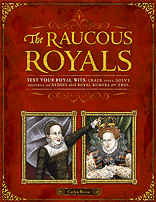
Know someone who could be suffering from green sickness this month? The Raucous Royals is here to help you diagnose and cure their illness.

People most susceptible:
Female virgins with passionate inclinations

Symptoms:
1. A pale green complexion
2. Listless energy
3. Decreased appetite
4. Lack of menstruation
5. Patient has recently fallen in love and that love has gone unrequited

Treatments (Results may vary):

1. Drink a flask of red wine containing rusted iron filling
This cure was prescribed by Thomas Sydenham in 1624. He may have been on to something put ingesting iron in the pill form might be tastier.

2. Apply 6 to 8 leeches to the cutaneous part of labia
This cure was prescribed by Edward Tilt in the nineteenth century. If the leeches make you squeamish then you could always try the alternate cure of cutting the hymen.

3. Apply Electricity to "stimulate" the womb
This cure was prescribed by none other than our randy Benjamin Franklin who had the wisdom to envision infinite uses for electricity. A girl suffering from green sickness visited Mr. Franklin in Philadelphia and stayed for two weeks (aaahem). She left with "a glass and bottle" and the strict instructions to electrify herself (1). She was cured two months later.

4. A pinch of chalk in four to six spoonfuls of water
This cure was prescribed by the hydropathist Sebastian Kneipp in the belief that the magnesium and salt in the chalk would help iron absorption. But as any female with PMS can attest to...chocolate (containing magnesium) goes down much easier.

*The owner of this blog takes no responsibility for negative side effects resulting from these treatments.


Notes:
King, p. 106

Sources and Further Reading:
King, Helen. Disease of Virgins: Green Sickness, Chlorosis and the Problems of Puberty, New York: NY, Routledge, 2003.
Shakespeare Quarterly, V0l. 12, No. 1 (Winter, 1961), pp. 47-55

Wednesday, February 25, 2009

Interview with J. David Markham

Thank you to everyone who submitted a question for this month's author interview with author and Napoleonic expert, J. David Markham. Even though the interview was originally only to have the top five questions, Mr. Markham graciously agreed to answer a few more....all while he is busy working on his next book AND filming for the History Channel!

And the book winner is announced at the bottom of the interview....

- From Amanda
1. What inspired you to become such a Napoleon enthusiast?
Amanda, like many people I can credit my parents, in this case my father, with encouraging my interests. He would tell me stories of various famous people in history, including Napoleon. Napoleon once said, ‘What a novel my life has been,’ and he really had it right. A rise from obscurity to greatness, a fall and a rise again. Love, sex, military glory, lots of battles, neat uniforms, glorious cavalry charges: what’s not to like, if you are a young boy? Dad had been to Paris and showed me picture postcards of places like the Arch of Triumph, Napoleon’s tomb, etc. I was hooked!

-From Amanda (this was going to be my question too!)
2. And what is your favorite piece in your Napoleonic collection and why?
Well, Amanda, you have really asked a tough one here. I have hundreds of items in my collection, many of them beautiful and often pretty valuable, either in terms of price or in terms of historical rarity. Sometimes I ask myself the terrible question of which piece I’d grab if there was a sudden fire and I had to get out quick. Its a depressing thought!

Still, your question deserves an answer and, as it happens, I have a pretty good one.

Some years ago my wife, Barbara, and I were given a private tour of the palace of Versailles, including some major areas that are not open to the public. Our guide was one of the curators, so it was a great honor. I showed him some photos of my collection (which was much smaller then), and he picked out what he considered to be the best pieces in the collection. As it happens, they were my favorite as well.


The pieces he picked were a pair of ivory miniatures (shown above), one of Napoleon, the other of Josephine. They are in 83x96 millimeter frames (about 3.25 inches by 3.75 inches), so they are fairly small. They are signed by the French miniaturist of the late 18th and early 19th century François Noël. The pieces are almost certainly from the First Empire period (1804–1815), and might even have been created for the coronation in December of 2004.

They are exquisitely carved in great detail. Josephine is especially wonderful, as the detail in her gown, jewelry and diadem are really quite amazing. And each person has wonderful, very human, expressions. If I could only keep one item (or set, in this case), I’m pretty sure this would be it.

-From Maija
3. Where do you even begin to research the history to write a book?!?!
Maija, the answer to that question will be different, depending on who you ask. In my case, I am fortunate enough to have a library of about 1200 different volumes on Napoleonic history, including English translations of virtually all of the memoires of the period and many documents as well. I have written some of my books just using these sources.

There are other sources as well, including some that I can get from my computer. Google Books has some rare books available for free in PDF form, and some websites have some outstanding information as well. But you have to be careful when you use the Internet, as some websites have very poor information. Of course, you have to be careful about some books as well!

Finally, for some of my research I have been to the British Library and the French Library and the French National Archives.

-From Carmi.
4. Where is your favorite place to see Napoleon history?
A city, museum,or special site?
Carmi, I’ve had the great pleasure and good fortune to follow Napoleonic history from England to Israel, from France to Russia, and just about everywhere in between. But I must say that the place to start is the center of the Napoleonic world: Paris! There you have his tomb, the Arch of Triumph, his rooms at Versailles (just in the outskirts), and several museums full of important Napoleonic artifacts. Then you can go a little further out of town to Fontainebleau and see where he lived some of the time and where he abdicated his throne in 1814 before being sent in exile to Elba.

Another exciting place to see Napoleonic history is the city where he was born, Ajaccio, Corsica. Corsica is a French island just of the Mediterranean coast. You can see the house where he was born and many other places of his childhood.

Of course, there are some very interesting battlefields, including Marengo (Italy), Waterloo (Belgium), Austerlitz (Czech Republic), Acre (Israel), Wagram (Austria) and Borodino (Russia).

But if I had to pick just one, it would definitely be Paris!

-From Maria Reed
5. Did Napoleon really touch the bobos of the plague victims at Jaffa? Wouldn't he had feared certain death? Or was the image of him doing that pure propaganda on the part of David?

Maria, you have touched (no pun intended) on an important consideration when researching history: who do you believe? In this case, you should believe the sources that say that Napoleon did, in fact, touch the plague victims. There are accounts of him mingling with the soldiers and then helping to move a corpse, which was, in fact, a dangerous thing to do. But Napoleon always had a very special relationship with his soldiers. For the plague victims, he arranged for extra good food and some military music to be available as well.

The British have always promoted the idea that this was just French propaganda, but it is, in fact, British propaganda that is at work here. They always have tried to downplay any really positive aspects of Napoleon’s career.

To be sure, the painting by Antoine-Jean Gros (1771–1835) (not Jacques-Louis David as you suggest, though Gros studied under David for a time) may not be exactly as it happened. It certainly makes the scene look very dramatic. But the building shown in the painting still exists and I have stood in the exact spot where Napoleon stood in the painting.


-From Maria Reed

6. How many snuff boxes do you own David?

Maria,That is not quite as easy a question as you might think. I have many boxes, most of which are probably snuffboxes. But a few might be actually for something else, such as small jewelry, makeup, or even perfume. But the total number (at last count) is about 160 boxes, and I believe I have perhaps the largest private collection of Napoleonic snuffboxes in the world.


-From Maria Reed

7. Was Napoleon really successful in banning La Marseillaise? How often was his anthem 'Veillons au Salut du l'Empire' sung? Was it an official part of all most ceremonies?
Bonjour, Marie. Your question is a good one, and the answer is a little complex. The Marseillaise was composed as a marching song for soldiers marching from–-you guessed it—Marseillaise, a coastal city in the south of France. The soldiers had a long march to Paris and this made the constant hours of marching go by a little easier. It was called the War Song of the Army of the Rhine, but eventually became known as La Marseillaise.

This was in 1792, the early years of the French Revolution, and if you listen to the words, it is very Revolutionary and, to some, a bit revolting. It is also quite bloodthirsty, at least to some people. You’ve got your basic cutting of the throats of sons and consorts, impure blood watering our furrows, ripping open mother’s wombs: you get the picture. It is a call to action in defense of the Fatherland, and it became the symbol of the French Revolution.

That’s all well and good, but by the time Napoleon came to power, he wanted less Revolution and more stability. Revolution is fine against some other leaders, but not against the current leader, namely Napoleon. So when Napoleon became Emperor, he replaced the Revolution with an Empire, and La Marseillaise with Veillons au Salute du l‘Empire. This song sounds more like an anthem than a rousing call to Revolution. It was used at most public official ceremonies, especially those featuring Napoleon, but there were other songs as well that were used from time to time, certainly during the Consulate (1800-1804).

However, while Napoleon discouraged the singing of La Marseillaise and apparently issued orders banning its official use, it was used from time to time when it seemed necessary to rouse the people to action. It was also used by some military leaders with deep Revolutionary roots. Most notably, Napoleon himself used it when he returned for the 100 Days, wishing to remind the French that it had been him who had saved the Revolution and fought against those who would restore the Bourbon monarchy. When that same monarchy came to power in the person of Louis XVIII, he banned it for the same reasons. The July Revolution of 1830 brought it back, but Napoleon III banned it again, as did Vichy France in 1940. After World War II, however, it returned as the French National Anthem.

From Amanda
8. What is your favorite Napoleonic movies? (My dad was a huge fan of Waterloo.)

Well, Amanda, I must say that your father has good taste, as I usually say that Waterloo is my favorite Napoleonic movie. It really gives a good impression of what it was like during the 100 days, and the battle scenes are quite realistic. I love Rod Steiger as Napoleon, even if he is a bit over the top! The recent Monsieur N is beautifully done, but pretty much entirely fiction. The Abel Gance silent film, Napoleon is a real classic, but if I had to stick with just one, I’d stick with Waterloo.

Thank you Mr. Markham for taking the time to answer these questions.

And the winner is....Maija for her question - "Where do you even begin to research the history to write a book?!?!" Just email me your address at:
info@CarlynBeccia.com so we can mail out your prize. I do hope your library is not as big as Mr. Markham's library...there might not be any more room for books.

Tuesday, February 24, 2009

The Profane Renaissance

The following content is intended for a mature audience....

Many people think of the Renaissance as a period of courtly love illustrated by the love-sick knight wooing his fair virgin from afar, never to debase her with his sexual desires. Petrarchan verses and Shakespearean love sonnets further portray this ideal of platonic love. True, these notions of courtly love were a strong part of Renaissance culture. But beneath the quixotic tales of Romeo and Juliet lay a darker side to the Renaissance led by the artists and writers of Italy.

In short, the people of Renaissance Italy were very naughty.

It is these frisky Italians that we can thank for tons of printed erotica. One of the best examples of the Italian Renaissance attitude toward sexuality can be found in La Cazzaria: The Book of the Prick. For those of you who might not be familiar with this great work of homoerotic satire, Antonio Vignali wrote The Book of the Prick in 1525 as a ribald allegory for the power politics that threatened the independence of Siena. Vignali uses the metaphor of different body parts to communicate this struggle for power. And just like any lewd frat boy joke, you can guess which body part comes out on top. *

The picture on the left is from The Book of the Prick featuring a profile of a man composed of well….it ain’t fruit. Certainly, the print at least shows the playful side of Renaissance erotica for the inscription deftly translates as, “everyone looks at me as if I am a dickhead”

Ahhhh yes, I am afraid we do.

*Just like Machiavelli’s The Prince, The Book of the Prick was written for the academic male elite and not intended for public consumption. In other words, his mother would not have read it.

Sources and Futher Reading:
Antonio Vignali, Arsiccio & Moulton Frederick, Ian
. La Cazzaria: The Book of the Prick, New York: NY, Routledge, 2003.
Sunday at the Met Series : Sex in the Eternal City - Can be downloaded off of uTunes.


Sunday, February 22, 2009

Who stole the Love Letters of Henry VIII to Anne Boleyn? Part II

In last week’s post, I offered three possible suspects in the theft of Henry VIII's love letters to Anne Boleyn. If you read this blog regularly then you probably already figured out that I am up to my old tricks....I don’t think any of the suspects is our thief.

The clue to who did steal them may even be in one of the letters themselves.

Letter XV
Darling, I heartily recommend me to you, ascertaining you that I am a little perplexed with such things as her brother will declare to her. Wrote in his last that he trusted shortly to see her, "which is better known at London than with any that is about me; whereof I not a little marvel, but lack of discreet handling must be the cause thereof. I hope soon "our meeting shall not depend upon other men's light handlings, but upon your own.

Written with the hand of him that longeth to be yours

H.R.


It is well known that intercepting letters was a common occurrence in the French and English courts.* On August 20th, 1528, shortly after Anne had returned to court, the French ambassador, Du Bellay makes reference to the breach of security in a letter to the Constable of France, Montmorency. He says, “Mademoiselle Boulan has returned to court. The intercepted letters that you sent me about this matter have disquieted them” (1). Was Henry reference to “lack of discreet handling” an indication that he knew his letters were being read? And what would the French court have to gain by reading Henry's love letters?

The Greatest of Enemies or Friends?
Any sort of affair that could tarnish Henry's reputation abroad was only bound to weaken his position politically too. Most importantly, Henry with a male heir was a far bigger threat to France than Henry with just a daughter. In short, the French had nothing to gain if Henry remarried and produced a heir. Perhaps a French spy for Francis I sold the letters to Clement believing that it would force Clement to denounce Henry. If a French spy did steal the letters, then they underestimated the pope’s desire to rule on the matter. As discussed in last post, Pope Clement VII needed time not evidence in the King’s Great Matter.

Who do you think stole the letters?

*Political letters with sensitive information were often written in cipher.

Notes:
(1)Letters and Papers, Foreign and Domestic, Henry VIII, Volume, August 1528

Friday, February 20, 2009

How to cover your house in toilet paper

I am honored to receive the excessively diverting award from Enchanted by Josephine and Scandalous Women. These sites are my favorite blogs that I read regularly. My daughter too loves when mommy reads her blogs because, knowing my attention is excessively diverted, she will make her usual mad dash for the toilet paper.

I have recently found some new excessively diverting sites that I want to share with you in case you have missed them. Lately, I am especially obsessed with Victorian life after reading Henry Mayhew’s accounts. Here are some sites that will make you wish you were traveling in a Handsome cab down Regent Street.

The Victorian Era – Where else will your learn the correct way to tie a cravat? And for you love junkies, check out the recent entry on Zoorholts. What? Don’t know what a Zoorholt is? Well, grab your parasol and wiggle your bustle on over…

The Victorian Peeper – Nineteenth- century Britain through the looking glass
I must have read too much Dickens because the recent article on workhouse diets disabused me of the belief that innocent children were left to starve. In truth, the rations of bread, meat potatoes, pudding, cheese and gruel were enough to sustain without developing vitamin deficiencies. How dare that brat Oliver Twist ask for more?

NineteenTeen – being a teen in the 19th century
If you fancy yourself a debutante then you might want to promenade over to the article on Balls.

Curious Expeditions – Traveling and Exhuming the Extraordinary Past
You will find tons of oddities like the Chapel of Bones, Mummified Relic of St. Catherine and the bullet that took President Lincoln’s life.


And if Victorian life isn't your thing than check out these excessively diverting blogs:


Tudor Stuff: History from the heart of England
What do secret letters and oranges have in common? You will have to read the recent article on Tudor secret messages to find out...

My Middle Name is Patience Knitting, reading, lounging around the SF East Bay
Read beautiful poetry, take a break for a history poll or just admire the beautiful knitting. (I don’t knit….but if I did then I wish it would look like some of Carrie’s stuff)

The Period Movie Review - Historical Costumes in Review
This is a can't miss site for you fashion junkies

The Rules:
Recipients, please claim your award by copying the HTML code of the Excessively Diverting Blog Award badge, posting it on your blog, listing the name of the person who nominated you, and linking to their blog. Then nominate seven other blogs that you feel meet or exceed the standards set forth. Nominees may place the Excessively Diverting badge in their side bar and enjoy the appreciation of their fellow blogger for recognition of their talent.

Thursday, February 19, 2009

17th Century Dating – Bundle up

With divorces far less common amongst the peasant class, finding the right husband was a serious matter. One of the ways a girl could try a man on for size was called “bundling.” Bundling was sleeping together without intercourse. Parents would literally tie the girl into a ‘bundling sack’ and place her in bed with her potential mate. Sometimes a board was placed in between the young lovers to further deter any mischief. The basic idea was that couples could spend the night together without the temptation of….nakedness. I am not exactly sure what this accomplished, but at least you could figure out if your potential spouse snored or had morning breath. (of course, if he did snore than there was nothing you could do about it because you were tied up in a sac. )

Bundling was a common ritual in Switzerland and Germany too, but was called Kiltzgang …which is German for ‘keep your kilt on kids’. The practice continued in Colonial England with ballads singing its dubious praises;

“ but bundlers clothes are no defense, unruly horses push the fence.” (1)

or

“Care, Nance and Sue proved just and true,
Tho' bundling did practice;
But Ruth beguil'd and proved with child
Who bundling did despise.”
(2)

The practiced continued in rural England until those clever Victorians thought it best to keep a girl’s suitor at arms length.

It is still freezing here in New England. If you are reading this from an equally icy location, then please bundle up with your loved ones. burrrrrrrrr

Notes:
(1) Denny p. 83
(2) Ulrich p. 123

Sources and Further Reading:
Wikipedia Article
Denny, Joanna. Katherine Howard: A Tudor Conspiracy, London: UK, Piatkus Books, 2005.
Ulrich, Laurel Thatcher. Good Wives: Image and Reality in the Lives of Women in Northern New Enland, 1650 -1750, New York: NY, Vintage, 1991.

Wednesday, February 18, 2009

The Love Letters of Henry VIII to Anne Boleyn

Letter I
My mistress and friend, I and my heart put ourselves in your hands. Let not absence lessen your affection; for it causes us more pain than I should ever have thought, reminding us of a point of astronomy that the longer the days are, the further off is the sun, and yet the heat is all the greater. So it is with our love, which keeps its fervour in absence, at least on our side. Prolonged absence would be intolerable, but for my firm hope in your indissoluble affection. As I cannot be with you in person, I send you my picture set in bracelets, with the whole device, which you know already, wishing myself in their place, when it shall please you. This from the hand of your loyal servant and friend

H Rex

In letter I, Anne has left court with Henry panting in her wake like an abandoned puppy. Henry calls her “My mistress and friend,” but the word "mistress" did not have the same connotations as it does today. It was a polite term of address and did not imply a sexual relationship.

Henry also throws in a bit of science to impress his lady friend and likens his passion to the sun being farther away yet still making their days long and hot. This line gives us an interesting glimpse into what was believed about the seasons for Henry actually got the science part right. (The earth is tilted away from the sun in June when it is summer in the northern hemisphere…and yes I had to look that one up because I slept through 3rd grade science). Henry probably picked up this factoid from his astronomer, Nicholas Kratzer.

The picture set in bracelets was made my Hans Holbein the Younger. Portrait miniatures had become a popular art genre and were often exchanged as a token of friendship or to woo a young lady.

Ok so let’s recap. The man knows his jewelry and his science AND he just happens to be the king. Will Anne fall for his sweet letters and gifts? Will her absence make Henry’s heart grow fonder?

Stay tuned for next post to find out.

Monday, February 16, 2009

Passionate Love Monkeys

Throughout the 16th and 17th century, it was believed that women had less control of their sexuality than men. This lack of control made women weaker than their male counterparts. It was only through the quiet domesticity of marriage that lust could be tamed. Ironically, gender stereotypes are reversed today.

As discussed in a previous post, monkeys in Renaissance art often symbolized frivolity and gave a lighthearted feel to a painting. But monkeys also represented beastly desires. How does a queen control these desires? She must chain the monkey.


In the painting by Sir Anthony van Dyck, Henrietta Marie's monkey is safely chained to her dwarf, Sir Jeffrey Hudson. In this painting above of Catherine of Aragon, the queen is also not taking any chances with an unleashed monkey*. A chained monkey represented the subject’s absolute control over base desires. Clearly, neither queen is giving into that crazy monkey love.

* Actually it is a marmoset to those who know their monkeys
Sources: Edited by: Fudge, Erica, Renaissance Beasts, University of Illinois Press, 2004.

Friday, February 13, 2009

Love advice from Benjamin Franklin

Not only was Benjamin Franklin not afraid to fly a kite in a thunderstorm, invent a day planner, and wear a ridiculous beaver hat, but he also didn’t shy away from giving love advice. In a letter entitled ‘Advice to a young man on the choice of a mistress,’ Ben gave 8 reasons why his friend should find himself a ripe, old gal instead of a young chippie.

My favorite is number 5:

Because in every animal that walks upright, the deficiency of the fluids that fill the muscles appears first in the highest part: The face first grows lank and wrinkled; then the neck; then the breast and arms; the lower parts continuing to the last as plump as ever; So that covering all above with a basket, and regarding only what is below the girdle, it is impossible of two women to know an old from a young one. And as in the dark all cats are grey, the pleasure of corporal enjoyment with an old woman is at least equal, and frequently superior, every knack being by practice capable of improvement.

So to any male readers, please remember the sage advice of Mr. Franklin this Valentines day –all you need to find true love is an older woman… and perhaps a basket.

Sources: Gatreli, Vic. City of Laughter, New York, NY: Walker &Co., 2006

Thursday, February 12, 2009

Who stole Henry VIII's love letters to Anne Boleyn?

In 1529, English authorities stopped Cardinal Campeggio in Dover on his way out of England. Although he refused to have his bags searched, the locks were broken on his coffers. Unfortunately, the king’s men failed to find what they were looking for. (1) Were authorities looking for the love letters from Henry VIII to Anne Boleyn? These 17 love letters mysteriously resurface in the 17th century in the Vatican collection. Who stole them and how they came to Rome is a mystery that has puzzled historians for years.(2)

Suspect #1: Pope Clement VII
At first blush, Cardinal Campeggio or a papal spy for Pope Clement VII seems the obvious suspect. But what would the Pope have gained by stealing the letters? Clement never desired evidence for or against Henry. Clement’s strategy was to keep stalling Henry in the hopes that either the matter would resolve itself (Henry would tire of Anne) or someone else would have to deal with the matter (Clement would be too dead to care.) Even the French Ambassador, the Bishop of Tarbe, voiced his frustration at Clement’s repeated stall tactics in a letter to King Francis I. Tarbe writes that Clement “has told me more than three times in secret, he would be glad if the marriage was already made, either by a dispensation of the English legate or otherwise, provided it was not by his authority” (3) Caught in the middle of Charles V and Henry, Clement's strongest weapon was procrastination. The letters would have done little to serve his cause.

Suspect #2: Charles V
Charles V probably had the biggest motive to steal the letters. He was bitterly opposed to the idea of his aunt being kicked to the curb and her daughter Mary being declared a bastard. The court gossip and Spanish Ambassador, Chapuys wrote to Charles at least once a week with tales of Henry and Anne's palace romps. Chapuys held nothing back in his communications with Charles and several of his letters would have been damaging if they had been intercepted. Yet, nowhere does he mention stealing the letters.


And even if Chapuys had stolen them, Charles V would have never shipped the originals off to the Vatican. He trusted Clement about as much as we trust a CEO with some bailout cash. If he had the letters, he would have made copies of them and sent those to Clement.

Suspect #3: Freelance Spy
The biggest motivation behind stealing the letters was not religion, but money. Whoever stole them probably was trying to make a quick buck. Maybe they were even sold directly to the Vatican. Perhaps they were even stolen from Hever castle years after Anne was dead and buried. It would not be the first time that love letters resurfaced years after they were written. Either way, the Pope (either Clement or subsequent Popes) had no use for them. But we…. have tons of use for them. As discussed in last post, the love letters not only give us clues into one of the most infamous torrid love affair in history, but also give us a peak into Henry’s motives behind his divorce.

Who do you think stole the letters?

Stay tuned for next post when the individual letters will be analyzed.


Notes:
(1)Letters and Papers, Foreign and Domestic, Henry VIII, Volume 4, 25 Oct. 1529
(2)The theories presented here can be found in: Ridley, Jasper, The Love Letters of Henry VIII. pp 17-18

(3)Letters and Papers, Foreign and Domestic, Henry VIII, Volume 4, 27 March. 1530

Sources and Further Reading:
Ridley, Jasper. The Love Letters of Henry VIII, University Printing House, Oxford, 1988
Starkey, David. The Six Wives of Henry VIII. New York, NY: Harper Perennial, 2004.
Ives, Eric. The Life and Death of Anne Boleyn, Malden, MA: Blackwell Publishing, 2005.
Weir, Alison. The Six wives of Henry VIII, New York, NY: Grove Press, 2000.
Fraser, Antoinia. The Six wives of Henry VIII, New York, NY: Vintage, 1993

Monday, February 9, 2009

The Love Letters of Henry VIII: Part 1

Henry VIII and Anne Boleyn
Background:
In the spring of 1527, Henry VIII began questioning the validity of his marriage to Catherine of Aragon. Always the theologian, the king turned to Leviticus as proof of his unnatural union. Scripture conveniently stated that anyone who married his brother’s wife would have no children. Bingo. Henry had done just that by marrying Catherine, his brother Arthur's widow and now he desperately needed an heir. So Henry sent his minions running off to Rome to seek a divorce from Catherine in what had become the King’s ‘Great Matter.’ Yet somewhere between guilt and the desire for a do-over, Henry met the enigmatic Anne Boleyn and decided to make her his queen.

Why Snoop?
The 17 love letters from Henry to Anne span two very different time periods in their courtship. They begin with the heady first days of infatuation to the tender promises of two betrothed lovers. Unfortunately, the letters are undated leaving historians to grapple with the most important question of all – when did their affair begin? This question leads to a far weightier question: Did Henry seek a divorce from Catherine of Aragon to ease his conscience and secure an heir? Or was Henry’s burning desire to extricate himself from his marriage influenced by the burning desire in his nether regions?

If we assign an earlier date to the letters, Anne becomes the catalyst that ended Henry’s marriage and the impetus behind the whole English Reformation – surely a heavy cross to bear. If we assign a later date to the letters than Henry’s motive to divorce Catherine lies in his own troubled conscience and his even more troublesome need for an heir to protect the future of England. Antonia Fraser, Eric Ives, and Alison Weir believe Henry first noticed Anne at Shrovetide in 1526 and the love letters soon followed. Starkey believes the affair could have started as early as 1525. Who is right? And even if the affair did begin in 1525, how much did Anne influence Henry to begin divorce proceeding? I will be exploring all theories in the next posts.

How we got the letters
The love letters resurfaced in the 17th century in the Vatican Archives probably stolen from Anne’s residence at Hever Castle. The letters do contain several clues as to when they were written, but how they are numbered does not. When they first came to the Vatican, some disgruntled archivist took the thin velum and transferred them to Parchment and numbered them in either random order or the order in which they were found. Throughout the next week’s posts, I will be referencing the letters by their numbers, but keep in mind that this is not the order in which they were written.

Where are Anne's letters?
The letters are also very one-sided because none of Anne's letters to Henry have survived. Most likely, Henry destroyed her letters, along with her portraits, when he ceased to need mementos of their affair. Henry could have also destroyed the letters as soon as they were read because the rules of courtly love deemed it indiscreet to save love letters. (It was especially tacky if the love letters were not from your wife.) But considering that Henry hated to write letters, we are lucky to have any relics of his love affair with the mysterious Brunet.

Stay tuned for next post on who stole the letters.

Art Note: Picture of Henry VIII's writing desk from the Victoria and Albert Museum

Sunday, February 8, 2009

The execution of Mary Queen of Scots

Mary Queen of Scots
Today is the anniversary of one of my favorite Raucous Royals - Mary Queen of Scots. I REALLY wanted to write a post to commemorate her death but....time slipped away. So I am going to be the lazy poster and dig up some of my favorite Mary Queen of Scots posts:

Mary Queen of Scots and Elizabeth I in extreme doll fighting
Mary Queen of Scots having a bad hair day

and if you are really bored...
Save Mary from the executioner

Thursday, February 5, 2009

Last Chance to enter the Book Giveaway

The deadline is today to submit your questions to author and historian, J. David Markham.

Reminder: Not only do you get those niggling Napoleon questions answered....you also get your name entered into the book giveaway. And if Napoleon just ain't your thing, then you might want to ask David about his fascinating bit of "what if" history. For example, Would President Lincoln’s assassination during the Gettysburg Address have left the Confederacy as a separate country? You will have to get the book to find out.

To participate in the interview and book giveway, enter your question at the bottom of this post. Good luck!

Wednesday, February 4, 2009

Unrequited Love – Henry VIII and Catherine of Aragon

Catherine of Aragon Whenever I think of unrequited love, I think of the intractable Catherine of Aragon who refused to be pushed aside for Henry VIII's mistress, Anne Boleyn. Catherine even went to her deathbed with only forgiveness in her heart for the king who had caused her so much pain. Her death fits into the Raucous Rumor of the month...

Rumor: Anne and Henry wore yellow to mourn the death of Catherine of Aragon because it was the color of mourning in Spain. Some accounts report both Anne and Henry wearing yellow to show their respect. Some accounts report just one wearing yellow.

Possible Source: This rumor has been floating around the internet for some time. Its origins are not completely unfounded. Edward Hall, the chronicler, reported that Anne wore yellow for mourning.

The Truth:
After Catherine's death, the Spanish Ambassador, Chapuys, wrote a letter to Emperor Charles V stating:

“On the following day, Sunday, the King was clad all over in yellow, from top to toe, except the white feather he had in his bonnet, and the Little Bastard (Elizabeth) was conducted to mass with trumpets and other great triumphs. After dinner the King entered the room in which the ladies danced, and there did several things like one transported with joy.” (1) Parenthesis added by me

Chapuys was well aware that yellow was the color of jubilation. In the inventory for the Accounts of the Revels, there are numerous examples of yellow velvet and yellow satin being ordered for the ladies’ dresses to celebrate the royal festivities. Interesting, Anne was pregnant at the time of Catherine’s death and had decorated her confinement room in yellow ochre. Hall's reference to Anne wearing yellow to mourn may have been merely a sarcastic jab at Anne's lack of grief for Catherine’s death. (2)

Juana the Mad
Either way, the color of mourning in Spain was black, not yellow. When Juana the Mad’s husband died (shown above), she ordered all her ladies to wear black. When she herself died, Charles V wore black. And when Philip II died, a proclamation ordered by his son, Philip III sent the country into mourning. In Seville, so much black fabric was sold that it created a black market on black clothes. (no pun intended) In fact, when Chapuys was invited to attend Catherine’s funeral, he was offered black cloth to mourn his beloved queen, not yellow.

Sorrowful Tears or Dancing on the Grave?Anne Boleyn
We can only guess as to why Anne and Henry were callous enough to wear yellow. Henry was certainly relieved at the death of his ex-queen for it meant that he no longer had to fear any meddling from her nephew, Charles. Catherine’s death signified a brief respite from the fear of Spanish invasion. For Anne, it signified the death of her greatest rival.

There seems to be this trend lately amongst Annophiles to raise the tragic queen up to sainthood as a woman incapable of any blame. I personally don’t see any figure who usurps another women’s position as a feminist role model. Whether you choose to see the controversial Anne Boleyn as harlet or heroine, neither Henry nor Anne were feeling twangs of compassion over Catherine's death. The two lovers were as joyous as their yellow attire.

Stay tuned for next week when we snoop into the love letters of Henry VIII to Anne Boleyn....

Notes:
(1) SP January 1536, 21-25, 141. Chapuys to Charles V, 21 Jan.Vienna Archives.
(2) Warnicke, p. 188

Sources and Further Reading:
Warnicke, Retha M. The Rise and Fall of Anne Boleyn. New York, NY: Cambridge University Press; Reprint edition (July 26, 1991).
Starkey, David. The Six Wives of Henry VIII. New York, NY: Harper Perennial, 2004
State Papers Online


Monday, February 2, 2009

The Sisters Who Would be Queen

You can now listen to BBC's interview with Leanda de Lisle on her latest book - The Sisters Who Would be Queen. You have probably heard the story of Lady Jane Grey, the infamous nine day queen, but what about her sisters? Leanda de Lisle weaves an intriguing tale of the forgotten Katherine and Mary Grey. You can only download the interview until February 8th. (Fast forward to the middle of the show to get to the interview.)

16th Century Love: Children

This month, I will be writing posts only about the subject of love and passion throughout history. I am starting out with the greatest love of all - the love of a child.

In the 16th century, the ideal relationship between parent and child was spelled out clearly in emblem books. Emblem books were sort of like the clip art of their day. Women would flip through them and copy the images of birds, animals, and fish to use in embroidery. Emblem books sometimes contained both pictures and text and usually contained allegorical themes with some moral lesson. The purpose of emblem books was to convey a set of beliefs. Think of them as cliff notes to the bible for people who couldn't read.

Here is an example from Claude Paradin's Emblem book. The motto reads “Love of parents to their children is blind or void of reason.” To illustrate this point, we have a rather ugly looking mama ape lovingly gazing into the eyes of her even uglier ape baby. The mama ape doesn't realize junior looks like a simian elf. All she knows is that she loves him to death even though junior is about to whack mama ape on the side of her head.

But wait...this is not a message of maternal love. If you turn the page and read the rest of the text. You will see that the moral lesson is to not be overindulgent with your children. (The word cocker means to treat with over indulgence.) The message here is...give your kid an inch and they take a mile. ahhhh alas still true even today.

Monkeys in 16th century art and portrature often symbolized uncontrollable passion and desires. Stay tuned for more mad monkey love in later posts....